
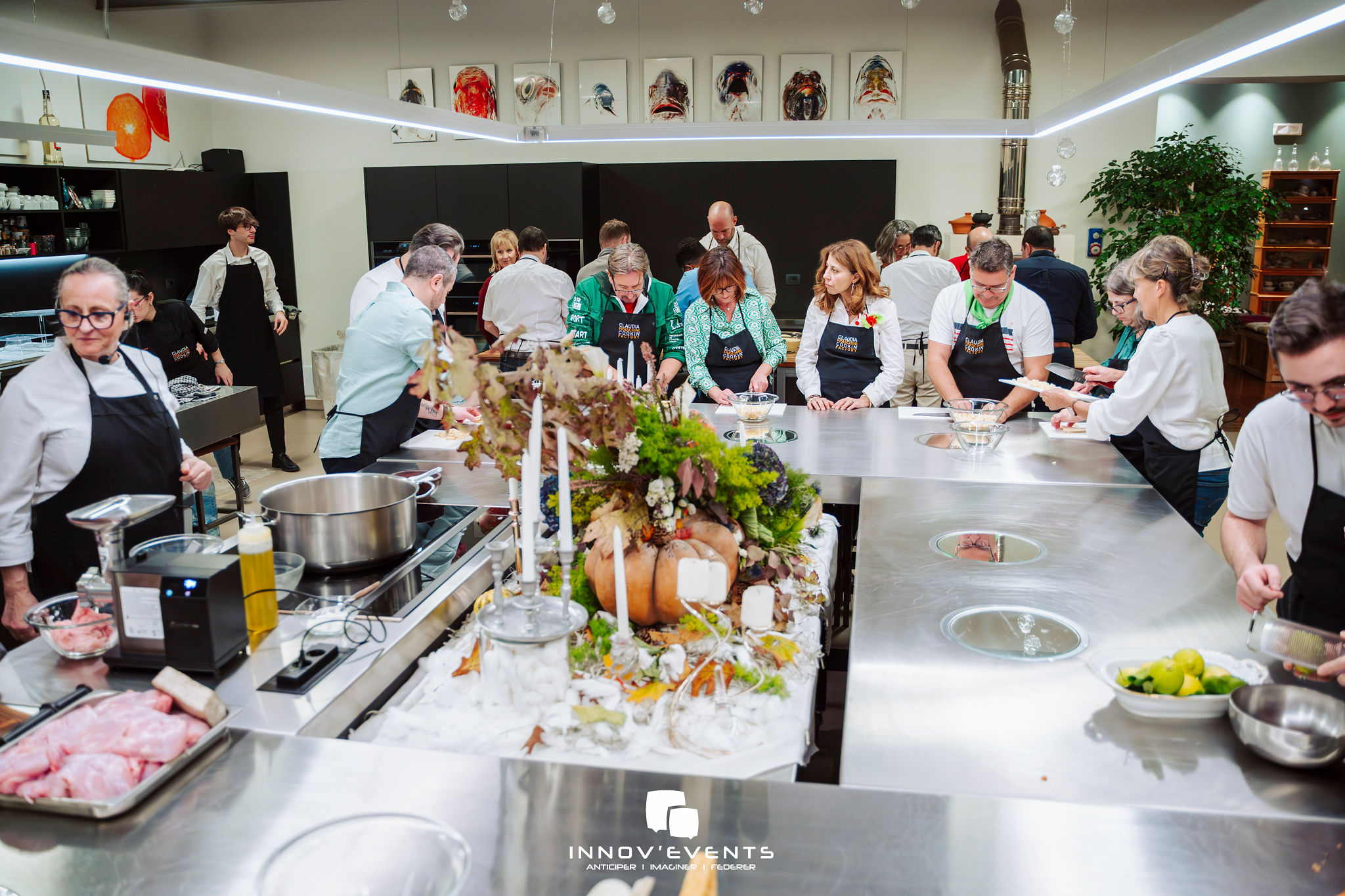
MasterChef-Style Cooking Workshop in Laval for teams that need real cohesion
At INNOV'events, we design and run a MasterChef-Style Cooking Workshop for executive teams, HR and communications leaders in Laval, typically for 12 to 250 participants. We manage the full operational chain: venue coordination, chef brigade, ingredients, timing, AV, and on-site facilitation.
The result is a structured team experience that fits corporate constraints: fixed schedules, brand image, dietary requirements, and measurable engagement—not a “fun activity” that becomes a logistical headache.
Sommaire
In a corporate event, entertainment is not a “nice-to-have”: it’s a controlled lever to create interaction between departments, accelerate trust, and give leadership a credible moment to reinforce priorities without forcing speeches. A cooking competition works because it creates immediate roles, deadlines, and visible collaboration.
Organizations in Laval usually expect efficiency: punctual start times, smooth parking and access, bilingual facilitation when needed, and a format that respects the reality of hybrid teams and tight calendars. They also expect impeccable hygiene standards, clear allergen management, and a deliverable experience aligned with corporate values.
INNOV'events is a Montréal-based team with an active footprint on the North Shore; we build events in Laval week after week with the same discipline we apply to national mandates: documented run-of-show, supplier redundancies, and on-site supervision focused on risk prevention.
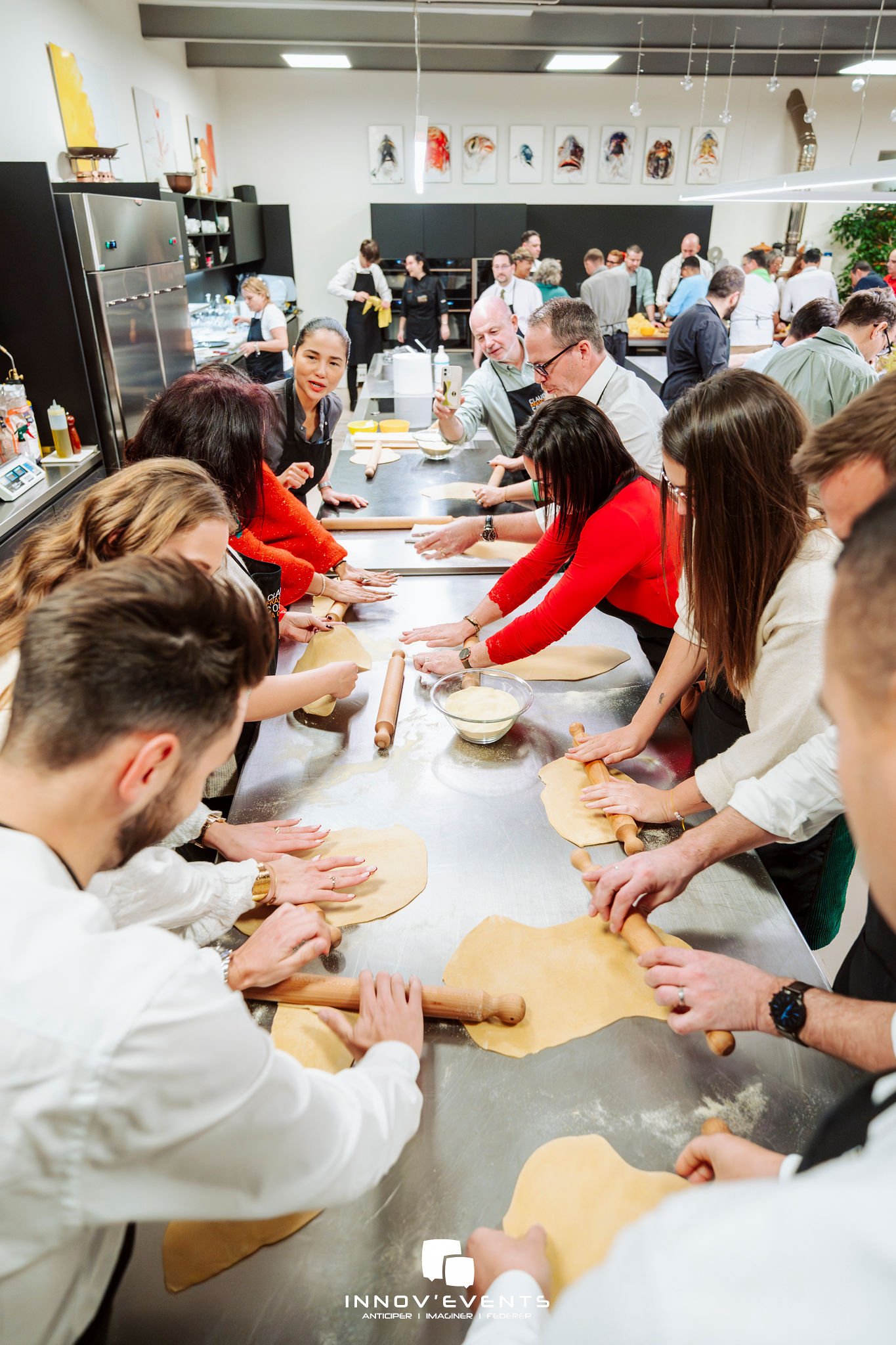
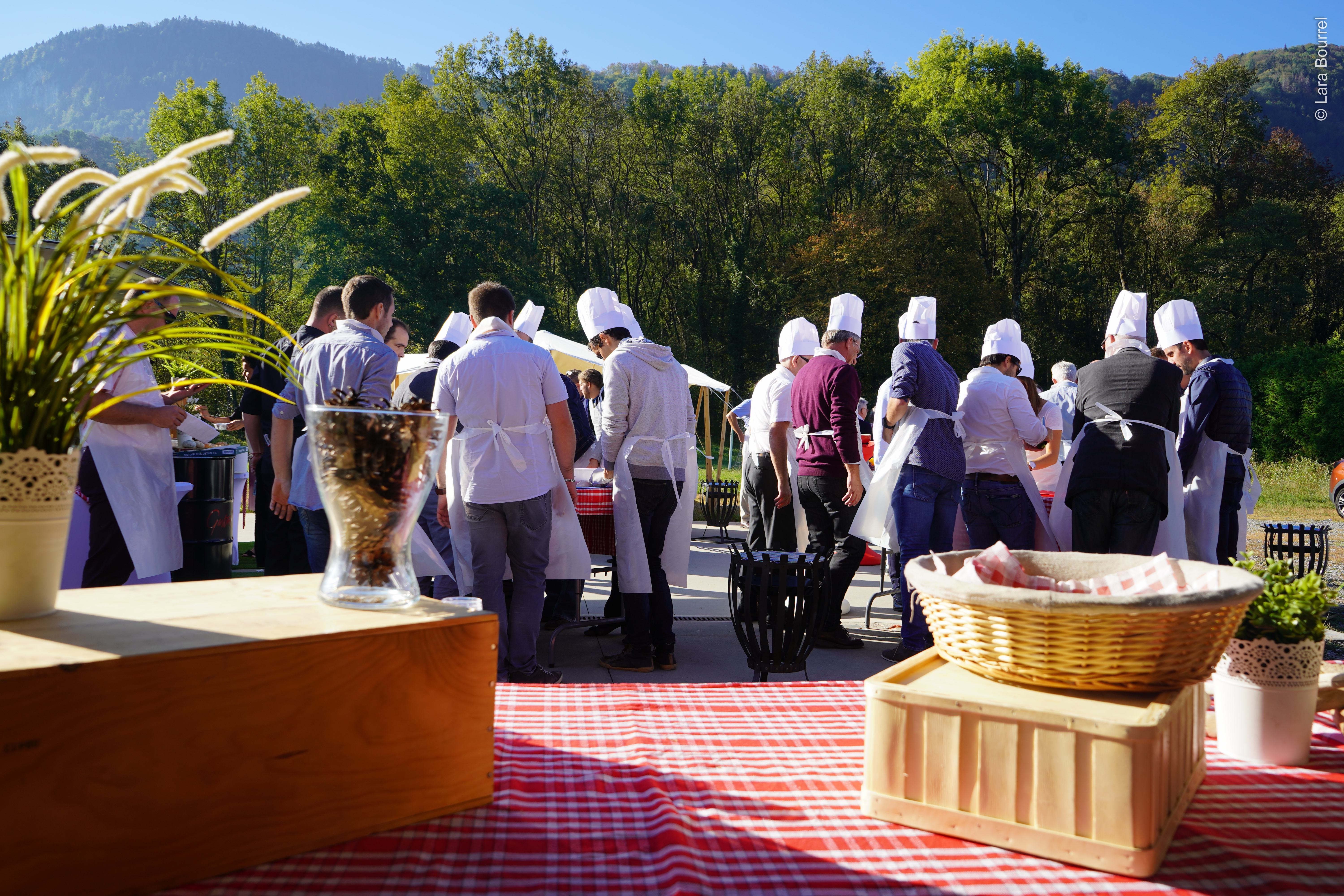
Operational credibility for corporate events in Laval
10+ years coordinating corporate activations across Québec and Ontario, with repeat mandates driven by delivery consistency.
Access to a network of vetted chefs, culinary studios, caterers, and rental partners—allowing us to scale a MasterChef-Style Cooking Workshop in Laval from 12 to 250 participants without improvisation.
Standardized production tools: run-of-show, staffing plan, risk register, and venue checklist used on every mandate (HR-friendly, audit-friendly).
On-site ratio typically planned at 1 facilitator per 25–35 participants plus kitchen brigade, to keep the experience fluid and safe.
Corporate references and repeat collaborations on the North Shore (Laval)
In Laval, many clients come back because they want the same operational stability year after year: a format that lands on time, looks professional in photos, and does not create friction with building management or internal HSE policies. We regularly support organizations with recurring calendars (recognition events, leadership offsites, onboarding cohorts, and end-of-year gatherings) where consistency matters as much as creativity.
If you have internal reference names you want us to highlight (companies, institutions, associations), we can integrate them in this section in a compliant way (brand approval, public mention validation, and scope description). In practice, what decision-makers appreciate most is our ability to translate internal objectives—retention, cross-functional collaboration, culture shift—into a corporate event entertainment in Laval that is concrete, framed, and safe.
We also know the local reality: supplier lead times around peak season, traffic constraints between Montréal and the North Shore, and the operational expectations of venues in the territory. That local understanding shows up in the details: load-in timing, elevator access, waste management, and contingency planning.
 Besoin d’un devis rapide ?
Nous vous envoyons une première proposition sous 24h.
Why schedule a cooking competition in Laval for executives?
A MasterChef-Style Cooking Workshop is one of the rare team formats where collaboration is unavoidable, visible, and time-boxed. For executives and HR, it’s a controlled environment to observe leadership behaviors (decision-making, delegation, listening, resource management) without putting people in an artificial “training room” dynamic.
Cross-silo collaboration you can actually see: finance and operations end up negotiating priorities in real time (menu choice, plating, timing). It mirrors project work without the political baggage of daily files.
A natural stage for leadership messages: you can open with a 3–5 minute talk and then let the activity do the work. When people are engaged, they remember the message; when they’re passive, they don’t.
Employer brand without overproducing: cooking content is easy to capture (short clips, team photos, judging moments) while remaining professional. Communications teams get usable material for internal channels.
Inclusion management: with the right design, dietary restrictions and cultural preferences become a sign of organizational maturity. We plan allergen protocols and alternative baskets so nobody is “the exception.”
Measurable engagement: we can structure scoring (taste, presentation, teamwork, time management) and provide a short post-event pulse survey. HR can track participation and perceived collaboration impact.
Controlled timeline: a full experience typically fits in 2h30 to 3h30 including briefing and awards—compatible with half-day meetings and leadership offsites in Laval.
Laval has a pragmatic business culture: results, efficiency, and respect for operations. A cooking competition aligns well with that mindset because it is hands-on, structured, and outcome-driven—without feeling like another meeting.
What Laval organizations expect from a corporate workshop provider
When we design a MasterChef-Style Cooking Workshop in Laval, we start from the constraints we repeatedly see in local organizations: tight agendas, mixed seniority groups, and venues with strict operating rules. Executives don’t want “surprises”; they want controlled energy, flawless timing, and a team that can adapt without escalating every decision.
Common expectations in Laval include:
- Predictable logistics: clear arrival instructions, parking plan, and check-in flow that doesn’t create a bottleneck.
- Professionalism in facilitation: the tone must work for directors and VPs (no infantilizing games), while still being engaging for all levels.
- Compliance and safety: food handling, allergen labeling, glove and sanitation rules, and clean-up standards that satisfy venue requirements and internal HSE expectations.
- Bilingual capability: many teams are francophone with anglophone stakeholders. We can deliver bilingual briefings and signage when needed.
- Brand and image control: communications teams often need a format that looks premium, photographs well, and avoids anything that could be perceived as wasteful or tone-deaf.
We also factor in seasonality. In Q4, for example, venues and suppliers are under pressure; lead times compress and costs can rise. Our planning approach anticipates this with early holds, clear deposit schedules, and backup options.
Which cooking workshop formats work best in Laval corporate events?
Entertainment creates engagement when it forces meaningful interaction and gives teams a shared objective with constraints. A MasterChef-Style Cooking Workshop works because it blends pressure, creativity, and coordination—three ingredients that mirror business reality.
Interactive animations in Laval
Executive “mystery box” briefing: leadership opens with a strategic theme (customer focus, operational excellence, innovation). Each team receives a mystery ingredient linked to that theme, and must integrate it into their dish. This creates a concrete bridge between message and action.
Role rotation challenge: teams must rotate roles every 15–20 minutes (captain, prep lead, plating lead, timekeeper). It highlights delegation habits and prevents one strong personality from carrying the group.
Cross-team trading window: a 5-minute trading period where teams negotiate ingredients. This is surprisingly effective for illustrating negotiation styles and resource allocation under time pressure.
Art animations in Laval
Plating and visual identity module: we add a short segment on plating principles (color, height, negative space). Communications teams appreciate this because the result is more photogenic and brand-safe.
Table presentation coaching: each team presents in 60–90 seconds with a clear structure (concept, constraints, choices). It strengthens concise messaging—useful for sales and leadership teams.
Innovative animations in Laval
Local-product spotlight (North Shore focus): we can integrate Québec ingredients that resonate locally while keeping supply reliable. The point is not “tourism”; it’s credibility and quality control.
Mocktail pairing station: a professional pairing adds a premium feel without the compliance concerns some organizations have with alcohol. We plan service flow to avoid lineups.
Dietary-inclusive menu design: vegetarian and allergen-aware options built into the core challenge (not an afterthought). This reduces HR friction and increases participation comfort.
Gourmand animations in Laval
Real-time scoring dashboard: QR-based scoring (taste, presentation, teamwork). It gives structure and lets you share results quickly for awards, without arguing over subjective impressions.
Short debrief for managers: a 10-minute facilitated wrap-up connecting behaviors observed (communication, prioritization, conflict management) to day-to-day work. It’s practical and avoids the “team-building cliché.”
Content package for internal comms: curated set of photos + a short recap template that communications can publish internally within 24–48 hours. We align it with your tone and brand guidelines.
Whatever the format, alignment with brand image is non-negotiable. We calibrate tone, judging style, alcohol policy, and visual setup so the experience reflects how your organization wants to be perceived in Laval: serious, welcoming, and well-run.
Where to host a cooking workshop in Laval (and what to verify)
The venue determines what is possible: menu complexity, participant comfort, AV quality, and even the perceived professionalism of the day. For a MasterChef-Style Cooking Workshop in Laval, the main question is not “what looks nice,” but “what supports safe production and smooth flow.” We validate capacity, kitchen infrastructure, ventilation, and handwashing points before we confirm a format.
| Venue type | For which objective? | Main strengths | Possible constraints |
|---|---|---|---|
Culinary studio / teaching kitchen in Laval | Run a true competition with multiple stations and chef supervision. | Built-in equipment, sanitation standards, predictable workflow, easier timing control. | Capacity can be limited; peak dates book early; catering and alcohol rules vary. |
Hotel or conference venue with banquet kitchen (Laval / 53) | Combine leadership meeting + workshop + networking reception. | One-stop logistics, AV options, professional service staff, strong accessibility. | Not always designed for many hands-on stations; may require rentals and simplified menus. |
Converted industrial/loft event space on the North Shore (53) | Create a brand-forward experience with strong visuals and media capture. | Great atmosphere, flexible layout, easier branding and staging. | Often needs temporary kitchen build-out; power/ventilation/load-in must be validated. |
We strongly recommend a site visit (or a technical walkthrough with photos, floor plans, and venue rules) before locking the menu and participant count. That’s where we catch the operational details that protect your timeline: service elevators, waste disposal, access hours, and noise constraints.
How much does a MasterChef-Style Cooking Workshop cost in Laval?
Pricing is driven by production reality more than “package names.” A cooking competition is a mini operational project: staffing, food, equipment, venue constraints, and timing. In Laval, the budget also depends on whether we use a fully equipped culinary venue or build temporary stations in a meeting space.
Participant count and team structure: most corporate formats are designed for 12–250 people. More participants mean more stations, more chef support, and more facilitation.
Venue type and infrastructure: teaching kitchens typically cost more per hour but reduce rentals; conference rooms may require significant equipment build-out (burners, refrigeration, prep tables).
Menu complexity: a three-component plate with a protein + side + sauce requires more supervision and timing control than a simpler format. Complexity increases risk and staffing needs.
Staffing levels: chef instructors, assistants, facilitators, production lead, and sometimes a dedicated health & safety support depending on venue rules.
Dietary restrictions and allergen protocols: alternative ingredient kits, labeling, separate utensils, and additional briefing time add real cost—but prevent reputational risk.
Branding and AV: microphones, music, screen timers, judging-stage setup, photo lighting, and content capture.
Schedule constraints: evening, weekend, or tight load-in windows can increase labor costs; Q4 demand can affect venue and supplier rates.
For executives, the ROI lens is straightforward: you’re buying structured interaction and a controlled message moment. When done properly, you reduce “empty networking time,” you increase cross-team contact density, and you generate comms-ready content—without adding risk to your agenda.
Why hire an event agency in Laval for a cooking workshop?
When your activity involves food production, timing, and safety, local execution matters. Working with an event agency in Laval reduces friction at every step: faster site visits, stronger relationships with local suppliers, and practical knowledge of venue operations in the territory.
For HR and communications teams, that local presence becomes a risk-management advantage. If a delivery is delayed, if a venue changes access rules, or if an executive’s schedule shifts, you want a team that can react quickly on the ground—without turning every adjustment into a renegotiation.
- Shorter response time for walk-throughs, tastings, and last-minute checks in Laval.
- Supplier redundancy: backup options for key items (fresh ingredients, rentals, staff) to avoid single points of failure.
- Better cost control: fewer transport surprises and clearer understanding of local labor and access constraints.
- Venue-specific know-how: load-in realities, service corridors, kitchen rules, waste management, and noise policies that impact your run-of-show.
For executives, the ROI lens is straightforward: you’re buying structured interaction and a controlled message moment. When done properly, you reduce “empty networking time,” you increase cross-team contact density, and you generate comms-ready content—without adding risk to your agenda.






Examples of corporate formats delivered in Laval (adaptability proof)
Our mandates vary because corporate realities vary. We’ve delivered leadership workshops where the cooking challenge had to fit between two board-level sessions, with a strict start at 12:15 and awards at 14:45—no flexibility because executives had travel booked. We’ve also supported HR teams running onboarding cohorts where the objective was to connect new hires across departments, requiring a softer judging tone and a strong inclusion plan for dietary needs.
On the communications side, we often work with teams who need content but cannot disrupt the experience. In those cases, we plan specific “capture moments” (team briefing, plating, judging reactions) and keep cameras out of the workstations. The outcome is usable internal content without participants feeling like they are on a film set.
We’ve also managed sensitive contexts: post-merger integration, reorganization fatigue, and unionized environments where perceived fairness matters. For those, we adjust scoring criteria, avoid public call-outs, and ensure the facilitation tone remains respectful and adult—while still maintaining energy.
Common mistakes to avoid for cooking events in Laval
Underestimating kitchen logistics: too many participants per station leads to congestion, frustration, and safety issues. We plan workstation ratios and flow.
Ignoring venue constraints: ventilation, power, and access hours can make or break the format. We confirm technical feasibility before selling a menu.
Allergen management treated as “special requests”: in corporate environments, it’s a governance topic. We build allergen protocols into the base plan.
Judging that embarrasses people: what works on TV can backfire in a company. We keep it competitive but respectful and aligned with culture.
Agenda drift: cooking activities can easily run late if timing isn’t managed like a production. We run a tight schedule with buffer.
No plan for communications capture: either you miss the content, or cameras become disruptive. We plan capture points and approvals in advance.
Our job is to prevent these risks before they become visible to your employees—or worse, to your leadership team. In Laval, where teams expect pragmatism, that prevention is what differentiates a reliable partner from a supplier who just “shows up.”
Why Laval clients renew with the same agency
Repeat business in corporate events is rarely about novelty; it’s about trust under pressure. HR and communications teams come back when they know the agency will protect internal stakeholders: the executive sponsor, the project owner, and the brand.
Planning lead time: most successful mandates are confirmed 6–10 weeks in advance; Q4 often requires 10–14 weeks to secure top venues and chef availability.
Operational staffing: we plan a clear on-site chain of command (production lead + culinary lead + facilitators) so client contacts aren’t pulled into micro-decisions.
Post-event deliverables: when requested, we provide a short debrief (what worked, what to adjust, supplier notes) that makes next year’s planning faster.

Loyalty is proof of quality because it means we delivered on the two hardest things in Laval corporate events: operational stability and stakeholder confidence.
Our delivery process for corporate events in Laval
👉 Step 1 (Laval): Clarify objectives and constraints
We start with a working call with the executive sponsor, HR, or communications lead: participant profile, cultural context, agenda constraints, internal policies (alcohol, procurement, dietary), and success criteria. We confirm target headcount ranges (not just a single number) because kitchen design depends on it.
👉 Step 2 (53): Select the right format and venue configuration
We propose 1–2 workshop formats that match the venue reality: workstation count, menu complexity, timing, and judging structure. If the venue is not a teaching kitchen, we specify what we will build temporarily (equipment, power requirements, sanitation points) and what we will simplify to protect timing and safety.
👉 Step 3 (Laval): Budget framing and approval-ready options
We provide a budget with clear levers: what changes if you go from 60 to 90 participants, what the premium options are (content capture, upgraded ingredients, additional chefs), and where we recommend not cutting (sanitation, staffing, core equipment). This makes internal approvals easier and reduces surprises.
👉 Step 4 (53): Production planning and stakeholder alignment
We lock the run-of-show, staffing plan, food procurement schedule, allergen matrix, and signage needs. We coordinate with the venue on access, load-in, waste, and insurance requirements. For communications, we validate brand elements (visuals, tone, photo permissions) and define capture moments.
👉 Step 5 (Laval): On-site execution and time control
On event day, a production lead is your single point of contact. The culinary lead manages kitchen flow; facilitators manage teams and energy. We keep the agenda on track with visible timers, structured transitions, and contingency plans (ingredient replacement, station reassignment, pacing adjustments).
👉 Step 6 (53): Wrap-up, clean handback, and debrief
We manage teardown and venue handback to agreed standards. If requested, we deliver a short post-event debrief within 3–5 business days: participation notes, what to improve, and recommendations for your next internal cycle (recognition, leadership offsite, onboarding).
FAQ sur l'organisation MasterChef-Style Cooking Workshop à Laval
How many people can join in Laval at once?
Most MasterChef-Style Cooking Workshop setups in Laval work best from 12 to 120 in one wave, depending on kitchen capacity. For 120–250, we typically plan rotations (two waves) or a hybrid format (some cook, some judge/network, then switch).
How long should we plan for in Laval?
Plan 2h30 to 3h30 for the full experience (briefing, cooking, judging, awards). If you want a leadership message, photo moments, or a networking add-on, we recommend 3h30 to 4h30.
Can you manage allergies and restrictions in Laval teams?
Yes. We collect restrictions in advance, build an allergen matrix, and prepare swap kits (e.g., gluten-free, dairy-free, nut-free). On-site, ingredients are labeled and the chef lead briefs teams on cross-contamination basics. This is planned, not improvised.
What budget range is typical in Laval for this workshop?
Budgets vary by venue and complexity, but many corporate groups in Laval fall within a mid four-figure to low five-figure range for standard formats. The main drivers are participant count, venue infrastructure, staffing levels, and menu complexity. We can provide 2–3 options to fit your approval process.
Do you offer bilingual facilitation in Laval events?
Yes. We can deliver bilingual briefings and signage (French/English) and adapt facilitation based on your audience composition. If VIPs require English-first, we plan that upfront so the flow stays natural for everyone.
Request a quote for a cooking workshop in Laval
If you’re comparing agencies, we suggest a quick scoping call before you choose a format. In Laval, the difference between a smooth cooking competition and a stressful one is usually decided in planning: kitchen feasibility, staffing ratios, allergen protocols, and timing discipline.
Send us your date window, estimated headcount, venue (if known), and any internal constraints (bilingual needs, alcohol policy, dietary considerations). INNOV'events will come back with a clear proposal, operational assumptions, and budget options you can circulate for approval.
INNOV'events Laval Agency
Thierry GRAMMER is the manager of the INNOV'events Laval office. Reach out directly by email at canada@innov-events.ca or via the contact form.
Contact the Laval agencyToutes nos prestations & animations Laval, Quebec
Découvrez nos prestations événementielles
Découvrez nos animations événementielles disponibles au Quebec
- Event Hostess in Laval
- Escape Game in Laval
- MasterChef-Style Cooking Workshop in Laval
- Corporate Magician in Laval
- Tent Rental in Laval
- Color Analysis Workshop in Laval
- Inflatable Games in Laval
- Valet Service in Laval
- Soccer Simulator in Laval
- LED Furniture Rental in Laval
- LED Branding Activation in Laval
- Immersive Culinary Experience in Laval
- Light Painting Activity in Laval
- Immersive Mystery Night in Laval
- Promotional Contest in Laval
- Promotional Materials (POS) in Laval
- Virtual Reality Experience in Laval
- Molecular Gastronomy Workshop in Laval
- Halloween Event in Laval
- Fireworks Show in Laval
- Sports Challenge – Giant Games in Laval
- Professional Event Host in Laval
- Photo Booth Animation in Laval
- Santa Claus Appearance in Laval
- Kids Entertainment in Laval
- Guided Tour in Laval
- Urban Rally in Laval
- Ball Pit Activity in Laval
- Flight Simulator in Laval
- Food Truck Rental in Laval
- World Record Attempt in Laval
- Surf Simulator in Laval
- Soccer Simulator in Laval
- Wine Casino in Laval
- Makeover Workshop in Laval
- Perfume Creation Workshop in Laval
- Acting Workshop in Laval
- CSR Activities in Laval
- Archery Activity in Laval
- Event Security Guard in Laval
- Wine Tasting Workshop in Laval
- Mime Performance in Laval
- TV Game Show Animation in Laval
- Funfair Event in Laval
- Crisis Management Workshop in Laval
- Crisis Negotiation Workshop in Laval
- Arcade Games in Laval
- Indoor Skydiving Simulator in Laval
- Ski Simulator in Laval
- Racetrack Driving Experience in Laval
- Introductory Flight Experience in Laval
- Tasting Experience in Laval
- Build Your Own Foosball Workshop in Laval
- 2CV Rally in Laval
- LEGO Challenge in Laval
- Casino Night in Laval
- Interpreter / Translator in Laval
- Promotional Merchandise in Laval
- Shuttle / Transportation Service in Laval