
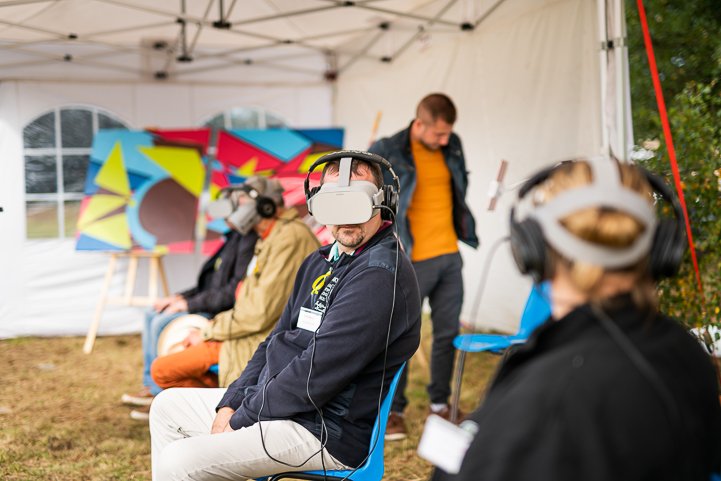
Virtual Reality Experience in Montréal for corporate events that need real engagement
INNOV'events delivers Virtual Reality Experience activations across Montréal for 30 to 1,500+ attendees, from executive offsites to public-facing employer-brand events. We manage the full operational chain: content selection, hardware, onsite staffing, safety, internet/power planning, and traffic flow so your teams stay focused on guests—not troubleshooting.
Whether you need a high-throughput VR zone for a holiday party or a controlled, brand-safe scenario for leadership or HR objectives, we build an experience that holds up under event-day pressure: tight schedules, VIP expectations, and compliance constraints.
Sommaire
In a corporate program, entertainment is not a “nice-to-have”; it’s one of the few levers that reliably increases dwell time, conversations between departments, and perceived event value. A well-designed Virtual Reality Experience gives you measurable outputs: participation rate, throughput per hour, and an engagement moment your communications team can actually reuse.
In Montréal, organizations expect professionalism: bilingual guest handling, fast rotations, clean staging, and no “beta-test” feeling in front of executives. The standard is high—venues, AV partners, and internal stakeholders want a clear run-of-show and zero surprises around power, Wi‑Fi, and safety.
We’re a Montréal-based team used to corporate constraints (security, brand approval, union rules in some venues, limited load-in windows). We bring field-proven VR formats, trained facilitators, and an operations-first approach so the activation runs smoothly from the first guest to teardown.
Montréal delivery capacity you can rely on
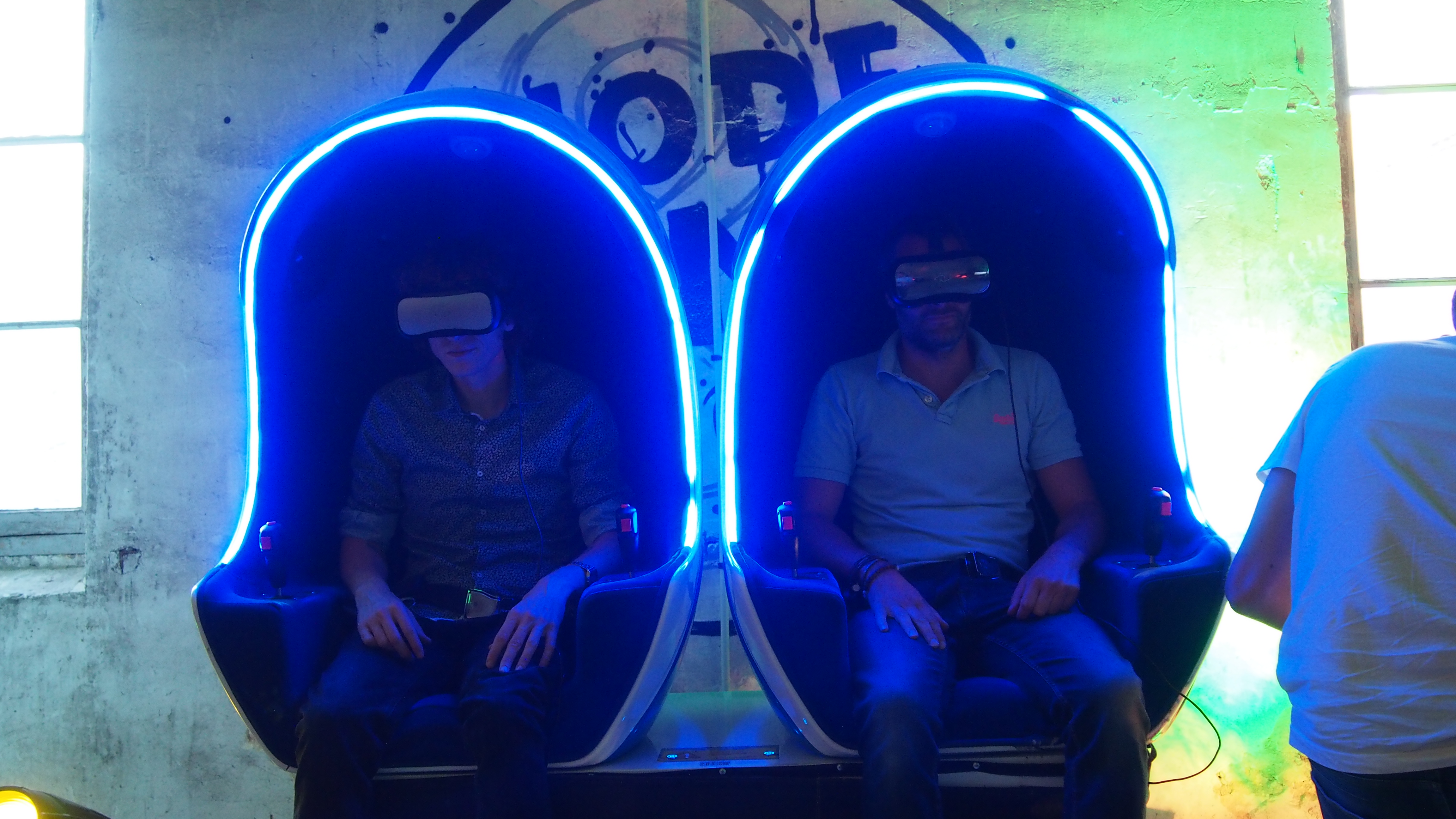
10–25 VR stations deployable on the same event when throughput is the priority (holiday parties, large town halls, conferences).
2 facilitators per 4–6 headsets as a baseline staffing model to avoid queues, sanitize properly, and keep guests safe and confident.
30–120 seconds average guest onboarding time when the content and layout are optimized (measured onsite; we track it to manage line length).
5–8 minutes typical experience duration for high-volume events; 10–15 minutes for curated executive demos.
24–48 hours for a first quote and feasibility check once we have venue, guest count, and timing windows.
Montréal corporate teams we support year after year
Our Virtual Reality Experience in Montréal projects are often repeat collaborations because internal teams need predictability. HR leaders want a clear participant flow and a safe environment; communications teams need brand control and content they can film; executive sponsors want a professional activation that doesn’t steal attention from the agenda but raises the event’s perceived value.
In practice, that means we build an operating plan that can survive real conditions: late start due to speeches, room changes at the last minute, VIP arrivals, venue restrictions on adhesives or rigging, and the reality that guests will show up in waves (not evenly). We document what worked, what didn’t, and we improve the next year—same company, different objectives.
If you have specific references you want included (clients or partner venues), send the list and we’ll integrate them in a compliant way (name use approvals, context, and what was delivered).
 Besoin d’un devis rapide ?
Nous vous envoyons une première proposition sous 24h.
Why Montréal executives use VR to drive participation
A Virtual Reality Experience works when it supports a managerial goal: accelerating connections, reinforcing culture, or creating a controlled “wow” moment without taking operational risks. For leadership teams, VR is valuable because it is structured: we can design throughput, timing, and messaging with the same discipline you apply to the agenda.
Higher participation without forcing it: guests self-select into VR, but we design the space to pull traffic naturally (entry sightline, signage, queue management). On a 300-person cocktail, we typically target 120–220 participants depending on program length and headset count.
A cross-department conversation starter: VR eliminates “small talk friction.” We regularly see finance, operations, and sales mixing because the shared experience gives them an immediate topic and a reason to stay.
Employer brand and culture proof: for HR, VR can anchor themes like innovation, safety culture, or collaboration. The key is not the tech—it’s the narrative and the way facilitators frame it in English and French.
Content for internal communications: we can stage a branded photo/video angle (without filming screens with sensitive data). Comms teams leave with usable clips: reactions, queue shots, leadership trying it, and wide shots of the activation.
Predictable experience quality: unlike some live entertainment, VR is controllable. We define the content, the session length, sanitization protocol, and the guest journey—so the result is consistent from the first guest to the last.
Safety and compliance handled professionally: we plan for accessibility, motion sensitivity, and hygiene. This matters in regulated environments and with mixed audiences (employees + partners + clients).
Montréal is a fast-moving market where teams compare experiences across industries—tech, finance, retail, and public organizations often attend each other’s events. VR is one of the few activations that still feels modern when executed with operational rigor, not as a gadget.
What Montréal organizations expect from a VR activation
Local decision-makers are pragmatic. They’ve seen activations fail because the queue was unmanaged, the internet was unreliable, or staff couldn’t explain the experience confidently. In Montréal, expectations are specific and non-negotiable:
- Bilingual guest experience: signage, onboarding, safety instructions, and facilitator scripts in English and French. When a VP walks in with a client, the team must switch languages instantly.
- Venue constraints: limited load-in windows downtown, elevator bookings, narrow service corridors, and strict “no tape/no marks” policies in premium spaces. We plan staging that respects venue rules and protects floors/walls.
- Union and in-house AV realities: some venues require in-house technicians for power drops or rigging. We coordinate early to avoid day-of stoppages and unplanned fees.
- Network limitations: relying on guest Wi‑Fi is risky. For multiplayer or connected content, we propose a dedicated solution (wired where possible, or controlled cellular backup) and we select content that can run offline if needed.
- Hygiene and optics: headsets must be cleaned visibly and consistently. We use disposable face covers when appropriate and a strict rotation plan so the station never looks improvised.
- Brand governance: comms teams need assurance that visuals and themes are appropriate. We pre-approve content, avoid anything that can appear violent, and align the environment with your brand codes.
These are not theoretical points. They come directly from what tends to break on event day—and what Montréal stakeholders will remember when they decide whether to rehire an agency.
Which VR formats work best for Montréal corporate events
VR becomes a strong engagement tool when you pick the right format for your crowd. A holiday party has different constraints than a client reception or an HR recruitment evening. Below are VR-driven ideas we deploy in Montréal, with the practical implications that matter to a director: staffing, space, and brand control.
Interactive animations in Montréal
High-throughput VR arcade zone: short games (3–8 minutes) with clear onboarding and fast resets. Best for large internal events where you want high participation. We design a “watch area” so non-participants still engage and the activation feels lively.
Team challenge leaderboard: scores tracked by department or table. Works well when you need a light competitive layer without creating friction. We validate that the scoring is fair and repeatable (some VR titles are not), and we align the tone with your culture.
Guided VR discovery: a facilitator narrates a curated experience (e.g., exploration, art, innovation theme). Strong for mixed audiences, including partners and clients, because it reduces the intimidation factor and keeps the experience brand-safe.
Art animations in Montréal
VR art gallery + physical scenography: combine headset moments with a real-world set (lighting, soundscape, branded panels). This is effective when communications wants strong visuals beyond “people wearing headsets.”
Immersive audio + VR meditation reset: appropriate for leadership retreats or wellbeing programming. We manage volume, privacy, and time slots so it doesn’t conflict with agenda blocks.
Innovative animations in Montréal
VR + tasting pairing: a short VR segment (travel, terroir, production story) followed by a guided tasting. This works for client hospitality in Montréal when you want something refined, not a loud arcade vibe. We coordinate pacing so the VR queue doesn’t disrupt service.
Interactive “choose the menu” VR prompt: guests vote after a quick VR vignette, feeding into dessert or cocktail selection. It’s a simple way to connect catering and activation without overcomplicating operations.
Gourmand animations in Montréal
Branded safety or process simulation: for industrial, logistics, or public organizations, VR can demonstrate decision-making under constraints. We keep scenarios short and compliant; this is not a training certification, but it can reinforce culture and leadership messages.
Multi-user collaborative VR: powerful for executive sessions and innovation days, but it requires stricter network planning and more space. We recommend it when the objective is collaboration, not just entertainment.
Mixed reality spectator screen: mirror the VR view on a screen so colleagues understand what’s happening. It reduces drop-off and makes the zone feel inclusive—important when not everyone wants to wear a headset.
The best result comes when the corporate event entertainment in Montréal aligns with your brand posture: playful, premium, technical, or people-first. We’ll challenge the format if it contradicts your image (e.g., chaotic arcade for a formal client reception) and propose a setup that matches the room, the audience, and the story you want to tell.
Where to host a VR activation in Montréal without compromises
The venue shapes how your Virtual Reality Experience in Montréal is perceived. VR needs more than square footage: you need predictable power, controlled lighting, a sensible noise level, and enough circulation space so the zone doesn’t choke the cocktail or registration area. We evaluate venues through an operational lens: load-in access, ceiling height, rigging rules, security, and the ability to isolate the VR footprint.
| Venue type | For which objective? | Main strengths | Possible constraints |
|---|---|---|---|
| Downtown hotel ballroom / conference floor | High-volume participation during congresses, annual meetings, holiday parties | Power availability, predictable logistics, staff on hand, easy to scale to 300–1,500 guests | Union/in-house AV rules, limited load-in windows, noise management if multiple activations |
| Industrial-chic event spaces in Montréal | Employer brand nights, product storytelling, client receptions with a modern tone | Strong aesthetic for comms, flexible layouts, memorable staging for VR zones | Power distribution may require planning, uneven floors, stricter capacity and sound limits |
| Office or headquarters takeover | Leadership sessions, culture moments, internal milestones with controlled audience | Brand immersion, easy executive attendance, secure environment for sensitive groups | Elevator access for load-in, limited ceiling height, neighbor noise constraints, IT/security approvals |
We strongly recommend a site visit (or at minimum a detailed venue tech pack review) before confirming headset count and layout. In Montréal, two venues with the same capacity can behave very differently once you factor in service corridors, power locations, and where the crowd naturally gathers.
What a Virtual Reality Experience costs in Montréal
Budget depends on operational reality: number of headsets, staffing ratio, content licensing, venue constraints, and your throughput target. A transparent budget discussion upfront prevents the classic situation where an activation looks affordable on paper but fails onsite due to under-staffing or insufficient stations.
For corporate events in Montréal, you’ll typically see these working ranges (before taxes, depending on complexity and duration):
- $3,500–$7,500: small VR zone (2–4 headsets), short duration, standard content, basic branding.
- $7,500–$15,000: medium activation (4–8 headsets), higher throughput, bilingual facilitation, spectator screen, stronger staging.
- $15,000–$35,000+: large-format VR (8–25 stations), multiple content options, advanced scenography, dedicated queue management, redundancy plan, and tighter production constraints.
Throughput target: the fastest way to increase satisfaction is often adding stations, not shortening the experience. We model capacity so you don’t end up with a 40-minute line.
Facilitator staffing and supervision: proper staffing protects the experience and your brand. Under-staffed VR looks chaotic and increases hygiene and safety risk.
Content selection and licensing: brand-safe, corporate-appropriate content sometimes has different licensing terms. If you need multilingual prompts or a specific theme, that affects cost.
Venue logistics: downtown load-in restrictions, in-house technician requirements, and overtime rules can materially impact budget.
Branding and scenography: from simple signage to a full immersive set. We price this clearly so you can decide where it adds real value (photo angles, sponsor visibility, executive perception).
Connectivity and redundancy: multiplayer or networked features may require dedicated connectivity. We cost it as an option rather than hoping guest Wi‑Fi holds.
ROI is rarely about “VR for VR’s sake.” The return comes from measurable engagement (participation rate), stronger internal connection (people mixing outside silos), and communications outputs (usable content). We can also propose simple KPIs—participants/hour, average wait time, NPS-style quick poll—to document value for leadership.
Why choose an event agency in Montréal for VR delivery
When VR is part of a corporate program, the agency’s local execution strength matters as much as the creative. A team established in Montréal reduces friction with venues, suppliers, and last-minute changes that inevitably happen in real life. You’re not paying for “local pride”; you’re buying operational control and speed of decision-making.
As your event agency in Montréal, we’re on the ground for site visits, coordination with in-house AV, and quick pivots if the room plan changes. That local presence is what keeps your VR zone professional when the schedule shifts or when a power drop is not where the floor plan said it would be.
- Faster venue coordination: we speak the same operational language as Montréal venues and their technical teams (load-in, security, service elevators, technician call times).
- Reliable staffing: trained bilingual facilitators who understand corporate posture and can handle VIP moments without improvising.
- Better risk control: local redundancy options—backup gear, replacement staff, and the ability to respond quickly if something changes day-of.
- Realistic scheduling: we know how traffic behaves downtown, how long it takes to load in certain buildings, and how to build buffers that protect your agenda.
ROI is rarely about “VR for VR’s sake.” The return comes from measurable engagement (participation rate), stronger internal connection (people mixing outside silos), and communications outputs (usable content). We can also propose simple KPIs—participants/hour, average wait time, NPS-style quick poll—to document value for leadership.




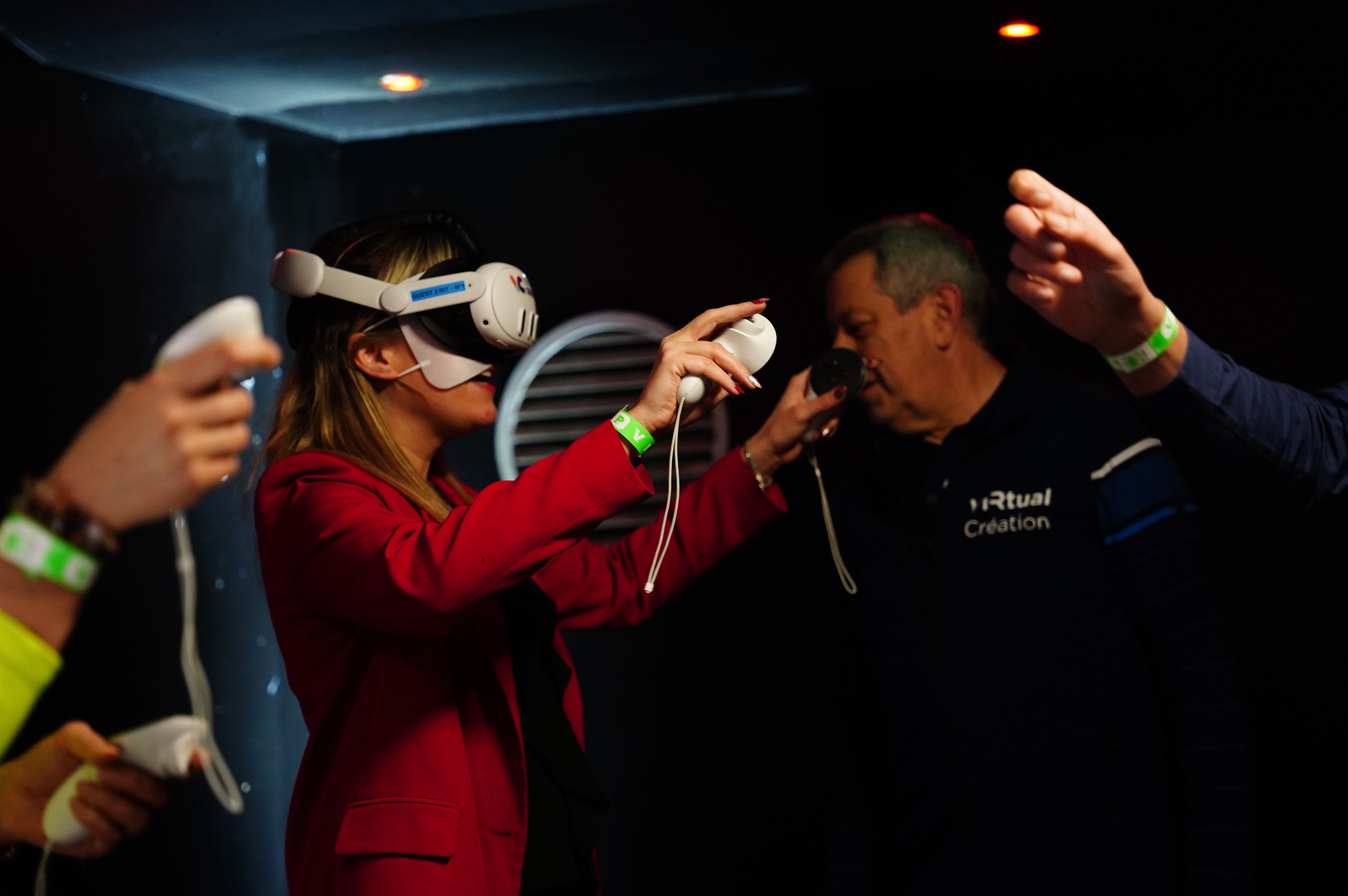
Examples of VR use cases delivered in Montréal
Our VR mandates range from high-energy internal celebrations to controlled executive demos where brand and risk management are the priority. We adapt the format to your program, not the other way around.
Common scenarios we handle in Montréal:
- Holiday party with high participation pressure: guests arrive in waves, the bar area gets congested, and the VR zone must remain accessible without blocking service. We design a visible queue line, use short sessions, add a spectator screen, and staff specifically for turnover and hygiene.
- Town hall + networking: the VR activation must not compete with leadership messages. We schedule “open” moments around key segments, place the zone away from the stage, and use content that doesn’t create noise or disruptive reactions near plenary spaces.
- Client reception: executives need a premium, controlled feel. We reduce the arcade look, prioritize clean staging, curate content with minimal risk of discomfort, and train staff to host discreetly and confidently.
- Employer brand / recruitment: HR wants people to stay, talk, and remember the organization. We add structured prompts, integrate branded visuals, and provide a simple participation metric for post-event reporting.
Across these contexts, our focus remains the same: a Virtual Reality Experience in Montréal that is brand-safe, operationally stable, and aligned with your event’s hierarchy of messages.
Common VR pitfalls we prevent in Montréal venues
Underestimating throughput: choosing a long experience with too few headsets creates long waits and frustration. We model capacity and set realistic participation targets.
Weak traffic flow design: without a clear entry/exit path, guests cut lines, staff repeats instructions, and the zone looks disorganized. We treat layout like a micro-operation.
Relying on guest Wi‑Fi: it’s rarely stable enough for connected VR. We plan for offline operation or dedicated connectivity.
Insufficient staffing: VR needs facilitation, not supervision. Without trained staff, hygiene slips, onboarding slows, and executives notice.
Ignoring motion sensitivity: some content triggers discomfort. We curate content, provide pre-briefing, and have alternatives ready.
Brand mismatch: a “cool” VR game can undermine a premium or conservative corporate image. We validate tone, visuals, and communication scripts with comms stakeholders.
No contingency plan: batteries, spare controllers, and reset procedures must be planned. We build redundancy and a quick fallback scenario.
Our role is to remove these risks before they reach your floor plan or your run-of-show. In Montréal, where stakeholders are experienced and venues are demanding, prevention is what protects your credibility on event day.
Why Montréal clients rebook VR activations with us
Repeat business in corporate events is earned through reliability, not promises. Clients come back when the activation is easy to approve internally, easy to operate onsite, and produces results the sponsor can defend.
80–90% of our repeat VR requests come from two drivers: predictable onsite operations and clear stakeholder management (HR, comms, executive sponsor).
0 critical incidents is the standard we plan for: we use safety briefing scripts, facilitator ratios, and content curation to keep risk low.
1 post-event debrief included: what worked, what to adjust, and how to improve throughput or staging next time.

Loyalty is not about locking you in—it’s proof that the Virtual Reality Experience held up under real event conditions in Montréal, and that your internal stakeholders were satisfied enough to do it again.
How we deliver a VR activation in Montréal from brief to teardown
👉 Montréal discovery and feasibility call
We start with three decision points: your objective (engagement vs. premium demo vs. brand story), your event structure (cocktail, plenary, stations), and your constraints (venue rules, bilingual needs, audience profile). You get a first recommendation on headset count, session length, and required footprint.
👉 VR content curation and brand validation in Montréal
We shortlist content options that fit your audience and risk tolerance (motion, visuals, tone). Communications can review screenshots and a short description of the guest journey. If your event includes clients or public stakeholders, we prioritize brand-safe content and a controlled facilitation script.
👉 Operational design and floor plan for Montréal venues
We map the VR zone: stations, queue, spectator area, exit flow, storage, and cleaning point. We confirm power requirements, cable routing, and what must go through venue technicians. We also plan signage (bilingual) and define the run-of-show integration so the activation supports—not competes with—key moments.
👉 Production and onsite delivery in Montréal
Our team arrives with a checklist: equipment verification, test runs, hygiene setup, battery rotation, and staff briefing. Facilitators manage onboarding, safety, and flow; a lead stays accountable for coordination with the venue and your internal point person.
👉 Event-day monitoring and contingency management in Montréal
We track queue length, participation pace, and bottlenecks. If speeches run late or the room shifts, we adjust session length or station allocation to protect guest experience. Backup gear and reset procedures are ready to keep operations stable.
👉 Teardown, reporting, and next-step recommendations in Montréal
We dismantle cleanly within venue rules and provide a concise wrap-up: estimated participants, peak times, what to optimize, and what format would scale better next time. For HR and communications teams, we can also suggest what content to reuse internally and how to report value to leadership.
FAQ sur l'organisation Virtual Reality Experience à Montréal
How many headsets do we need in Montréal for 300 guests?
For a 3-hour cocktail, plan 6–10 headsets if you want meaningful participation without long waits. With 6 headsets and 7–9 minute rotations, you can typically serve 100–160 participants. If your goal is 200+ participants, move closer to 10–12 headsets or shorten sessions with a tighter onboarding script.
What space is required for a VR zone in Montréal venues?
As a practical rule: 35–50 sq. ft. per headset station plus circulation, and 80–150 sq. ft. for a queue/spectator area depending on expected peaks. For 6 stations, we often recommend roughly 400–700 sq. ft. total to keep the zone readable and safe.
Is VR safe for all employees at Montréal corporate events?
VR is generally safe, but not universal. We provide a short safety briefing and recommend alternatives for guests who are pregnant, have vertigo, or are prone to motion sickness. We curate content with low discomfort risk and keep a seated option available when appropriate. Expect a small opt-out rate; that’s normal and manageable.
Do we need Wi‑Fi for a Virtual Reality Experience in Montréal?
Not always. Many experiences run fully offline, which is often the most reliable choice in event conditions. If you want multiplayer, live leaderboards, or connected features, we recommend a dedicated solution rather than guest Wi‑Fi. We confirm this during feasibility so there are no day-of surprises.
How far in advance should we book VR in Montréal?
For standard setups, 3–6 weeks is usually comfortable. For large events (10+ stations), premium venues with strict load-in rules, or heavy branding/scenography, plan 6–10 weeks. Last-minute is possible, but it limits content choice and staffing availability—two factors that directly impact quality.
Request a quote for a Virtual Reality Experience in Montréal
If you’re comparing agencies, we can make the decision easier with a practical proposal: recommended headset count, footprint, staffing plan, content options, and a clear budget range—based on your venue and agenda.
Send us your event date, venue (or shortlist), estimated attendance, and timing (cocktail duration or program blocks). We’ll respond with a structured plan and a realistic throughput estimate so you can validate the activation internally and move forward with confidence in Montréal.
INNOV'events Montréal Agency
Thierry GRAMMER is the manager of the INNOV'events Montréal office. Reach out directly by email at canada@innov-events.ca or via the contact form.
Contact the Montréal agencyToutes nos prestations & animations Montréal, Quebec
Découvrez nos prestations événementielles
- Employee Party in Montréal
- Corporate Christmas Party in Montréal
- Networking Cocktail Event in Montréal
- Shopping Mall Activation in Montréal
- Grand Opening Event in Montréal
- Product Launch Event in Montréal
- Open House Event in Montréal
- Field Brand Activation in Montréal
- Event Catering Service in Montréal
Découvrez nos animations événementielles disponibles au Quebec
- Event Hostess in Montréal
- Escape Game in Montréal
- MasterChef-Style Cooking Workshop in Montréal
- Corporate Magician in Montréal
- Tent Rental in Montréal
- Color Analysis Workshop in Montréal
- Inflatable Games in Montréal
- Valet Service in Montréal
- Soccer Simulator in Montréal
- LED Furniture Rental in Montréal
- LED Branding Activation in Montréal
- Immersive Culinary Experience in Montréal
- Light Painting Activity in Montréal
- Immersive Mystery Night in Montréal
- Promotional Contest in Montréal
- Promotional Materials (POS) in Montréal
- Virtual Reality Experience in Montréal
- Molecular Gastronomy Workshop in Montréal
- Halloween Event in Montréal
- Fireworks Show in Montréal
- Sports Challenge – Giant Games in Montréal
- Professional Event Host in Montréal
- Photo Booth Animation in Montréal
- Santa Claus Appearance in Montréal
- Kids Entertainment in Montréal
- Guided Tour in Montréal
- Urban Rally in Montréal
- Ball Pit Activity in Montréal
- Flight Simulator in Montréal
- Food Truck Rental in Montréal
- World Record Attempt in Montréal
- Surf Simulator in Montréal
- Soccer Simulator in Montréal
- Wine Casino in Montréal
- Makeover Workshop in Montréal
- Perfume Creation Workshop in Montréal
- Acting Workshop in Montréal
- CSR Activities in Montréal
- Archery Activity in Montréal
- Event Security Guard in Montréal
- Wine Tasting Workshop in Montréal
- Mime Performance in Montréal
- TV Game Show Animation in Montréal
- Funfair Event in Montréal
- Crisis Management Workshop in Montréal
- Crisis Negotiation Workshop in Montréal
- Arcade Games in Montréal
- Indoor Skydiving Simulator in Montréal
- Ski Simulator in Montréal
- Racetrack Driving Experience in Montréal
- Introductory Flight Experience in Montréal
- Tasting Experience in Montréal
- Build Your Own Foosball Workshop in Montréal
- 2CV Rally in Montréal
- LEGO Challenge in Montréal
- Casino Night in Montréal
- Interpreter / Translator in Montréal
- Promotional Merchandise in Montréal
- Shuttle / Transportation Service in Montréal