
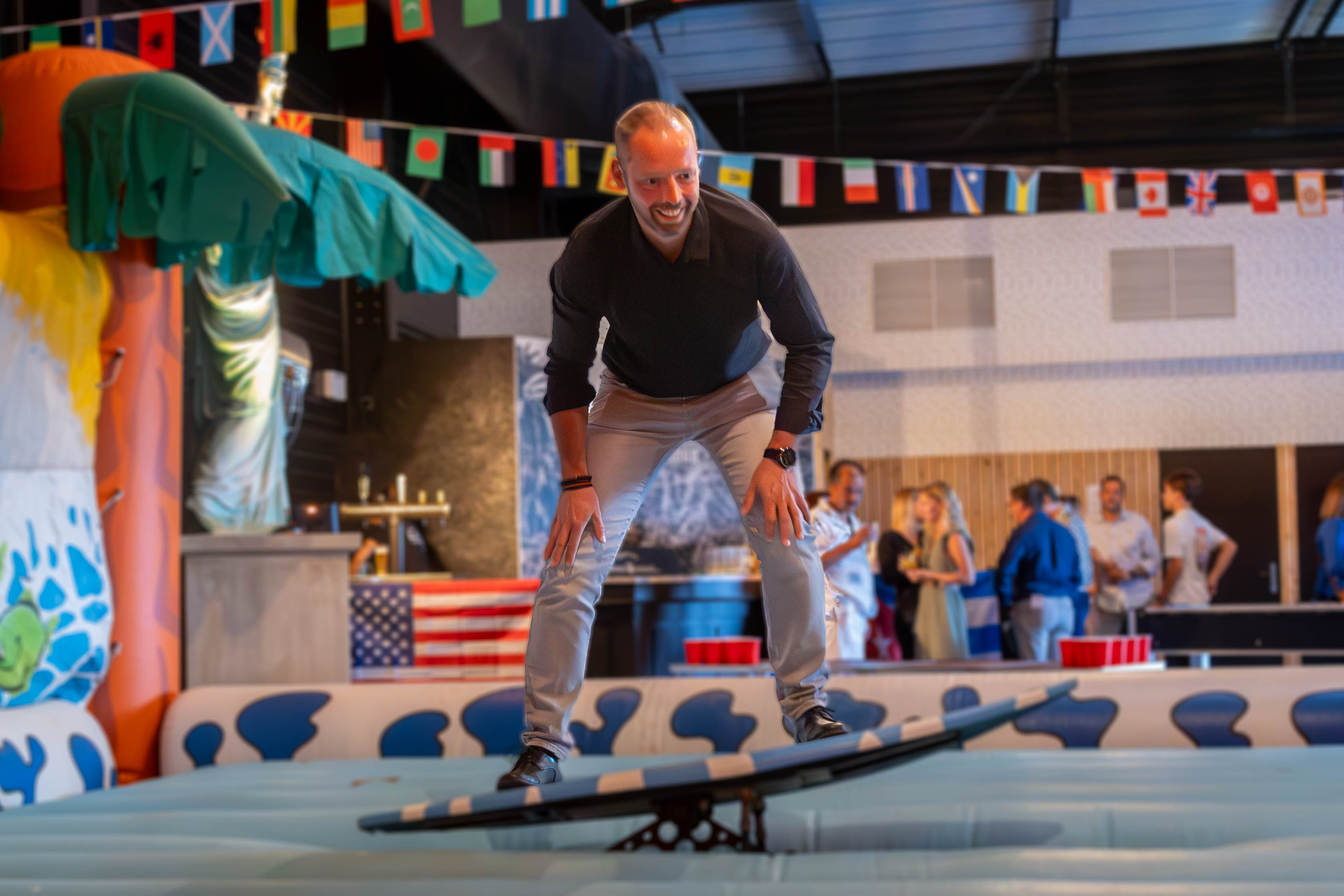
Surf Simulator in Montréal for corporate events that need real engagement
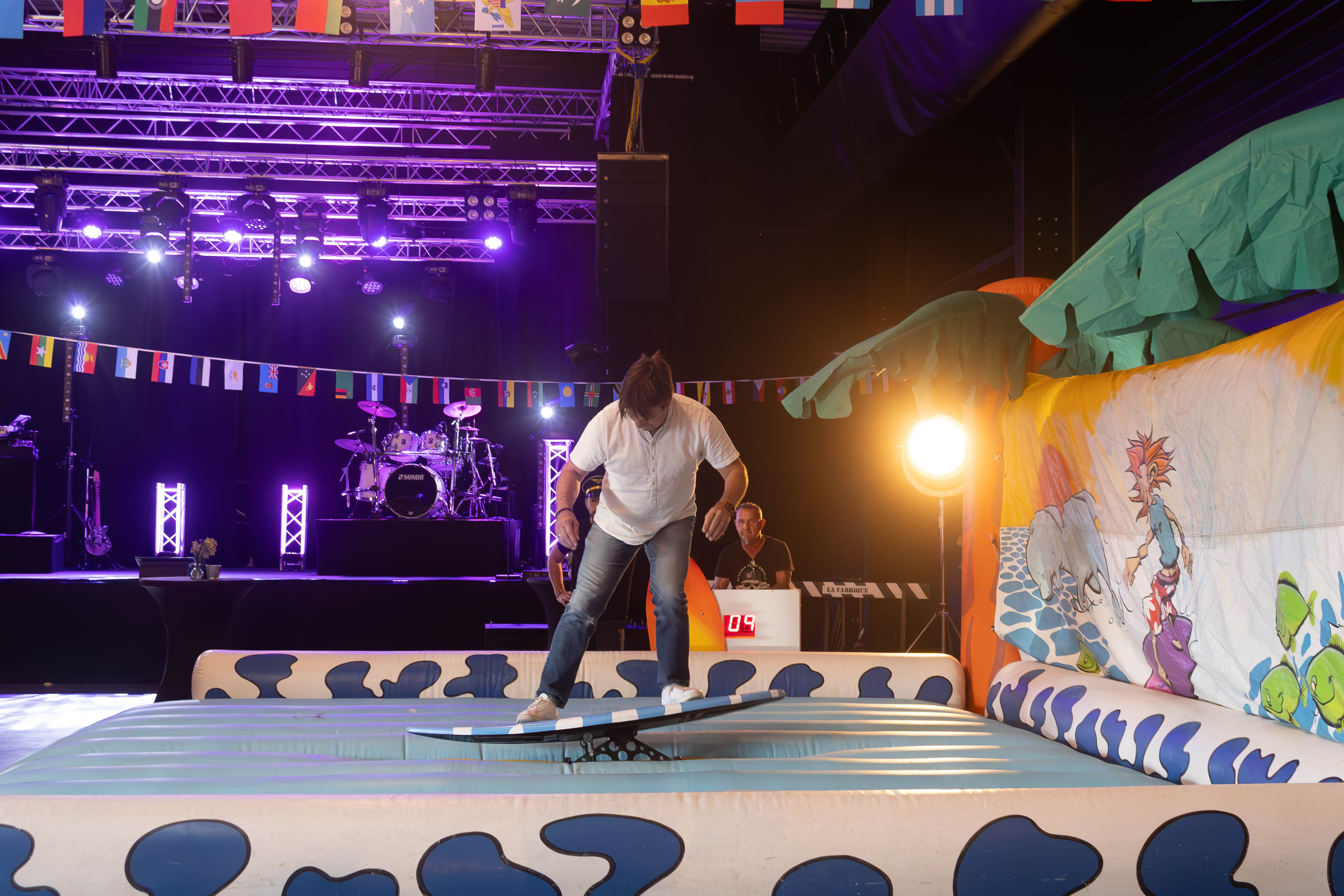
INNOV'events is a Montréal-based corporate event agency providing Surf Simulator rentals with full operational management (delivery, setup, staffing, safety, and crowd flow). Typical formats range from 50 to 1,500 attendees, from internal team events to public-facing brand activations. You get a controlled, measurable animation that keeps people moving, talking, and staying on site longer.
Sommaire
At an executive level, entertainment is not “extra”—it’s a lever to protect your event objectives: attendance, energy in the room, and the quality of interactions between departments. A Surf Simulator in Montréal works because it creates a visible focal point that resets attention and drives participation without needing a stage show or heavy scripting.
Montréal organizations expect professional execution: on-time load-in despite downtown constraints, staff who can handle bilingual guest flow, and safety protocols that stand up to HR scrutiny. If your guests are clients or partners, the activation also has to respect brand image—no chaos, no cheap look, no long lines that frustrate VIPs.
Our advantage is field experience in Montréal: we plan around unionized venues, freight elevators, winter logistics, and building rules that can block an installation last minute. We bring the right surf unit format, staffing ratio, and floor protection so the animation runs as smoothly as the rest of your program.
Montréal results you can verify with operations, not slogans
10+ years delivering corporate entertainment and logistics across Québec, with teams mobilized weekly in Montréal.
Typical service capacity: 1 to 6 simultaneous activations managed on one event day (multi-floor venues, multi-zone festivals, or concurrent breakout schedules).
Operational reliability: documented checklists for power, floor load, barriers, and staffing—the same rigor used for high-traffic public activations.
Standard response time: proposal and operational questions answered within 1–2 business days when all venue constraints are provided.
Montréal corporate teams that rebook because the day runs clean
We support organizations across the Montréal territory—head offices, industrial sites on the island, and satellite teams coming in for quarterly meetings. Several clients rebook year after year because they don’t want to re-litigate the same operational issues (venue access, power distribution, staffing, flow, and safety).
If you shared a list of company references, we can include them precisely here as named examples. In the meantime, what we see most often in Montréal is a mix of industries with strict brand requirements (finance, aerospace, pharma, tech, professional services) where an activation like a Surf Simulator must look controlled and premium—especially when clients, media, or recruitment targets are on site.
Our approach is designed for that reality: clear production notes, bilingual on-site supervision, and proactive coordination with venue operations and your internal communications team so the activation supports your message instead of competing with it.
 Besoin d’un devis rapide ?
Nous vous envoyons une première proposition sous 24h.
Why choose a Surf Simulator in Montréal for an HR objective?
A Surf Simulator is more than a fun station—it’s a programmable engagement tool. For HR, internal comms, and executives, it solves a common event problem: people split into cliques, the energy dips after speeches, and participation becomes passive. A surf activation creates a reason to gather, cheer, rotate, and connect—without forcing “team building” exercises that some employees resist.
Increase participation without pushing people: guests can ride, spot, cheer, film, or judge. That multi-level involvement reduces the “I don’t do activities” barrier we often see with mixed seniority groups in Montréal offices.
Improve interdepartmental mixing: structured rotations (2–3 rides per person, timed queues, and a host who calls names) creates organic cross-team contact—useful for mergers, reorganizations, or post-project resets.
Support recruitment and employer brand: for campus or hiring events, the surf zone becomes an attractor with content output (short clips, leaderboards, branded backdrops) while maintaining a professional look.
Create measurable outcomes: we can track participation volume, average wait time, and peak usage windows. Communications teams can also capture planned content (employee stories, leadership participation, “challenge the VP” moments) without improvising on event day.
Control risk and reputation: the activation is managed with defined rules, spotters, and protective flooring. This is critical in Montréal venues where the host/tenant relationship can be sensitive and damages are not negotiable.
In Montréal’s business culture, events are expected to be efficient and well-run: people appreciate creativity, but they judge execution. When the surf activation is installed cleanly, staffed properly, and aligned to your schedule, it becomes a credible signal that leadership invested in the experience—not just the slideshow.
What Montréal venues and corporate teams expect from production
Montréal is operationally demanding for event production. Downtown load-ins can be limited to short windows, parking for trucks is rarely straightforward, and many buildings require certificates of insurance, specific elevator bookings, and strict noise rules. A Surf Simulator in Montréal needs to be planned like any other technical element—not treated as “a game we drop off.”
On the corporate side, we frequently see three non-negotiables:
- Safety and HR acceptability: clear participation rules, staff who can refuse unsafe behavior, and a setup that limits trip hazards and crowding.
- Brand protection: the activation area must look clean (barriers, signage, tidy cables, controlled queue) and integrate into the venue’s aesthetic—especially for client-facing events.
- Bilingual delivery: signage and hosting in English and French when needed, without slowing the experience or creating confusion in the line.
We also plan for Montréal seasonality. Winter boots, wet coats, and slushy entrances are real factors for flooring and slip management. In summer, higher foot traffic and festival-style layouts require more queue control and clearer wayfinding. These are small details, but they are exactly what determines whether your event feels professional.
What to pair with a Surf Simulator in Montréal to drive engagement
A surf activation works best when it is part of a coherent engagement plan. In Montréal corporate events, we often combine it with one or two complementary stations that absorb traffic and create different participation levels—so the overall experience stays fluid and inclusive.
Interactive animations in Montréal
Leaderboard + timed challenges: we can run 30–60 minute “heats” by department or table, then announce winners during a natural program moment (before dinner seating, after a keynote). This is effective for sales kickoffs and quarterly town halls.
Video capture workflow: a simple setup with a branded backdrop and clear “where to send clips” process increases internal comms output. We coordinate with your comms team so content is captured intentionally, not randomly.
MC-style hosting (bilingual as needed): a host keeps the queue moving, sets expectations, and reduces risky behavior. In Montréal, the right tone matters: energetic, but never “carnival.”
Art animations in Montréal
Brand-aligned DJ set: not just background music—structured peaks during challenges, lower volume during networking blocks, and compliance with venue sound limits.
Live illustrator or caricaturist nearby: a quieter option that balances the high-energy surf zone and creates take-home value for guests who don’t want to ride.
Innovative animations in Montréal
Mocktail or espresso bar positioned as a buffer: placing food & beverage adjacent (not inside the immediate ride perimeter) improves flow and keeps non-riders engaged while they wait for colleagues.
“Après-surf” snack concept: simple, fast service items that won’t create mess near the equipment—important for venues with strict cleaning rules in Montréal.
Gourmand animations in Montréal
CSR micro-action tie-in: a sponsor-style mechanic where each successful ride triggers a small donation. This resonates with Montréal organizations that want fun without looking frivolous.
Photo moment designed for LinkedIn: controlled signage and framing (not cheesy props) so executives are comfortable sharing, and the brand remains credible.
The best results come when the animation matches the company’s tone. A corporate event entertainment in Montréal program should feel intentional: same brand voice, same level of finish, and the right balance between energy and professionalism.
Which Montréal venues work best for a Surf Simulator setup?
The venue changes everything: access, ceiling height, noise tolerance, and how “premium” the activation looks. For a Surf Simulator in Montréal, we typically prioritize spaces with clear sightlines, controlled entrances, and enough buffer space for the queue and safety perimeter.
| Venue type | For which objective? | Main strengths | Possible constraints |
|---|---|---|---|
Downtown hotel ballroom / conference center | Town hall, sales kickoff, gala pre-function activation | Professional infrastructure, predictable power, easy integration with AV and program timing | Strict load-in windows, carpet/floor protection requirements, sound limits, freight elevator bookings |
Converted industrial venue (Griffintown / Mile-Ex style) | Brand activation, product launch, client event with “wow” visual impact | High ceilings, strong aesthetic, open layout for crowd flow and filming | Power distribution sometimes limited, access ramps/doors can be narrow, noise considerations for neighbors |
Corporate office / headquarters (on-island) | Employee appreciation day, recruitment open house, internal comms campaign | High attendance convenience, strong employer-brand storytelling, lower venue rental costs | Elevator size limits, building insurance requirements, security protocols, limited storage/backstage |
Outdoor terrace or closed street (seasonal) | Summer family day, festival-style corporate celebration | High visibility, natural “event” feel, strong content production | Weather contingency plan required, permitting, generator planning, surface leveling and barriers |
We strongly recommend a site visit or at minimum a technical walk-through with photos and measurements. In Montréal, small constraints (a tight corner, a short ceiling section, a service door schedule) are often what determines whether installation is smooth or stressful.
What does a Surf Simulator in Montréal cost for a corporate event?
Pricing depends on format, duration, staffing level, and the venue’s logistical complexity. A surf simulator is a mechanical installation that requires supervision and time buffers; the budget is not only the equipment, but also the labor and risk management that keep your event protected.
Duration and operating hours: a 2–3 hour activation is not priced like a full-day public event. Longer hours usually mean additional staffing rotations and breaks.
Staffing ratio and hosting level: for corporate audiences, we generally plan for 2 to 4 staff depending on crowd size, queue volume, and whether bilingual hosting is required.
Venue access complexity in Montréal: downtown load-in constraints, elevator bookings, long pushes, and limited truck access can increase labor time.
Safety and perimeter needs: barriers, floor protection, signage, and controlled entry points are often required by venues and insurers.
Branding and content: optional elements like a branded backdrop, leaderboard display, or organized video capture add cost but can significantly improve communications ROI.
Seasonality and scheduling: peak periods (holiday parties, summer event season) affect availability and crew planning.
When executives ask about ROI, we link budget to outcomes you can defend: participation volume, time-on-site, internal content creation, and the reduction of “dead time” where guests drift away. A well-run Surf Simulator station is often less expensive than a stage act, while driving more sustained engagement across the event.
Why work with a Montréal event agency for surf activations?
With mechanical entertainment, local execution matters. A Surf Simulator isn’t forgiving when the venue changes rules, when access is tight, or when the schedule compresses. A team established in Montréal brings practical advantages: quicker site checks, realistic planning for local venues, and reliable last-minute support if something changes on the day.
At INNOV'events, our role is to reduce operational uncertainty for your HR and communications teams. We coordinate upstream with building operations, confirm the technical requirements in writing, and show up with the right crew size—so your internal stakeholders are not asked to “figure it out” in front of leadership.
If you are comparing suppliers, you’ll also want an agency that can manage more than the animation: production timing, guest flow, signage, and vendor coordination. This is exactly where working with an event agency in Montréal makes the difference between a stress-free activation and a high-maintenance rental.
- Venue relationships and realistic load-in planning: we build schedules that account for Montréal’s access constraints and typical building procedures.
- On-site decision-making: a local supervisor can adjust flow, staffing, and timing without escalating every micro-issue to your project lead.
- Consistent quality control: we work from standardized operational documents (risk notes, floor plans, staffing briefs) that corporate stakeholders can review.
- Better integration with your program: we align the activation with speeches, awards, and catering service so nothing competes or causes delays.
When executives ask about ROI, we link budget to outcomes you can defend: participation volume, time-on-site, internal content creation, and the reduction of “dead time” where guests drift away. A well-run Surf Simulator station is often less expensive than a stage act, while driving more sustained engagement across the event.



Montréal event formats where a Surf Simulator performs best
We’ve deployed surf-style mechanical activations in multiple corporate contexts, and the best outcomes happen when the format matches the business objective. For example:
- Sales kickoff in Montréal: we run timed department heats before dinner, then award a simple trophy during the program. The key is not the trophy—it’s the shared narrative and the cross-team cheering that carries into networking.
- Client appreciation event: we set a controlled VIP window early in the evening, ensuring clients can participate without long waits. We also keep hosting tone more discreet to protect brand positioning.
- Recruitment activation: we integrate a structured content plan (short interviews, leader ride clips, branded backdrop) so the day generates usable assets for LinkedIn and internal channels.
- Employee family day: we tighten the safety perimeter, add additional spotters, and implement an age/height policy clearly communicated at entry. This prevents uncomfortable on-the-spot refusals.
Across these scenarios, adaptability is operational—not improvisational. We bring the same discipline to entertainment as to AV: clear responsibilities, timing, and contingency planning so your event team stays in control.
Common mistakes Montréal planners want to avoid with surf rentals
Underestimating access constraints: the simulator fits in the room but not in the freight elevator or corridor. We confirm routes and turning radiuses early.
Ignoring floor protection and venue rules: Montréal venues can be strict on damage prevention. We plan floor coverings, cable management, and defined perimeter zones.
Creating a line that blocks networking: if the queue cuts through a main corridor or near bar service, you’ll feel it immediately. We design flow with buffer space and clear entry/exit.
No clear hosting standard: without a host, people hesitate, ride time stretches, and unsafe behavior creeps in. We keep instructions short and consistent.
Scheduling the activation against key program moments: if the surf simulator runs during speeches, you lose attention and create noise conflicts. We build a run-of-show that protects both.
Not planning for a “VIP moment”: when a senior leader wants to try it, the crowd gathers. Without a plan, it becomes chaotic. We schedule it intentionally.
Our job is to prevent these risks before they reach your event day. A surf activation should feel effortless for guests and predictable for your internal team—even when Montréal logistics are tight.
Why Montréal clients rebook INNOV'events for high-visibility activations
Repeat business in corporate events is rarely about novelty—it’s about trust. Teams come back when the agency protects timelines, brand image, and internal stakeholders under pressure. With mechanical entertainment like a Surf Simulator, reliability is the product.
High rebooking patterns for recurring formats (holiday parties, annual town halls, summer celebrations) when the first event proved operationally smooth.
Reduced internal workload after the first collaboration: we reuse validated venue notes, access plans, and staffing standards to speed up planning cycles.
Fewer day-of escalations thanks to pre-approved safety rules and a clear on-site chain of command.

Loyalty is the most practical proof: when a Montréal leadership team invites us back, it’s because the activation delivered energy without creating risk or distraction.
How we deliver a Surf Simulator in Montréal from quote to teardown
👉 Step 1 (Montréal): quick qualification and feasibility check
We confirm your event objectives, attendee profile, and schedule constraints, then validate feasibility: indoor/outdoor, approximate footprint, ceiling height, and access path. We also flag early risk points common in Montréal (loading dock booking, elevator restrictions, union labor requirements, and noise rules) so you’re not surprised later.
👉 Step 2 (Montréal): operational plan and staffing model
We propose the appropriate simulator format and staffing ratio based on expected throughput and guest mix. We define the perimeter, queue design, briefing script, and safety rules (including who can ride and under what conditions). If your comms team needs content, we incorporate a capture plan (where filming happens, what’s approved, and when leadership participation is scheduled).
👉 Step 3 (Montréal): venue coordination and documentation
We coordinate directly with the venue’s operations team on load-in/out timing, access routes, power, and floor protection. We provide the documents typically requested: insurance, technical needs, and setup timing. This step is where we protect your internal team from back-and-forth emails and last-minute operational debates.
👉 Step 4 (Montréal): event-day execution and crowd management
We arrive for setup with the right crew and a clear checklist: perimeter installed, signage placed, cables secured, and test runs completed before guests arrive. During operation, staff manages briefing, rotation, and safety. If schedule shifts, we adapt ride cycles to maintain a reasonable wait time and keep noise compatible with your program.
👉 Step 5 (Montréal): teardown, venue reset, and debrief
We teardown within the agreed window, protect floors during removal, and leave the space clean. For internal stakeholders, we can provide a short debrief: participation estimate, peak periods, and quick notes on what to improve next time (layout, timing, staffing). This is useful for executives and HR teams who want continuous improvement year over year.
FAQ sur l'organisation Surf Simulator à Montréal
How much space do we need in Montréal for a surf simulator?
Plan a clear zone of 18' x 18' to 25' x 25' depending on the unit, plus buffer space for a queue and exit path. If the venue is downtown Montréal, we also verify the access route (service doors, corridors, freight elevator size), not just the final room footprint.
How many guests can a Montréal surf simulator handle per hour?
In corporate conditions, expect roughly 20 to 40 riders per hour depending on ride time, briefing strictness, and guest profile. With strong hosting and a timed rotation, we keep wait time typically under 5–8 minutes during peaks for mid-size groups.
Is a surf simulator safe for a corporate event in Montréal?
Yes, when run with proper staffing and rules. We use a defined perimeter, clear participation criteria (including footwear and behavior), and active supervision. For HR comfort, we can formalize rules in writing and align them with your internal health & safety expectations and the venue’s requirements.
Can we run a surf simulator outdoors in Montréal?
Yes, seasonally. Outdoor setups require a weather plan (wind/rain thresholds), surface leveling, and power planning (often a generator). We recommend treating outdoor Montréal activations like a production: permits if needed, barriers, and a defined teardown plan if conditions change.
What information do you need to quote in Montréal quickly?
Send: event date, venue name and neighborhood, estimated attendance, operating hours, indoor/outdoor, and any known constraints (load-in window, elevator, union rules). With that, we can usually provide a clear Montréal quote range within 1–2 business days, then confirm after a technical check.
Request a Montréal quote with a real operational plan
If you’re evaluating options for a Surf Simulator in Montréal, we can provide a quote that includes what decision-makers actually need: feasibility notes, staffing model, safety approach, and a realistic schedule for load-in and operation. The earlier we validate the venue constraints, the smoother the event day will be—especially for downtown locations and high-visibility corporate programs.
Contact INNOV'events with your date, venue, and estimated attendance. We’ll come back with a clear recommendation (unit format, space plan, staffing, and budget range) so you can make a decision with confidence.
INNOV'events Montréal Agency
Thierry GRAMMER is the manager of the INNOV'events Montréal office. Reach out directly by email at canada@innov-events.ca or via the contact form.
Contact the Montréal agencyToutes nos prestations & animations Montréal, Quebec
Découvrez nos prestations événementielles
- Employee Party in Montréal
- Corporate Christmas Party in Montréal
- Networking Cocktail Event in Montréal
- Shopping Mall Activation in Montréal
- Grand Opening Event in Montréal
- Product Launch Event in Montréal
- Open House Event in Montréal
- Field Brand Activation in Montréal
- Event Catering Service in Montréal
Découvrez nos animations événementielles disponibles au Quebec
- Event Hostess in Montréal
- Escape Game in Montréal
- MasterChef-Style Cooking Workshop in Montréal
- Corporate Magician in Montréal
- Tent Rental in Montréal
- Color Analysis Workshop in Montréal
- Inflatable Games in Montréal
- Valet Service in Montréal
- Soccer Simulator in Montréal
- LED Furniture Rental in Montréal
- LED Branding Activation in Montréal
- Immersive Culinary Experience in Montréal
- Light Painting Activity in Montréal
- Immersive Mystery Night in Montréal
- Promotional Contest in Montréal
- Promotional Materials (POS) in Montréal
- Virtual Reality Experience in Montréal
- Molecular Gastronomy Workshop in Montréal
- Halloween Event in Montréal
- Fireworks Show in Montréal
- Sports Challenge – Giant Games in Montréal
- Professional Event Host in Montréal
- Photo Booth Animation in Montréal
- Santa Claus Appearance in Montréal
- Kids Entertainment in Montréal
- Guided Tour in Montréal
- Urban Rally in Montréal
- Ball Pit Activity in Montréal
- Flight Simulator in Montréal
- Food Truck Rental in Montréal
- World Record Attempt in Montréal
- Surf Simulator in Montréal
- Soccer Simulator in Montréal
- Wine Casino in Montréal
- Makeover Workshop in Montréal
- Perfume Creation Workshop in Montréal
- Acting Workshop in Montréal
- CSR Activities in Montréal
- Archery Activity in Montréal
- Event Security Guard in Montréal
- Wine Tasting Workshop in Montréal
- Mime Performance in Montréal
- TV Game Show Animation in Montréal
- Funfair Event in Montréal
- Crisis Management Workshop in Montréal
- Crisis Negotiation Workshop in Montréal
- Arcade Games in Montréal
- Indoor Skydiving Simulator in Montréal
- Ski Simulator in Montréal
- Racetrack Driving Experience in Montréal
- Introductory Flight Experience in Montréal
- Tasting Experience in Montréal
- Build Your Own Foosball Workshop in Montréal
- 2CV Rally in Montréal
- LEGO Challenge in Montréal
- Casino Night in Montréal
- Interpreter / Translator in Montréal
- Promotional Merchandise in Montréal
- Shuttle / Transportation Service in Montréal