
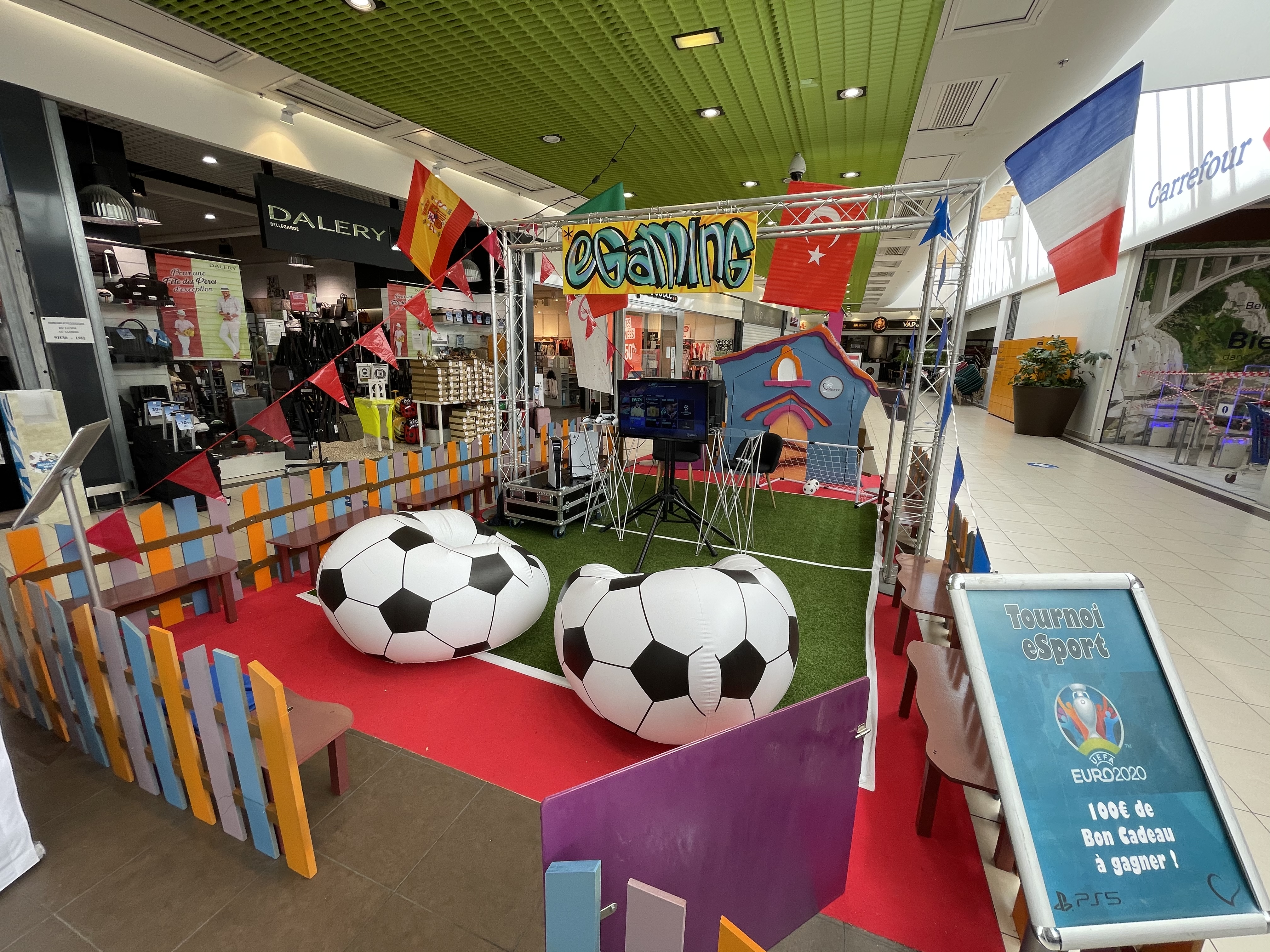
Soccer Simulator in Montréal for corporate events that actually engage teams
At INNOV'events, we deploy Soccer Simulator activations across Montréal for corporate events from 30 to 500+ attendees. We handle the operational side: delivery, installation, safety perimeter, technical checks, facilitation, and teardown—so your agenda stays on time.
Whether it’s a holiday party, team offsite, client activation, or internal comms campaign, we adapt the format to your audience: competitive, casual, or brand-driven. You get one accountable partner on event day, not a chain of subcontractors.
Sommaire
In a corporate agenda, entertainment isn’t a “nice-to-have”: it’s a lever to create interactions between departments, improve participation rates, and support the message leadership wants to land—especially when teams are hybrid and attention is fragmented.
In Montréal, organizations expect smooth bilingual execution, tight timing (often between speeches and service), and a set-up that looks premium in photos. A Soccer Simulator in Montréal has to be fun, but also clean, safe, and aligned with brand image.
Our team is on the ground locally. We know typical venue constraints downtown, in Griffintown, and around the airport corridor, and we plan accordingly—access, freight elevator schedules, union rules when applicable, and the reality of winter logistics.
What INNOV'events delivers in Montréal, in numbers
10+ years of corporate event delivery across Québec and Canada, with repeat clients in HR, internal communications, and brand teams.
Activations executed from 30 to 2,000+ participants, including multi-station game zones and high-traffic client events.
48–72 hours typical turnaround for a clear quote with technical assumptions, inclusion list, and venue questions—so you can validate internally without guesswork.
On-site staffing ratio often planned at 1 facilitator per station (plus a floater when volume is high) to keep queues moving and maintain a professional guest experience.
Local references in Montréal that value operational reliability
We support organizations that have the same pressures you do: leadership expectations, HR objectives, brand standards, and the reality that “event day” has zero tolerance for improvisation. In Montréal, we often work with teams who bring us back year after year because the execution is predictable and the experience is measurable.
Our local delivery includes recurring collaborations with companies such as Desjardins, CAE, Bombardier, and Ubisoft (references shared according to your approval process and event confidentiality). What they typically value: clear pre-event documentation, respect of venue rules, and an activation that remains elegant even when 200 people arrive at once after a keynote.
If you’re comparing agencies, we’re comfortable being evaluated on concrete elements: staffing plan, load-in method, risk controls, guest flow, and how we protect your schedule. That’s where a Soccer Simulator either becomes a highlight—or a bottleneck.
 Besoin d’un devis rapide ?
Nous vous envoyons une première proposition sous 24h.
Why book a Soccer Simulator for a Montréal corporate event?
A Soccer Simulator is one of the rare activities that works for mixed groups: sports fans, casual participants, executives who have 10 minutes, and teams who want to compete. The key is not the machine—it’s the event design around it: format, timing, facilitation, and how it fits your communication objectives.
Immediate participation without long explanations: guests understand the concept in seconds. That matters when you’re running a cocktail, a product reveal, or an internal town hall with limited time between segments.
Structured team-building without forcing it: you can run quick tournaments (2–3 minutes per shot series) or open-play. HR teams like it because it creates cross-team interactions without making people “perform” in front of everyone.
Measurable engagement: we can track attempts, top scores, and participation volume. That gives Communications teams content for internal recaps and allows leadership to see participation beyond “it looked busy.”
Brand-safe entertainment: when properly staged—clean backdrop, controlled lighting, defined safety perimeter—the activation looks professional in photos and doesn’t conflict with a premium brand environment.
Flexible integration into your agenda: works as a reception icebreaker, a break activity between plenary sessions, or a post-dinner competition. In Montréal venues, this flexibility is crucial because room access times can be tight.
Montréal business culture is practical: people want to have fun, but they also want to feel the event was well-managed and worth their time. A well-run Soccer Simulator in Montréal supports that expectation—energy on the floor, zero chaos behind the scenes.
What Montréal decision-makers expect from corporate entertainment
Most corporate clients we support in Montréal are balancing three realities: bilingual audiences, tight venue windows, and brand risk management. A successful corporate event entertainment in Montréal plan is built for those constraints from the start.
Bilingual facilitation is not a detail. If your audience is mixed (common with head offices, crown corporations, or national teams), the facilitator must be able to run rules, safety reminders, and tournament calls in French and English—without slowing the experience down.
Venues are strict on load-in and footprint. Downtown hotels, Old Montréal event spaces, and multi-tenant office towers often require COIs, freight elevator reservations, floor protection, and load-in timing that matches building rules. We plan around those operational checkpoints so your internal team isn’t negotiating with security on the day of.
Executives want control of the optics. The activation should look intentional: neat cabling management, branded signage if needed, a clean queue line, and staff dressed appropriately for the environment (from “tech casual” to “gala standards”). This is often what differentiates a professional agency setup from a simple rental drop-off.
Guest flow matters more than the equipment. The biggest failure we see is queue congestion at 8:15 p.m. when a speech ends and everyone migrates at once. We design the format (open play vs. tournament), station count, and timing so the simulator supports the event instead of becoming the choke point.
What to pair with a Soccer Simulator in Montréal to increase participation
A Soccer Simulator performs best when it’s part of a broader engagement strategy: you create multiple “entry points” for different personalities—competitive players, observers, and people who prefer lighter participation. In Montréal, that mix is common at holiday parties and client receptions where you have varied age groups and multiple departments in the room.
Interactive animations in Montréal
Leaderboard + timed challenges: fastest shot, accuracy round, or “3 attempts” format. This keeps queues moving and gives executives a quick participation option.
Team bracket in short cycles: 8 teams x 5 minutes each works well for ~80–150 guests; we publish a simple bracket on a screen or board to reduce confusion.
Multi-station sports zone: add a reaction wall, mini putting, or a table game so guests have alternatives when the simulator is busy—this is the simplest way to prevent bottlenecks.
Art animations in Montréal
Host/MC who can manage corporate tone: not a “hype” announcer—someone who can read the room, respect leadership moments, and switch language seamlessly.
Live music in controlled formats: a jazz trio or acoustic set during cocktail hour keeps volume comfortable near the simulator and avoids audio conflict with facilitator instructions.
Innovative animations in Montréal
Québec-focused snack pairing: a curated station (local cheeses, mocktail bar, or espresso setup) placed near the spectator zone keeps non-players engaged without forcing participation.
Timed service strategy: we coordinate activity peaks around service to avoid the “everyone queues for the simulator at the same time as the bar” problem.
Gourmand animations in Montréal
Brand-integrated content capture: short clips of top shots with a branded overlay for internal comms—useful for employer brand and post-event recap, provided your privacy policies allow it.
Charity tie-in: “every goal = donation” with a visible counter. This tends to work well with CSR-minded Montréal organizations and gives a clear narrative for leadership.
Whatever you add, the priority is alignment: the entertainment should reinforce your brand and your event purpose. We’ll tell you directly when an add-on will create more complexity than value, and we’ll propose alternatives that keep the event clean and controlled.
Where can a Soccer Simulator fit in Montréal venues?
The venue is not just a backdrop—it dictates guest flow, safety parameters, and the quality of the experience. For a Soccer Simulator in Montréal, we look at ceiling height, surface grip, power access, and whether the room allows a clear kick lane without interfering with catering and emergency paths.
| Venue type | For which objective? | Main strengths | Possible constraints |
|---|---|---|---|
Downtown hotel ballroom (René-Lévesque / Peel / Bonaventure corridor) | Holiday parties, awards nights, large internal events (150–600) | Predictable logistics, in-house AV options, easy to combine with dinner + stage program | Strict load-in windows, union/in-house supplier rules, footprint must respect banquet layouts |
Old Montréal event spaces (heritage buildings, loft-style rooms) | Client receptions, brand moments, executive gatherings (60–250) | Strong ambiance, great content for photos, natural “wow” without overdecorating | Narrow stairs/doors, limited loading access, uneven floors; requires tighter technical validation |
Office tower common areas / cafeteria / atrium (Ville-Marie, Griffintown) | Lunch activations, employee engagement weeks, internal campaigns (50–400) | High participation, no guest travel, easy to connect to HR initiatives | Building security rules, elevator booking, noise constraints; scheduling must respect peak traffic |
Conference centres and campus-style venues (near airport / West Island) | Kickoffs, multi-workshop days, national team meetings (100–800) | Large open spaces, flexible zoning, easier truck access | Distance can affect attendance; needs clear signage and timing for breaks |
We strongly recommend a quick site visit or a detailed venue tech call before confirming. In Montréal, the difference between a smooth install and a stressful one is usually access: one tight corner, one elevator window, or one last-minute room flip.
What does a Soccer Simulator cost in Montréal?
Budget for a Soccer Simulator in Montréal depends less on the device itself and more on the conditions around it: staffing, access, duration, and the level of event integration you need. We quote with clear inclusions so Finance and Procurement can compare apples to apples.
Duration (typical ranges): half-day activation, evening event (4–5 hours), or full day. Longer duration often requires staffing rotation to keep facilitation quality consistent.
Staffing and facilitation level: one facilitator is sufficient for controlled volumes; for high traffic we add a second staff member to manage queue + hygiene + scoring. This is often the difference between “busy” and “frustrating.”
Venue access complexity: downtown load-in constraints, parking, freight elevator booking, and long pushes from dock to room can materially impact labor time.
Branding and content needs: branded backdrops, signage, leaderboard screen, or a structured tournament MC. These elements elevate perception but must be planned to avoid clutter.
Risk and compliance: insurance requirements, COIs, and any venue-specific documentation. We manage these steps, but they can affect timelines and coordination.
Single station vs. multi-station zone: for 200+ guests, a one-station setup can create queues. Adding complementary stations is often a better experience than extending hours.
From an ROI standpoint, the right question isn’t “what’s the cheapest rental,” it’s “what level of participation and brand control do we need?” If your goal is employee engagement or client retention, smooth operations and high throughput usually justify the investment.
Why choose an event partner based in Montréal?
When you’re accountable for an event in Montréal, local execution reduces risk. A Soccer Simulator activation looks simple on paper, but the operational reality—dock access, bilingual facilitation, last-minute room flips, winter transport—requires a team that can react quickly and knows how local venues operate.
As an event agency in Montréal, we’re used to coordinating with venue teams, security, catering, and building management. That coordination is what protects your timeline and your internal credibility when leadership is present.
- Faster site troubleshooting: if something changes (room switch, delayed access), we can redeploy resources locally instead of renegotiating from out of town.
- Venue literacy: we anticipate common constraints in Montréal spaces (freight elevator scheduling, noise limits, service corridors) and build a realistic load-in plan.
- Language and cultural fluency: bilingual staff who can keep the experience moving without awkward transitions or repeated explanations.
- Supplier control: fewer handoffs, clearer accountability, and consistent standards on event day.
From an ROI standpoint, the right question isn’t “what’s the cheapest rental,” it’s “what level of participation and brand control do we need?” If your goal is employee engagement or client retention, smooth operations and high throughput usually justify the investment.






What corporate teams in Montréal typically ask us to deliver
Our Soccer Simulator mandates usually fall into a few real corporate scenarios:
Holiday party with mixed audiences: HR wants something inclusive, Communications wants good visuals, and leadership wants the program to stay on schedule. We run open play during cocktail, then a short finals round after dessert when energy typically drops.
Sales kickoff or quarterly meeting: agenda-heavy day, limited breaks. We deploy the simulator during two high-impact windows, with a fast “3 shots” format and a leaderboard to keep engagement high without derailing content sessions.
Client reception / product showcase: you need a branded experience that’s not too loud and doesn’t create operational mess. We prioritize clean staging, controlled lighting, and short turns so clients can participate without committing 20 minutes.
Employer brand / recruiting events: the activation needs to be approachable and photogenic. We help frame it as a campus-style challenge with simple prompts and clear staff guidance to avoid awkwardness for first-time participants.
In each case, our focus is the same: throughput, safety, and a professional presence that reflects well on your organization in Montréal.
Common mistakes we prevent on Montréal event days
Underestimating queue dynamics: one simulator for 250 guests can become a frustration point. We plan turn length, optional stations, and a queue approach that keeps participation smooth.
Ignoring venue access constraints: freight elevator windows, dock scheduling, and long pushes are common in Montréal. We confirm these early to avoid late installations.
Placing the activation in a high-conflict zone: near the bar, at the entrance, or across service lanes. The result is congestion and safety exposure.
No clear rules or safety boundary: especially in cocktail settings. A facilitator must actively manage spacing and guest behavior—passive supervision is not enough.
Over-branding the area: too many signs, cluttered backdrop, messy cabling. It reads cheap in photos and can conflict with premium environments.
Not planning for bilingual delivery: delays and confusion increase when rules are repeated inconsistently. We design a bilingual script that stays short and efficient.
Our role is to remove these risks before they show up in front of your VP, your client, or your entire staff. That’s the difference between “we rented something” and “we delivered an experience that held up under pressure.”
Why Montréal clients renew with INNOV'events
Repeat business comes when internal teams can trust that the event will run without draining their time. In Montréal, many of our renewals come from HR and Communications teams who manage multiple events per year and need a partner who documents, anticipates, and executes with discipline.
High repeat rate on annual moments (holiday parties, engagement weeks, leadership meetings) because we keep event files and improve year over year.
Low escalation on-site when responsibilities are clear: one point of contact, a written run-of-show, and a practical contingency plan.
Predictable budgeting with transparent inclusions and options, helping departments defend spend internally.

Loyalty is earned on details: the cable taped properly, the facilitator who reads the room, the load-out that respects the venue, the quick decision when the schedule shifts. That operational consistency is what brings clients back.
How we deliver a Soccer Simulator project in Montréal, step by step
👉 Step 1 (Montréal): Clarify objectives, constraints, and success metrics
We start with 15–30 minutes to confirm your event type (holiday party, kickoff, client event), attendee profile, and what “success” means: participation volume, leadership visibility, content capture, or pure networking. We also identify constraints early—bilingual needs, dress code, and any brand sensitivities.
👉 Step 2 (06): Venue and technical validation
We validate footprint, ceiling height, power, access route, load-in timing, and any documentation required by the venue (COI, vendor forms). If needed, we propose alternative layouts so you can choose based on guest flow, not guesswork.
👉 Step 3 (Montréal): Experience design and facilitation plan
We propose the best format for your volume: open play, timed challenges, or mini-tournament. We define turn duration, queue management, signage needs, and bilingual facilitation script. If leadership wants a “moment” (kickoff shot, finals round), we schedule it so it enhances the program.
👉 Step 4 (06): Production, logistics, and day-of coordination
We confirm delivery schedule, staffing call times, and on-site roles. On event day, we handle installation, testing, safety perimeter, operations during the event, and teardown—coordinated with catering and AV so the room stays clean and functional.
👉 Step 5 (Montréal): Post-event wrap and learnings
If you want measurable outcomes, we provide participation estimates and highlights (top scores, peak periods, what created queues). This helps HR and Communications improve the next event and gives leadership a concrete summary beyond anecdotes.
FAQ sur l'organisation Soccer Simulator à Montréal
How much space is needed for a Soccer Simulator in Montréal?
Plan a clear zone of about 3 m x 5 m minimum for the station, plus a queue/spectator area. For corporate comfort (no crowding), we often recommend 20–35 m² total depending on expected traffic and whether you add a leaderboard or branding.
Is a Soccer Simulator safe for a Montréal cocktail event?
Yes, if it’s managed. We set a visible safety perimeter, control turns, and keep the kick lane clear—especially important when guests carry drinks. Most incidents come from poor placement near service lanes or lack of active facilitation, not from the activity itself.
How many participants per hour can we handle in Montréal?
With a fast format (about 2–3 minutes per person), one station typically processes roughly 20–30 participants/hour. For 200+ guests in a short window, we recommend either extending activation time or adding complementary stations to protect guest experience.
Can we run a bilingual tournament in Montréal?
Yes. We use a short bilingual script and clear visual cues (bracket/leaderboard) so we don’t lose time repeating rules. For tournaments, we also set fixed turn times and a simple scoring method to keep things fair and on schedule.
When should we book a Soccer Simulator in Montréal?
For peak periods (November–December and end-of-quarter dates), aim for 4–8 weeks in advance to secure equipment, staffing, and venue coordination. For smaller internal activations, 2–3 weeks can work if venue access is straightforward.
Request a Soccer Simulator quote in Montréal
If you’re planning an internal event, holiday party, kickoff, or client reception in Montréal, we’ll help you determine the right format (open play vs. tournament), the realistic throughput for your guest count, and the operational plan that keeps your schedule intact.
Send us your date, venue (or short list), estimated attendance, and timing constraints. We’ll reply with a clear proposal, inclusions, and the key technical questions to validate—so you can approve internally with confidence and avoid last-minute surprises.
INNOV'events Montréal Agency
Thierry GRAMMER is the manager of the INNOV'events Montréal office. Reach out directly by email at canada@innov-events.ca or via the contact form.
Contact the Montréal agencyToutes nos prestations & animations Montréal, Quebec
Découvrez nos prestations événementielles
- Employee Party in Montréal
- Corporate Christmas Party in Montréal
- Networking Cocktail Event in Montréal
- Shopping Mall Activation in Montréal
- Grand Opening Event in Montréal
- Product Launch Event in Montréal
- Open House Event in Montréal
- Field Brand Activation in Montréal
- Event Catering Service in Montréal
Découvrez nos animations événementielles disponibles au Quebec
- Event Hostess in Montréal
- Escape Game in Montréal
- MasterChef-Style Cooking Workshop in Montréal
- Corporate Magician in Montréal
- Tent Rental in Montréal
- Color Analysis Workshop in Montréal
- Inflatable Games in Montréal
- Valet Service in Montréal
- Soccer Simulator in Montréal
- LED Furniture Rental in Montréal
- LED Branding Activation in Montréal
- Immersive Culinary Experience in Montréal
- Light Painting Activity in Montréal
- Immersive Mystery Night in Montréal
- Promotional Contest in Montréal
- Promotional Materials (POS) in Montréal
- Virtual Reality Experience in Montréal
- Molecular Gastronomy Workshop in Montréal
- Halloween Event in Montréal
- Fireworks Show in Montréal
- Sports Challenge – Giant Games in Montréal
- Professional Event Host in Montréal
- Photo Booth Animation in Montréal
- Santa Claus Appearance in Montréal
- Kids Entertainment in Montréal
- Guided Tour in Montréal
- Urban Rally in Montréal
- Ball Pit Activity in Montréal
- Flight Simulator in Montréal
- Food Truck Rental in Montréal
- World Record Attempt in Montréal
- Surf Simulator in Montréal
- Soccer Simulator in Montréal
- Wine Casino in Montréal
- Makeover Workshop in Montréal
- Perfume Creation Workshop in Montréal
- Acting Workshop in Montréal
- CSR Activities in Montréal
- Archery Activity in Montréal
- Event Security Guard in Montréal
- Wine Tasting Workshop in Montréal
- Mime Performance in Montréal
- TV Game Show Animation in Montréal
- Funfair Event in Montréal
- Crisis Management Workshop in Montréal
- Crisis Negotiation Workshop in Montréal
- Arcade Games in Montréal
- Indoor Skydiving Simulator in Montréal
- Ski Simulator in Montréal
- Racetrack Driving Experience in Montréal
- Introductory Flight Experience in Montréal
- Tasting Experience in Montréal
- Build Your Own Foosball Workshop in Montréal
- 2CV Rally in Montréal
- LEGO Challenge in Montréal
- Casino Night in Montréal
- Interpreter / Translator in Montréal
- Promotional Merchandise in Montréal
- Shuttle / Transportation Service in Montréal