
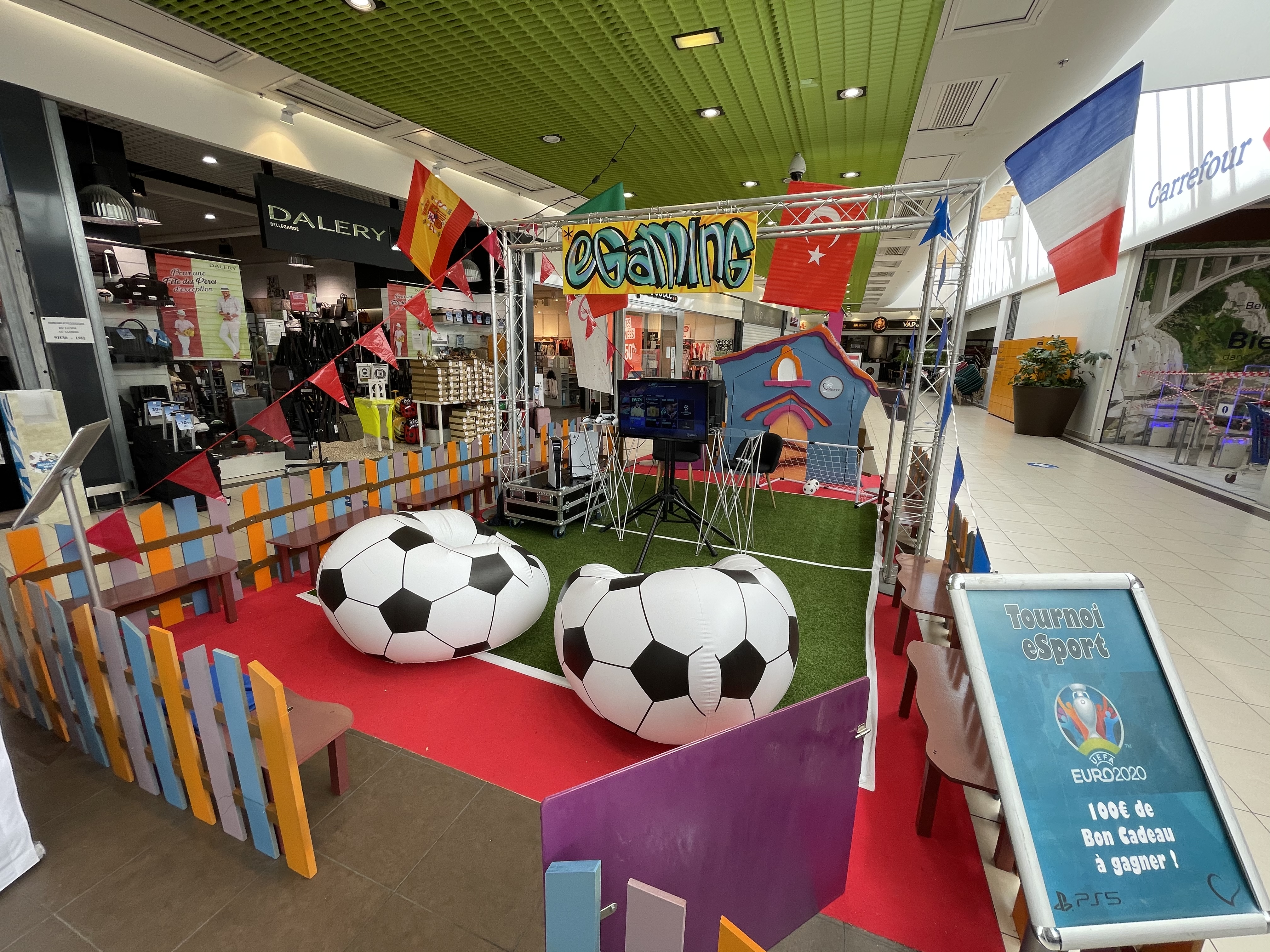
Soccer Simulator in Montréal for corporate events that drive participation
INNOV'events delivers Soccer Simulator activations across Montréal for corporate events from 30 to 600+ attendees. We manage logistics end-to-end: site check, load-in, staffing, safety perimeter, queue strategy, and scoreboard animation—so your team can focus on guests, not operations.
Whether it’s a holiday party, summer gathering, sales kickoff, or employer-brand activation, we build a reliable experience that works in real venues (ceiling limits, elevators, union rules, and downtown load-in windows included).
Sommaire
In a corporate event, entertainment is not “nice to have”—it’s a lever to move people from passive attendance to active participation. A Soccer Simulator creates measurable engagement (attempts, leaderboard, dwell time) and gives executives a simple way to reinforce culture: friendly competition, performance, and teamwork.
Organizations in Montréal expect professionalism: punctual load-in, bilingual hosting when needed, clean branding, and an activity that doesn’t hijack the evening. Most HR and Comms teams want something that energizes without risking safety, noise complaints, or chaotic lineups.
INNOV'events is on the ground in Montréal: we know freight elevator constraints, Old Port access realities, and how to run high-throughput activations in tight schedules. Our approach is operational first—clear plan, clear roles, and an experience your leadership can stand behind.
What you can expect from INNOV'events in Montréal
10+ years coordinating corporate entertainment and event logistics in Québec and Canada, with repeat clients who prioritize reliability.
30–600+ participants supported on Soccer Simulator in Montréal formats, from cocktail activations to multi-station tournaments.
1 lead producer + 2–4 on-site staff typical deployment to manage queue, briefing, safety perimeter, and results display—scaled based on volume and venue.
Load-in plans built around real constraints: downtown delivery windows, freight elevator access, parking limitations, and venue insurance requirements.
Montréal references and recurring collaboration
We support companies and institutions across Montréal that need predictable execution—especially when leadership is present and the brand is on display. Many of our mandates come back year after year because internal teams don’t want to “relearn” an agency each time: they want someone who already understands their room flow, their approval process, and what can’t go wrong on event day.
If you have internal stakeholders who require structured validation (HR, Legal, Health & Safety, brand team), we’re used to working with those checkpoints without slowing the timeline. We provide written operating notes (power, footprint, crowd control, risk controls), so your decision path is clear and defensible.
Note: if you want us to include specific client names as local references, share the list you authorize for publication and we will integrate them in a compliant way (logo and naming permissions included).
 Besoin d’un devis rapide ?
Nous vous envoyons une première proposition sous 24h.
Why choose a Soccer Simulator in Montréal for your teams
For executives, HR, and communications leaders, the question isn’t “Is it fun?”—it’s “What does it accomplish, and can we deliver it without operational risk?” A Soccer Simulator works because it’s simple to understand, quick to try, and easy to scale. It creates a shared talking point across departments without forcing people into a long commitment.
High participation in short time slots: a typical attempt takes 30–60 seconds, so you can run many participants per hour with the right queue design.
Inclusive engagement: you can offer “power shot” and “precision” modes so both sporty and non-sporty guests feel comfortable participating.
Employer brand and internal communications: scoreboard naming (teams, departments), branded backboard, and on-screen messaging make the activation work as a communications channel—not just a game.
Cross-team mixing: a leaderboard naturally sparks conversation between colleagues who rarely interact (operations vs. sales, HQ vs. field staff), especially at cocktail events.
Controlled risk profile: compared to many physical activities, the play zone can be clearly delimited with staff supervision and safety briefing, reducing incident exposure.
Measurable outcomes: participation count, top scores, and peak times can be shared post-event to support internal reporting and justify budget.
Montréal has a pragmatic business culture: events must be enjoyable, but also efficient and well-run. A Soccer Simulator in Montréal fits that reality—quick to onboard, easy to brand, and structured enough to satisfy leadership expectations.
What Montréal decision-makers expect on event day
In Montréal, operational details are often the difference between “a nice idea” and a successful corporate activation. We regularly see the same constraints: limited dock access downtown, strict load-in/load-out windows, noise considerations in mixed-use buildings, and venues that require proof of insurance and documented safety controls.
From an HR and communications perspective, the expectations are equally clear. You need an activation that:
- Starts on time and is ready before guests arrive (no cables visible, no last-minute testing in front of leadership).
- Works in bilingual environments when required—briefing, signage, and hosting can be adapted.
- Respects the venue (floor protection, wall clearance, no impacts outside the play zone).
- Does not create chaotic lineups that block bars, buffets, or emergency exits.
- Fits your culture: some companies want competitive tournament energy; others prefer a light, drop-in challenge with a small prize draw.
We plan for these realities upfront: site questions, flow mapping, staffing ratios, and a clear run-of-show so your internal team isn’t improvising under pressure.
What to pair with a Soccer Simulator in Montréal events
Entertainment performs best when it supports the event’s objective: retention, recognition, onboarding, client relationship building, or internal communications. A Soccer Simulator is a strong anchor, and we often pair it with complementary formats to balance energy, inclusion, and brand presence—especially in Montréal cocktail-style events where guests circulate.
Interactive animations in Montréal
Leaderboard challenge with time windows: run “power hour” segments (e.g., 19:00–19:45) to spread participation and avoid a single rush. Useful when speeches and awards must remain the program’s backbone.
Team bracket without the rigidity: instead of a long tournament, use short qualifiers and a final round with the top 6–10 scores. It creates a story without monopolizing the night.
Executive-friendly participation: we schedule a quick leadership round (pre-opening or early in the evening) so executives can participate without being pulled into the crowd. It signals approachability and drives uptake.
Art animations in Montréal
MC hosting and bilingual scripting: a professional host can connect the activation to your theme, values, or campaign language, and keep the pace consistent. In Montréal, bilingual delivery can be integrated without sounding forced.
Ambient DJ with controlled sound levels: we set volume targets and speaker placement so the simulator zone stays lively but doesn’t interfere with networking conversations.
Innovative animations in Montréal
“Stadium-style” snack station: practical in corporate venues—items that are easy to serve and eat while standing (e.g., pretzels, popcorn, mocktail bar). It supports the sports theme without turning into a full catering reinvention.
Post-challenge drink ticket: simple mechanic—participants get a token or ticket after their attempt. It smooths traffic between the activation and the bar and reduces idle waiting.
Gourmand animations in Montréal
Brand-safe photo moment: a clean branded backdrop near the simulator captures team photos after attempts. We keep it optional (no forced “photo line”) and position it to avoid congestion.
Data capture with consent: if the event includes recruitment or client activation, we can add opt-in QR capture tied to participation. We keep it compliant: clear consent language, minimal friction, and a defined data owner internally.
The best results come when the entertainment matches the company’s image and internal context. A financial institution may prioritize a polished, queue-managed challenge with discreet branding, while a tech employer brand event can lean into higher energy and gamified messaging. Our job is to align the activation to your standards—so it feels coherent, not bolted on.
Which Montréal venues work best for a Soccer Simulator
The venue shapes how your Soccer Simulator in Montréal is perceived: professional activation vs. cluttered corner. We evaluate ceiling height, clear sightlines, noise carry, access for load-in, and where the activity sits relative to bars, stages, and emergency exits. The goal is to create energy without blocking circulation.
| Venue type | For which objective? | Main strengths | Possible constraints |
|---|---|---|---|
Downtown hotel ballroom (Ville-Marie) | Holiday party, awards night, sales kickoff with structured program | Predictable AV infrastructure, staff support, controlled environment, easy to brand | Load-in windows, union/vendor rules, limited flexibility on rigging and placement |
Converted industrial venue (Griffintown / Saint-Henri) | Employer brand event, product launch, creative internal gathering | Large open footprint for safe play zone, strong visual impact, good for multi-activation layout | Power distribution planning required, acoustics can be loud, stricter neighbour/noise sensitivity |
Office atrium or headquarters common area (Montréal island) | Internal engagement day, wellness week, lunchtime activation | High participation because it’s on-site, minimal guest travel, strong internal visibility | Elevator access for equipment, floor protection, must maintain emergency corridors and building rules |
We recommend a short site visit (or a detailed virtual walk-through with photos and measurements) before finalizing. In Montréal, small constraints—like a narrow corridor to the freight elevator—can decide whether load-in takes 20 minutes or 90. A site check is the cheapest way to avoid day-of compromises.
What a Soccer Simulator costs in Montréal
Pricing for a Soccer Simulator in Montréal depends on the format you’re buying: simple rental vs. a fully managed activation with staff, branding, and throughput planning. For corporate clients, we budget based on risk control and guest experience—not just equipment.
As a realistic range, many corporate deployments land between $1,800 and $6,500 CAD before taxes. Smaller internal activations may sit below this range; multi-station setups with extended hours, branding, and higher staffing can exceed it.
Duration on site: a 2–3 hour activation is not the same cost structure as a full-day employer brand event with setup, peak period, and teardown.
Staffing level: one attendant can manage low volume; for 200–400 guests, we often recommend 2–3 staff to control queue, safety, and pacing.
Venue constraints: difficult load-in, long pushes, stairs, or strict time windows increase labour and planning. Downtown Montréal deliveries can require more coordination.
Branding and content: branded backboard, signage, on-screen visuals, and a structured “tournament story” add value but also production time.
Technical requirements: screens, sound reinforcement, or integration with your existing AV can be simple—or complex depending on the venue and your program.
Risk and compliance: insurance certificates, safety perimeter, floor protection, and documented operating procedures are often required by venues and corporate policies.
From an ROI perspective, the question is whether the activity increases participation and supports your objective (retention, recognition, internal comms). When the simulator is run with good throughput, you can engage a large share of attendees in a short window—often at a lower cost per interaction than many stage-based formats.
Why work with a Montréal event agency for this activation
When your event involves executives, clients, or a brand moment, you’re not buying a toy—you’re buying reliability. A locally established team reduces risk because we can validate realities quickly: access routes, venue rules, union constraints, last-minute weather impacts, and the availability of backup options.
As an event agency in Montréal, we also know how events actually move in this city: traffic patterns, parking limitations, where trucks can and can’t stop, and how to coordinate with venue operations teams so your internal stakeholders aren’t stuck mediating suppliers.
- Faster site validation: we confirm footprint, power, and flow early, which prevents late-stage compromises.
- Operational network: access to local technicians, staffing, and transport options to scale or replace quickly if constraints change.
- Realistic run-of-show integration: we align with your schedule (speeches, awards, meal service) so the simulator supports—rather than disrupts—the evening.
- On-site accountability: one responsible producer who coordinates venue, AV, catering, and entertainment in the same room, in real time.
From an ROI perspective, the question is whether the activity increases participation and supports your objective (retention, recognition, internal comms). When the simulator is run with good throughput, you can engage a large share of attendees in a short window—often at a lower cost per interaction than many stage-based formats.






Examples of Soccer Simulator formats used in Montréal
We adapt the Soccer Simulator to the type of corporate event and the internal dynamics—because the same setup does not work for every audience.
Holiday party in a downtown ballroom: the common challenge is that guests arrive in waves, then disappear into speeches, dinner, and awards. We position the simulator near the cocktail zone (not at the entrance), run it in two peak windows, and pause during keynote moments. The result is consistent energy without competing with the stage.
Employer brand activation in an industrial venue: here, the challenge is throughput and social content. We build a clean branded zone, add a clear rules board, and manage a short qualifier + final. HR gets high interaction volume; Comms gets controlled visuals that match brand guidelines.
On-site engagement day at HQ: the risk is disrupting work areas and building circulation. We coordinate with facilities to protect floors, keep corridors free, and run sign-up slots for departments. This format often delivers strong participation because people can try it in 5 minutes between meetings.
Common mistakes with Soccer Simulator rentals in Montréal
Underestimating space: placing the simulator in a tight corner creates safety issues and kills participation because people can’t watch comfortably.
No queue strategy: without pacing and a clear entry/exit path, the lineup blocks the bar or buffet and becomes a complaint channel.
Insufficient staffing: one person trying to brief, manage safety, reset, and hype will slow throughput and increase risk.
Ignoring venue access realities: downtown Montréal load-ins can be tight; arriving without a plan creates delays that cascade into your program.
Branding as an afterthought: slapping a logo somewhere rarely meets corporate standards. The visual zone must be planned so it looks intentional in photos and aligns with your brand rules.
Not aligning with internal policies: some companies need specific prize rules, alcohol-related restrictions, or accessibility considerations. We address this early to avoid last-minute changes.
Our role is to remove these risks before they touch your event day. That means asking the “annoying” questions early—space, power, access, staffing, and flow—so your leadership only sees a clean, controlled activation.
Why Montréal clients rebook INNOV'events
Recurring clients usually come back for one reason: they don’t want surprises. When a company invests in an internal event, the reputational cost of a technical issue or a safety incident is higher than the entertainment fee. We earn loyalty by being predictable, transparent, and operationally disciplined.
Planning documents delivered in advance: footprint, power needs, staffing plan, and a run-of-show integration note so stakeholders can approve with confidence.
On-site producer accountability: one point of contact who can make decisions quickly and coordinate with venue operations.
Post-event recap: participation volume, what worked, and what to adjust next time—useful for HR/Comms reporting and continuous improvement.

In practice, loyalty is proof of quality because it means your internal team is willing to put their name on the same partner again—often in front of the same executives.
Our production process in Montréal from quote to event day
👉 Montréal scoping call and decision-ready quote
We start with a short call focused on constraints: attendee count, venue type, timing, brand requirements, and the role of the activation (drop-in vs. structured challenge). You receive a clear quote with assumptions (hours on site, staffing, footprint, power) so procurement and leadership can validate quickly.
👉 Site validation and operational plan
We confirm practical elements: access route, loading dock rules, elevator dimensions, floor protection requirements, and power availability. We then lock the layout: play zone, spectator line, queue path, and where signage/screen will sit to avoid blocking service areas.
👉 Branding, messaging, and participation mechanics
We align on what guests will see and how they’ll participate: rules board wording, bilingual needs, team naming conventions, leaderboard approach, and prize mechanics that match your internal policy. If your Comms team needs approvals, we provide visuals and copy early.
👉 Event-day execution and real-time coordination
We arrive with a load-in schedule, set the safety perimeter, test the full flow, and brief staff on pacing. During the event, we manage throughput, guest experience, and any adjustments needed to respect speeches, service timing, and room density.
👉 Teardown and post-event recap
Teardown is planned to respect venue rules and minimize disruption. After the event, we can provide participation numbers, peak times, and recommendations for the next edition—useful when you need to justify budget and demonstrate engagement.
FAQ sur l'organisation Soccer Simulator à Montréal
How much space do we need in Montréal for a Soccer Simulator?
Plan for a dedicated zone of about 10' x 15' to 15' x 20' depending on the model and your desired buffer. We also recommend additional circulation space for a short queue so the line doesn’t block bars, buffets, or emergency exits.
How many participants per hour can we run in Montréal?
With a simple format (briefing + 3 shots), a well-staffed setup typically supports 40–80 participants per hour. Throughput depends mostly on queue control, reset time, and whether you’re running leaderboards or longer “tournament” rounds.
Can the Soccer Simulator be branded for Montréal corporate events?
Yes. We can integrate brand elements on the backboard/signage and align on-screen messaging with your guidelines. The key is to plan placement so branding appears clean in photos and doesn’t create visual clutter in the room.
Is a Soccer Simulator safe for a Montréal office event?
When properly zoned and staffed, the risk profile is controlled. We use a defined play perimeter, a short safety briefing, and floor/cable management. For office environments, we also coordinate with facilities to keep corridors clear and protect floors.
How early should we book in Montréal for peak dates?
For busy periods (holiday season and major summer Thursdays), we recommend booking 4–8 weeks in advance. For large events with venue constraints and branding approvals, 8–12 weeks is safer to secure time slots, staffing, and production alignment.
Request a Montréal quote with an operational plan you can approve
If you’re comparing agencies, we can make your decision easier: tell us your venue (or short list), date, attendee count, and what the activation must achieve (engagement, recognition, employer brand, client hosting). We’ll come back with a clear proposal for a Soccer Simulator in Montréal, including footprint, staffing recommendation, and a realistic schedule for load-in and operation.
For peak dates, early planning matters—especially downtown where access rules can tighten your setup window. Contact INNOV'events to lock a solution that is professional on the floor and easy to defend internally.
INNOV'events Montréal Agency
Thierry GRAMMER is the manager of the INNOV'events Montréal office. Reach out directly by email at canada@innov-events.ca or via the contact form.
Contact the Montréal agencyToutes nos prestations & animations Montréal, Quebec
Découvrez nos prestations événementielles
- Employee Party in Montréal
- Corporate Christmas Party in Montréal
- Networking Cocktail Event in Montréal
- Shopping Mall Activation in Montréal
- Grand Opening Event in Montréal
- Product Launch Event in Montréal
- Open House Event in Montréal
- Field Brand Activation in Montréal
- Event Catering Service in Montréal
Découvrez nos animations événementielles disponibles au Quebec
- Event Hostess in Montréal
- Escape Game in Montréal
- MasterChef-Style Cooking Workshop in Montréal
- Corporate Magician in Montréal
- Tent Rental in Montréal
- Color Analysis Workshop in Montréal
- Inflatable Games in Montréal
- Valet Service in Montréal
- Soccer Simulator in Montréal
- LED Furniture Rental in Montréal
- LED Branding Activation in Montréal
- Immersive Culinary Experience in Montréal
- Light Painting Activity in Montréal
- Immersive Mystery Night in Montréal
- Promotional Contest in Montréal
- Promotional Materials (POS) in Montréal
- Virtual Reality Experience in Montréal
- Molecular Gastronomy Workshop in Montréal
- Halloween Event in Montréal
- Fireworks Show in Montréal
- Sports Challenge – Giant Games in Montréal
- Professional Event Host in Montréal
- Photo Booth Animation in Montréal
- Santa Claus Appearance in Montréal
- Kids Entertainment in Montréal
- Guided Tour in Montréal
- Urban Rally in Montréal
- Ball Pit Activity in Montréal
- Flight Simulator in Montréal
- Food Truck Rental in Montréal
- World Record Attempt in Montréal
- Surf Simulator in Montréal
- Soccer Simulator in Montréal
- Wine Casino in Montréal
- Makeover Workshop in Montréal
- Perfume Creation Workshop in Montréal
- Acting Workshop in Montréal
- CSR Activities in Montréal
- Archery Activity in Montréal
- Event Security Guard in Montréal
- Wine Tasting Workshop in Montréal
- Mime Performance in Montréal
- TV Game Show Animation in Montréal
- Funfair Event in Montréal
- Crisis Management Workshop in Montréal
- Crisis Negotiation Workshop in Montréal
- Arcade Games in Montréal
- Indoor Skydiving Simulator in Montréal
- Ski Simulator in Montréal
- Racetrack Driving Experience in Montréal
- Introductory Flight Experience in Montréal
- Tasting Experience in Montréal
- Build Your Own Foosball Workshop in Montréal
- 2CV Rally in Montréal
- LEGO Challenge in Montréal
- Casino Night in Montréal
- Interpreter / Translator in Montréal
- Promotional Merchandise in Montréal
- Shuttle / Transportation Service in Montréal