
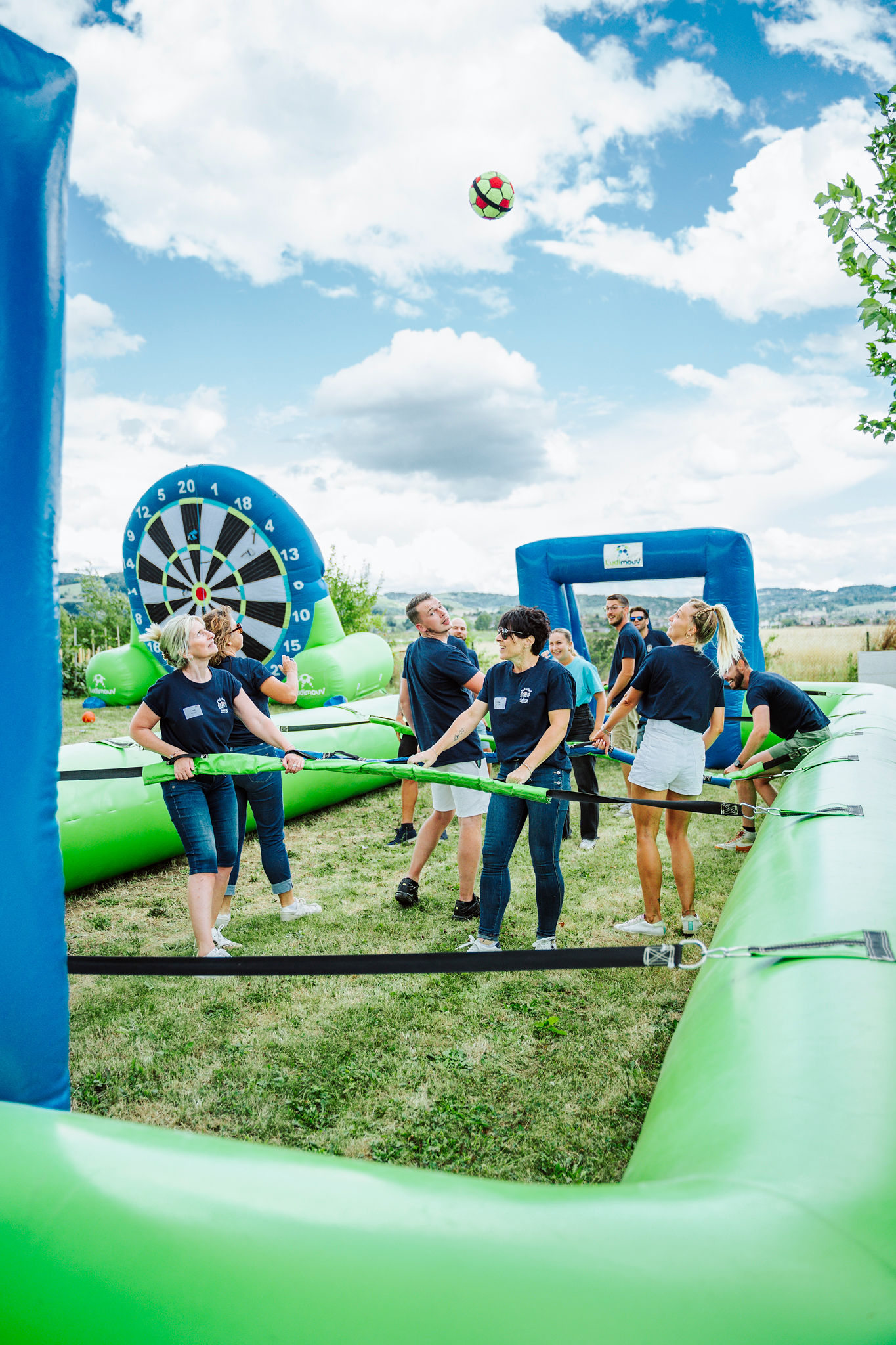
Inflatable Games in Quebec for corporate events that run on time and on brand
INNOV'events is a Montréal-based event agency delivering Inflatable Games for corporate teams across Quebec, from 30 to 2,000+ participants. We manage planning, delivery, set-up, staffing, safety checks, crowd flow and teardown—so your team stays focused on the agenda and the employee experience.
Whether it’s a summer party, a family day, a wellness activation or a team challenge, we design the inflatable zone like an operational department: schedule, risk control, and measurable participation.
Sommaire
In a corporate event, entertainment isn’t “nice to have”; it’s the lever that converts attendance into participation. Done properly, Inflatable Games in Quebec create visible energy in the room, reduce social friction between departments, and give HR and Comms concrete moments to amplify internally.
Organizations here expect zero improvisation: bilingual signage, strict respect of venue rules, realistic timing for set-up in urban sites, and a professional attitude with employees and families. In Quebec, one safety or noise issue can damage credibility faster than any branding can repair.
Our team works week-in/week-out on corporate sites, convention centres, parks and arenas across the province. We bring local supplier relationships, weather-ready planning, and field-tested operations that executives appreciate because the day runs cleanly.
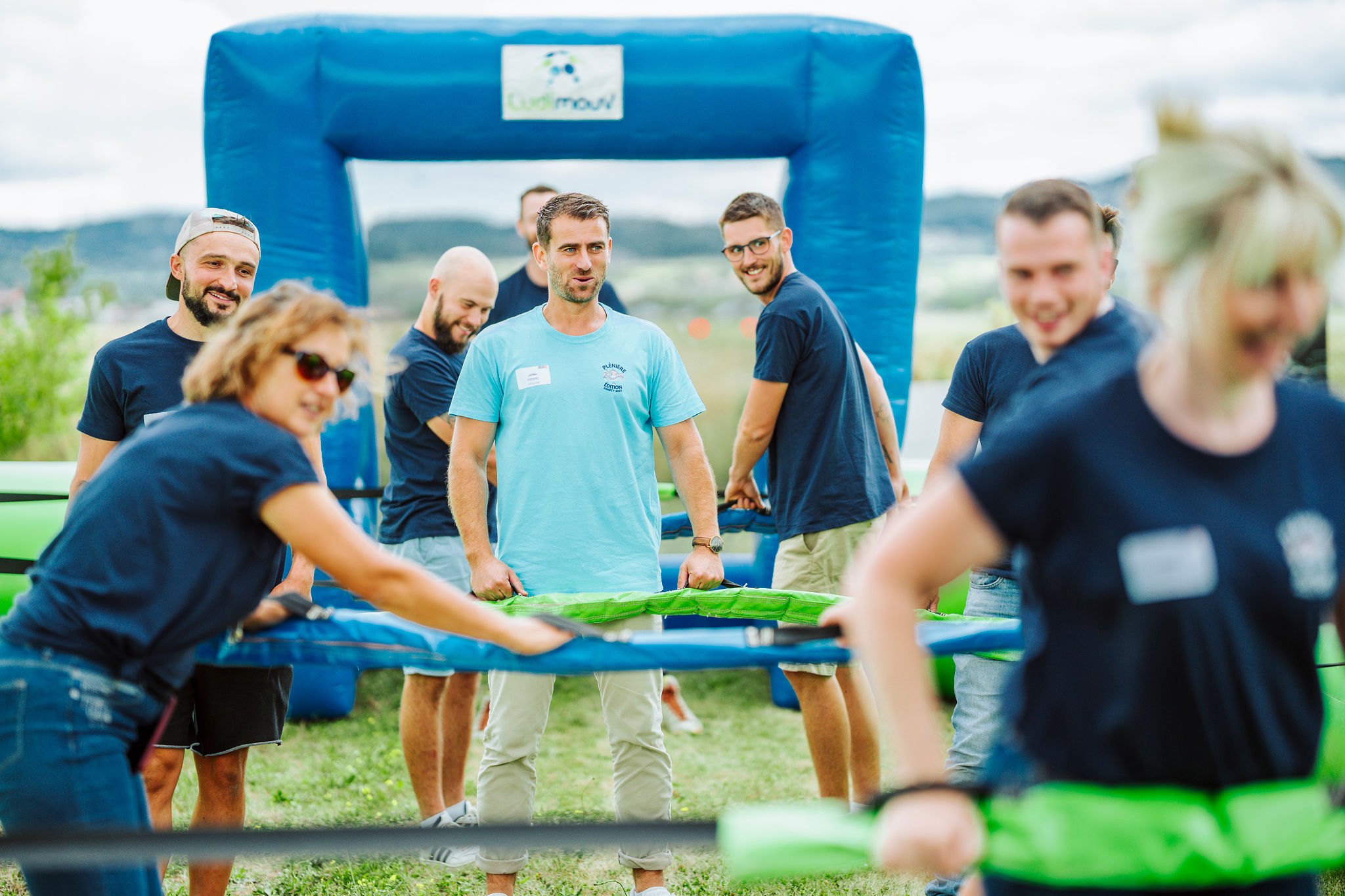
Operational benchmarks for Inflatable Games in Quebec
10+ years supporting corporate activations and employee events across Quebec (planning, logistics, and on-site production).
Typical deployment capacity: 1 to 20+ inflatable units in one event, with structured zoning (kids/family, teens, adult challenge, quiet areas).
Audience formats handled regularly: 30 to 2,000+ participants, including staggered participation plans to avoid lineups.
On-site structure: 1 lead producer + safety lead + attendants per zone, with radio comms and incident logging when required by the venue.
Who we support in Quebec year after year
INNOV'events supports organizations across Quebec that need reliable execution, not “one-off entertainment.” Many of our corporate clients book recurring formats—summer party, back-to-school family day, holiday celebration, plant open house—because once the internal stakeholders see how much coordination goes into inflatables (power, access routes, floor protection, staffing ratios, weather plans), they prefer to keep the same partner.
If you have internal references you want highlighted (business units, brands, or sites), we integrate them in a way that respects your approval process and brand standards. In practice, what convinces executive teams is consistency: the same site rules respected each year, the same safety discipline, and the same predictable schedule so operations, HR and comms don’t lose time.
 Besoin d’un devis rapide ?
Nous vous envoyons une première proposition sous 24h.
Why Quebec companies use inflatable games to move culture forward
For HR and leadership, a corporate event is one of the rare moments where culture becomes visible. Inflatable Games are effective when they’re positioned as a participation engine: they attract people early, keep them on-site longer, and create shared experiences that cut across hierarchy—without forcing anyone into a “team-building workshop.”
Stronger attendance and punctuality: when the inflatable zone opens at a set hour, employees show up on time and families plan around it—useful for sites where you need a controlled flow (shift workers, multiple entrances).
Cross-department mixing without awkwardness: a timed obstacle course or relay format gives people an easy reason to interact—especially between corporate and operations teams who don’t usually share social space.
A safe way to include families: a properly zoned inflatable plan (toddlers/6–12/teens/adults) reduces conflicts and lets parents participate instead of “supervising in stress.”
Content that your Comms team can actually use: branded photo backdrops near inflatables, medal moments, leaderboards, and short challenge clips create internal content without staging fake scenes.
Wellness + engagement: active entertainment increases movement and keeps people away from purely food-centric gatherings; it’s a concrete support to wellness objectives without turning the event into a health campaign.
Better control of crowd energy: instead of everyone rushing the bar or buffet at once, inflatables create “distributed interest,” which reduces queues and helps venues maintain service quality.
Quebec has a pragmatic business culture: people notice when execution is tight and respectful of site reality. When inflatables are handled professionally, they become a simple, credible way to reinforce culture—without adding operational headaches to your internal team.
What changes when you plan Inflatable Games in Quebec (QC)
Planning in Quebec is not the same as planning “anywhere.” We deal with real constraints that corporate decision-makers care about: unpredictable weather windows, strict municipal rules in parks, venue load-in schedules, and the operational rhythm of industrial and office sites.
For Montréal and surrounding areas, access and timing are often the main risk: elevators, dock reservations, restricted truck parking, and tight set-up windows because a space is used for business until a specific time. In Québec City and other urban cores, heritage sites and public spaces can impose additional limitations (noise, anchoring methods, pedestrian corridors).
Language and brand perception are also local realities. Many organizations require bilingual participant instructions, and you want staff who can speak to employees and families naturally—especially when a safety reminder must be understood immediately. We plan signage, scripts and briefing notes in English and French when needed, with clear safety wording and no ambiguous “fun first” messaging.
Finally, we build around how people actually show up: family days in Quebec often have a high participation rate from children; corporate-only events tend to see peaks right after speeches or meal service. We schedule inflatable access accordingly (staggered heats, time slots, or open play), because the best inflatable program is the one that doesn’t create 45-minute lineups and frustrated employees.
Which Inflatable Games formats work best for Quebec corporate teams?
Inflatable Games in Quebec work when the entertainment format matches your audience and your business context. A factory open house does not need the same intensity as a tech company’s summer party. We structure options by engagement style so you can choose based on participation goals, risk tolerance, and time available.
Interactive animations in Quebec
Timed obstacle course (duels or heats): ideal for corporate challenges. We can run 2-lane races with a scoreboard, short heats (30–60 seconds) and a clear rotation so queues stay reasonable.
Inflatable sports (soccer, basketball, archery tag-style ranges): great when you want repeat participation without fatigue. Works well in mixed fitness groups and encourages friendly competition between departments.
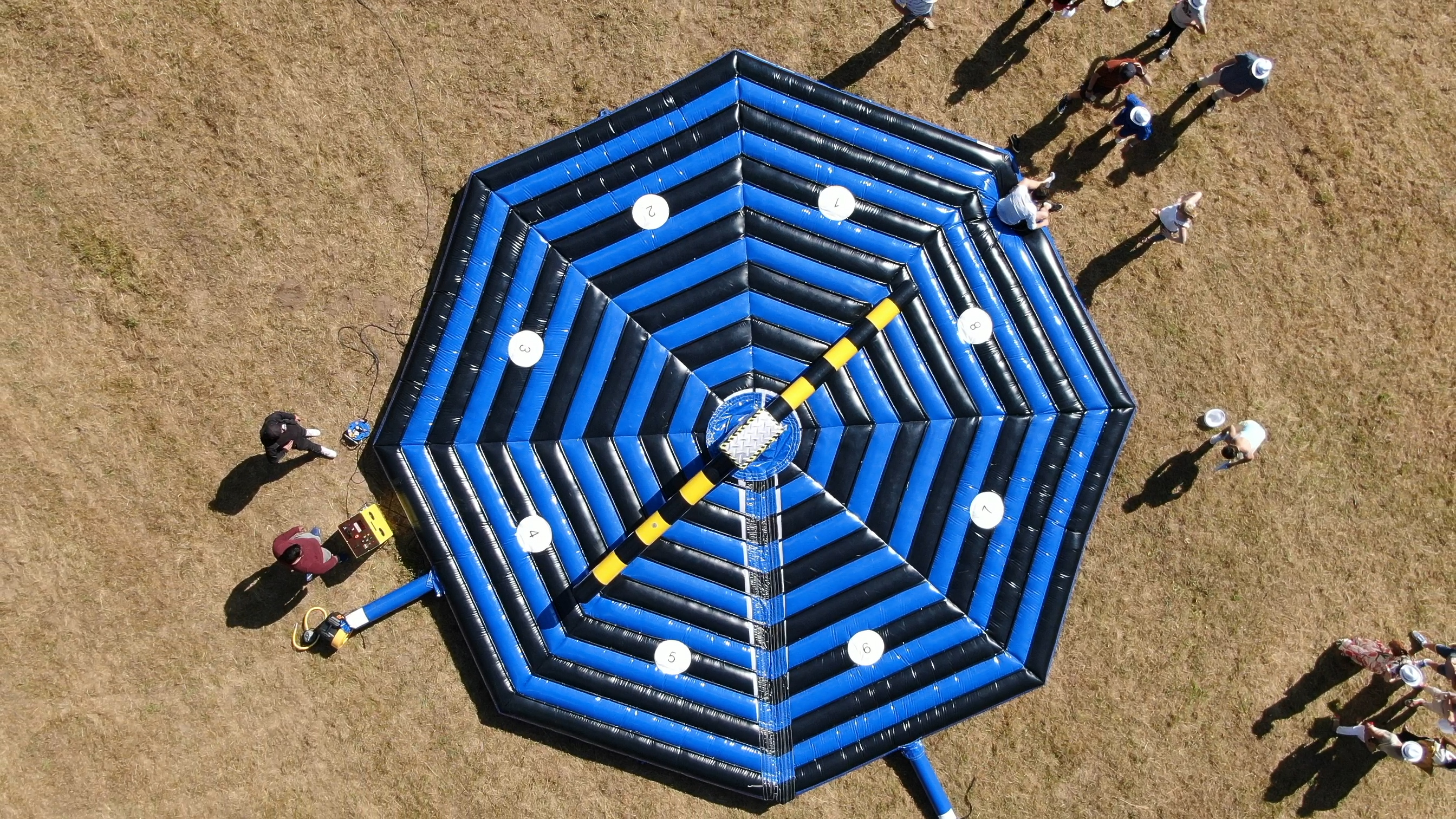
Wipeout-style sweeper challenge: high engagement but needs controlled capacity and an attendant who manages turns firmly. Recommended for adult-only or teen+ zones with clear rules.
Team relay circuits: structured for HR objectives (cross-functional mixing). We design teams, rotation timing, and “no-contact” rules to keep it inclusive.
Art animations in Quebec
Emcee + DJ coordination: the inflatable zone becomes a programmed area with cues (heat starts, awards, safety reminders). This reduces chaos and improves perception for executives.
Photo ops near the inflatables: branded step-and-repeat or a company-value wall placed at the exit of the obstacle course captures the “I did it” moment—content your Comms team can publish.
Micro-awards ceremony: short, controlled recognition moments (fastest time, best team spirit, safest play) that add meaning without turning into a long show.
Innovative animations in Quebec
Hydration + recovery station: water, electrolyte options, and shade seating placed strategically near high-intensity inflatables to prevent fatigue issues—important on hot Quebec summer days.
Snack timing to control queues: we schedule food service waves around challenge heats to avoid everyone leaving the activity at once.
Family-friendly treats: options like popsicles or fruit cups work better than messy items near inflatables, reducing slips and cleaning incidents.
Gourmand animations in Quebec
RFID or QR participation tracking: useful for large sites where HR wants participation data by department while respecting privacy constraints (opt-in). This helps justify budget and improves future planning.
Safety-first wristband system: simple colour coding by age/zone to enforce the right access quickly without constant disputes.
Hybrid programming: inflatables + indoor interactive games as a weather hedge (especially in shoulder seasons in Quebec).
Whatever the mix, we align the inflatable program with your brand image: clean visual layout, professional signage, staff presentation, and rules that protect people and reputation. Corporate event entertainment in Quebec has to look controlled—because your employees and leadership notice when it isn’t.
Where to install Inflatable Games in Quebec: choosing the right venue type
The venue determines what you can safely install, how fast you can load in, and how “corporate” the experience feels. We select venue types based on surfaces, access, power, and your audience profile—because the wrong venue creates hidden costs (extra staff, longer queues, compromised safety).
| Venue type | For which objective? | Main strengths | Possible constraints |
|---|---|---|---|
Corporate parking lot or yard (on-site) | Employee engagement on a worksite; easy access for shift workers | High attendance, minimal transportation, strong employer-brand signal on operations sites | Surface condition, traffic control, noise considerations, power distribution planning |
Municipal park in Quebec | Family day with high child attendance; picnic-style event | Natural flow, room for zoning, good perception for families | Permits, public access management, anchoring rules, weather exposure |
Indoor arena / sports complex | All-weather solution; predictable schedule; large crowd control | Stable conditions, clear entrances/exits, strong safety control | Ceiling height and door widths, floor protection, load-in time slots |
Convention centre or event hall (urban) | Corporate day with presentations + activity zone | Professional environment, AV integration, predictable services | Strict rigging/anchoring rules, dock scheduling, higher venue costs |
We strongly recommend a site visit (or at minimum a technical call with photos, measurements and access notes). In our field experience, most “event day problems” with inflatables in Quebec come from assumptions about doors, power, or surfaces—issues that are cheap to validate early and expensive to fix last minute.
What does Inflatable Games pricing look like in Quebec (QC)?
In Quebec, the cost of Inflatable Games is driven by logistics and risk control as much as by the number of units. Two events with “the same inflatables” can have very different budgets depending on access, staffing, power distance, and operating hours.
Number and type of inflatables: basic bouncers vs. multi-lane obstacle courses, large slides, or mechanical/interactive challenges.
Duration (service hours): a 3-hour activation is not staffed the same way as a full afternoon with staggered attendance.
Staffing ratio: attendants per unit/zone, plus a safety lead and a producer for corporate standards (radio comms, incident protocol, client liaison).
Power and distribution: proximity to panels, need for additional cabling, cable protection, or generators in remote areas.
Venue constraints: dock reservations, tight load-in windows, floor protection, restrictions on anchoring, and required insurance documents.
Transportation across Quebec: distance, vehicle type, and timing (early arrival requirements, overnight storage rules).
Weather contingency: additional indoor backup activities or tenting options when the program can’t simply be “cancelled.”
Branding and communication: signage, wristbands, bilingual instructions, and any leaderboard/photo activation that supports internal comms.
Executives often ask about ROI. The practical way to measure it is participation and dwell time: how many employees actually engaged, for how long, and how the event supported your employer brand. With the right structure, corporate event entertainment in Quebec becomes a measurable engagement tool—not just an expense line.
Why choose an event agency in Quebec for inflatable deployments
Inflatables look simple until you run them inside real corporate constraints: permits, weather calls, safety communication, tight schedules, and the expectation that everything will look professional for leadership and families. Working with an event agency in Quebec reduces operational risk because we understand local venues, suppliers, and the practical realities of production here.
We also coordinate easily with your internal teams (HR, Comms, Facilities, OHS) and your existing vendors. For organizations with sites outside Montréal, we can align regional realities without reinventing the wheel. If your event is specifically in the Capitale-Nationale area, you may also want to see our resource page for event agency in Quebec to understand how we operate locally.
- Faster approvals: we know what venues and municipalities typically request (insurance, site plans, anchoring methods, emergency access) and we prepare documents accordingly.
- Weather realism: local judgment on wind exposure, ground conditions and seasonal patterns, with clear go/no-go protocols.
- Staff that fits your audience: bilingual, corporate-appropriate, and trained to enforce rules without creating friction.
- Better vendor coordination: AV, catering, security and facilities coordination so your inflatable zone doesn’t conflict with other critical services.
Executives often ask about ROI. The practical way to measure it is participation and dwell time: how many employees actually engaged, for how long, and how the event supported your employer brand. With the right structure, corporate event entertainment in Quebec becomes a measurable engagement tool—not just an expense line.




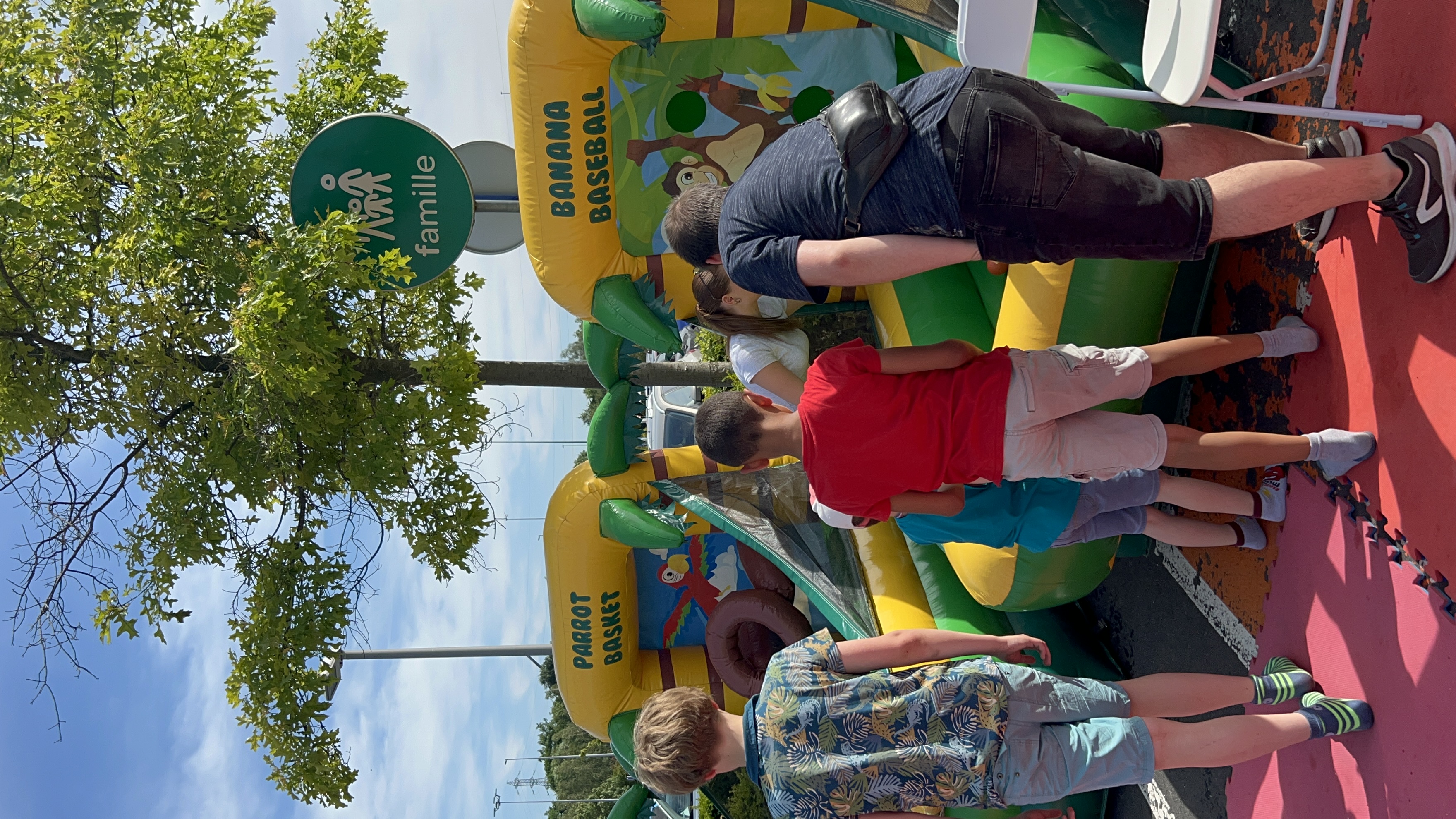
Examples of Inflatable Games setups delivered across Quebec
We regularly deliver inflatable zones for corporate summer parties, plant family days, and milestone celebrations across Quebec. The projects vary widely, and that’s exactly where agency value shows: the solution is not the same when you’re on an industrial site with strict safety corridors versus a public park with permit conditions and open pedestrian traffic.
Example 1: On-site family day for a multi-shift operation. The priority was to respect production constraints while still giving families a real event. We designed two attendance waves, placed inflatables to keep emergency access open, implemented wristbands by zone, and scheduled a controlled shutdown that matched shift changes.
Example 2: Corporate summer event with leadership visibility. HR wanted engagement without the optics of a “kids-only fair.” We added an adult challenge circuit with timed heats and a short awards moment, plus a calm family area and a photo point. The result was balanced participation: executives played, employees played, and parents weren’t stuck supervising all day.
Example 3: Urban venue with strict load-in and limited power. The success factor was technical planning: mapping circuits, prioritizing units with the best throughput per square foot, and building a queue plan that didn’t block service areas. We kept the event on schedule without last-minute compromises that would have been visible to attendees.
Common mistakes Quebec organizations make with inflatable games
Underestimating power needs: relying on “whatever outlets exist” leads to tripped breakers and downtime. We map circuits and protect cables to avoid incidents.
Choosing units based on photos instead of throughput: some inflatables look impressive but process too few participants per hour, creating long lines and frustration.
No zoning by age/energy level: mixing toddlers with teens or adults causes conflicts and increases risk. We design clear zones and signage.
Weak staffing plan: one attendant trying to manage multiple units is not realistic. Proper supervision is what keeps the activity safe and professional.
Ignoring weather thresholds: waiting until conditions are unsafe creates reputational risk. We plan clear shutdown rules and backup options.
Forgetting brand optics: messy cables, unclear rules, or staff who don’t communicate well undermines your employer brand in a single afternoon.
Our role is to prevent these risks before they touch your event day. That’s what executives pay for: predictable execution, controlled safety, and a program that supports the organization’s image in Quebec.
Why Quebec HR teams rebook inflatable events with the same partner
Client loyalty in corporate events is rarely emotional—it’s operational. Teams come back when they can predict outcomes: fewer internal meetings, fewer last-minute surprises, and an event day where leadership sees professionalism.
Rebook drivers we hear most in Quebec: easier internal approvals (documentation already aligned), repeatable site plans, and consistent staffing quality.
Operational value: once a site is mapped (access, power, surfaces, rules), future editions typically require fewer hours from your Facilities and OHS teams.
Communication value: when the program runs cleanly, Comms can plan content capture and messaging instead of reacting to issues.

Loyalty is a proof point: when organizations renew an inflatable program, it’s because the agency reduced risk and workload while delivering participation at scale—exactly what decision-makers in Quebec need.
How INNOV'events manages Inflatable Games production in Quebec
👉 Quebec needs assessment and risk review
We start with your constraints: audience size, audience mix (employees/families), event objective (engagement, recognition, recruitment, open house), and your internal approval context (HR, Facilities, OHS, Comms). We confirm whether the inflatable zone must be “drop-in” or programmed with time slots, and we identify reputational sensitivities (executive presence, client guests, media).
👉 Site validation and technical plan
We validate dimensions, surfaces, access routes, ceiling height (indoor), and load-in constraints. Then we produce a practical plan: unit placement, zoning, queue direction, safety perimeter, and power mapping. If the venue requires it, we provide a site plan and operational notes for approval.
👉 Programming and participant flow design
We design how people will actually use the inflatables: open play vs. timed heats, wristbands by zone, staffing points, and a schedule that coordinates with speeches, meal service and other activities. The goal is simple: high participation without bottlenecks.
👉 Staffing, briefing and on-site management
We assign an on-site lead who is your single point of contact. Staff are briefed on safety rules, communication standards, and escalation paths. We manage set-up, checks, opening, operations, and teardown with a professional rhythm—because in corporate settings, “calm control” is part of the experience.
👉 Contingency planning and post-event debrief
We confirm weather thresholds and backup scenarios (especially outdoors in Quebec). After the event, we debrief what worked, peak times, and improvements for next year—useful for HR reporting and budget planning.
FAQ sur l'organisation Inflatable Games à Quebec
How many people can use inflatables per hour in Quebec?
As a practical range, plan 60–150 participants/hour per high-throughput unit (like a 2-lane obstacle course) and 25–60/hour per standard bouncer, depending on age mix, rules, and staffing. For 500+ attendees, we usually recommend multiple units plus a timed-heat structure to avoid lineups.
Do Inflatable Games in Quebec require permits or insurance?
Often yes. Public parks and many venues in Quebec typically require proof of liability insurance, a site plan, and compliance with their safety rules (anchoring, noise, emergency access). We coordinate what’s needed with the venue/municipality and provide the documentation package.
What wind or rain conditions stop outdoor inflatables in Quebec?
Exact thresholds depend on the unit and site exposure, but wind is the main driver. We define a clear shutdown threshold with the venue in advance and apply a conservative approach. If weather is uncertain, we recommend an indoor backup activity plan so the event can continue without forcing unsafe decisions.
How much space do corporate inflatables need in Quebec?
As a planning baseline: allow 500–1,500 sq ft for a small zone (1–3 units) and 2,000–6,000+ sq ft for a medium to large zone with queues and safety perimeters. We confirm final footprints after site validation because access lanes and required clearances vary by venue.
How far in advance should we book inflatables in Montreal?
For summer peak dates in Montréal and across Quebec, book 6–10 weeks ahead for standard setups and 10–16 weeks for large events (multiple units, permits, complex venues). Last-minute is possible sometimes, but choice of units and staffing flexibility will be limited.
Request a Quebec quote with a clear plan, not guesswork
If you’re comparing agencies, we can help you make the decision based on operational facts: site feasibility, staffing ratio, throughput, safety plan, power requirements and a realistic schedule. Send us your date, location in Quebec, estimated attendance, and whether families are invited. We’ll come back with a structured proposal for Inflatable Games in Quebec that protects your brand, your people, and your timeline.
For best results, contact us early—especially for summer dates—so we can validate the site, lock the right equipment, and build a participation plan that your HR and leadership teams can approve with confidence.
INNOV'events Quebec Agency
Thierry GRAMMER is the manager of the INNOV'events Quebec office. Reach out directly by email at canada@innov-events.ca or via the contact form.
Contact the Quebec agencyToutes nos prestations & animations Quebec, Quebec
Découvrez nos prestations événementielles
Découvrez nos animations événementielles disponibles au Quebec
- Event Hostess in Quebec
- Escape Game in Quebec
- MasterChef-Style Cooking Workshop in Quebec
- Corporate Magician in Quebec
- Tent Rental in Quebec
- Color Analysis Workshop in Quebec
- Inflatable Games in Quebec
- Valet Service in Quebec
- Soccer Simulator in Quebec
- LED Furniture Rental in Quebec
- LED Branding Activation in Quebec
- Immersive Culinary Experience in Quebec
- Light Painting Activity in Quebec
- Immersive Mystery Night in Quebec
- Promotional Contest in Quebec
- Promotional Materials (POS) in Quebec
- Virtual Reality Experience in Quebec
- Molecular Gastronomy Workshop in Quebec
- Halloween Event in Quebec
- Fireworks Show in Quebec
- Sports Challenge – Giant Games in Quebec
- Professional Event Host in Quebec
- Photo Booth Animation in Quebec
- Santa Claus Appearance in Quebec
- Kids Entertainment in Quebec
- Guided Tour in Quebec
- Urban Rally in Quebec
- Ball Pit Activity in Quebec
- Flight Simulator in Quebec
- Food Truck Rental in Quebec
- World Record Attempt in Quebec
- Surf Simulator in Quebec
- Soccer Simulator in Quebec
- Wine Casino in Quebec
- Makeover Workshop in Quebec
- Perfume Creation Workshop in Quebec
- Acting Workshop in Quebec
- CSR Activities in Quebec
- Archery Activity in Quebec
- Event Security Guard in Quebec
- Wine Tasting Workshop in Quebec
- Mime Performance in Quebec
- TV Game Show Animation in Quebec
- Funfair Event in Quebec
- Crisis Management Workshop in Quebec
- Crisis Negotiation Workshop in Quebec
- Arcade Games in Quebec
- Indoor Skydiving Simulator in Quebec
- Ski Simulator in Quebec
- Racetrack Driving Experience in Quebec
- Introductory Flight Experience in Quebec
- Tasting Experience in Quebec
- Build Your Own Foosball Workshop in Quebec
- 2CV Rally in Quebec
- LEGO Challenge in Quebec
- Casino Night in Quebec
- Interpreter / Translator in Quebec
- Promotional Merchandise in Quebec
- Shuttle / Transportation Service in Quebec