
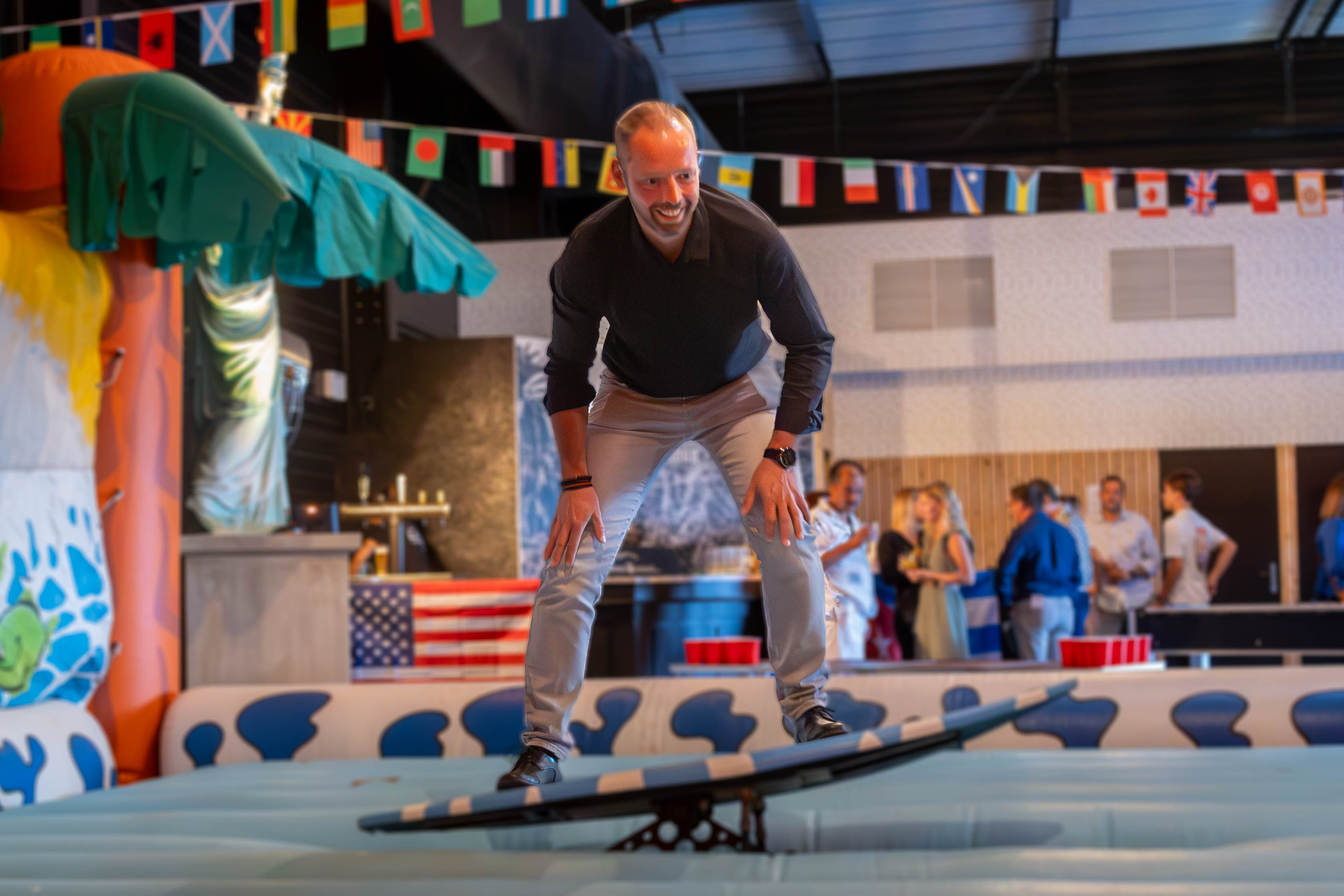
Surf Simulator in Montréal for corporate events that need real engagement
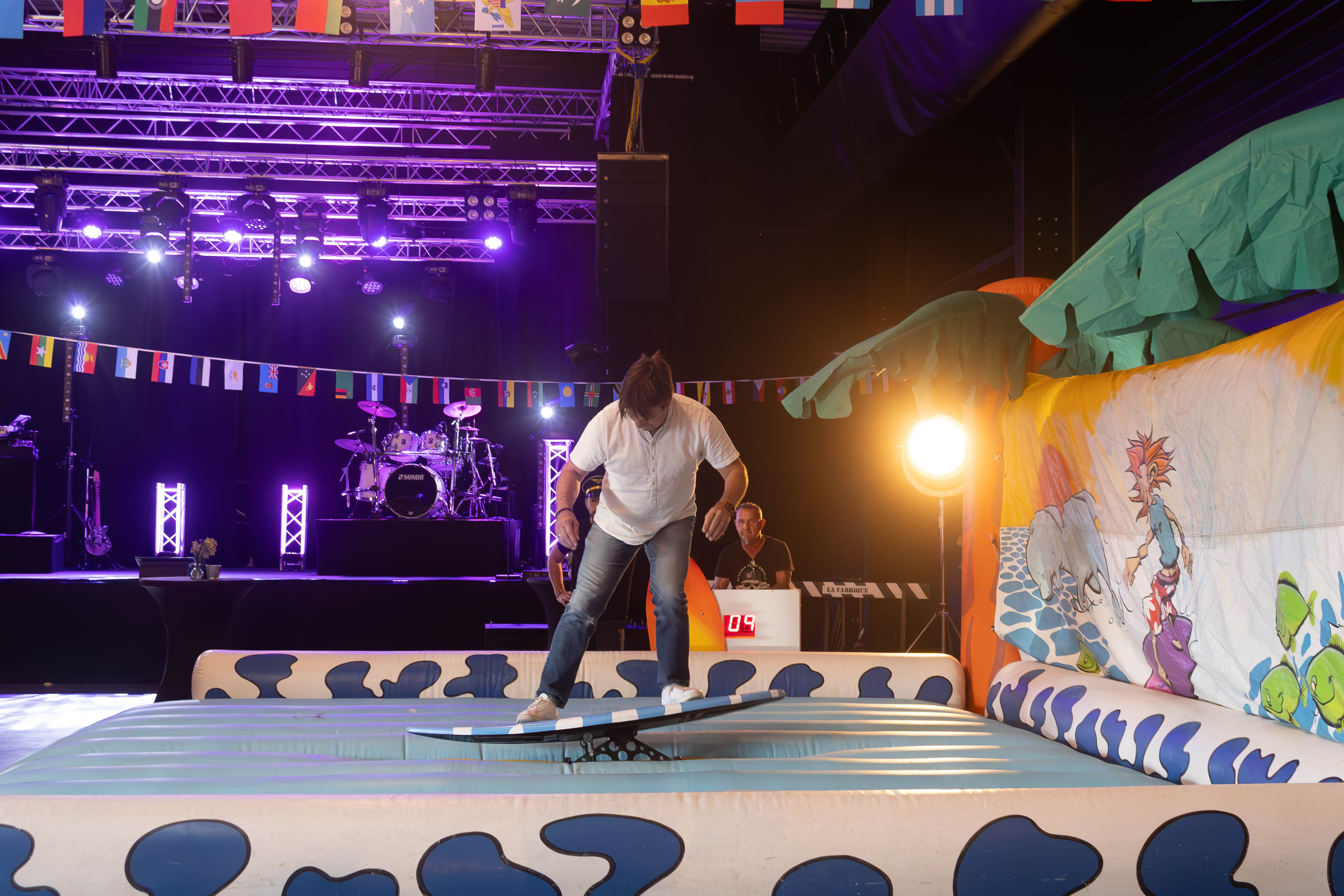
INNOV’events deploys a Surf Simulator for corporate events across Montréal, typically for 50 to 1,500 attendees. We manage the operational reality: venue validation, load-in, safety perimeter, staffing, timing, and guest flow—so your team stays focused on the program and stakeholder experience.
Whether it’s a holiday party, leadership offsite, product moment, or an internal culture event, we integrate the activation into your run of show and your brand standards, with clear deliverables and decision-ready options.
Sommaire
In a corporate event, entertainment is not “extra”—it’s a tool to manage attention, networking, and energy. A well-run Surf Simulator creates a structured reason for people to gather, talk, and stay on-site longer, which directly supports your objectives (retention, employer brand, leadership visibility, or client hospitality).
In Montréal, organizations expect flawless logistics: bilingual guest handling, tight schedules, strict venue rules (noise, access, insurance), and a professional look that matches the brand. If the activation causes line-ups, safety doubts, or delays in speeches, it becomes a liability—so the execution standard must be corporate-grade.
INNOV’events is an event partner rooted in Montréal. We plan around local constraints (downtown freight elevators, Old Port access windows, winter load-ins, unionized venues) and we bring the field experience to keep the simulator fun, safe, and on time.
Key numbers teams in Montréal ask for before approving
10+ years supporting corporate events with technical entertainment and on-site coordination.
Typical deployment capacity: 50–1,500 guests depending on event format, venue access, and time windows.
Operational staffing: 2–4 operators per simulator setup (recommended) plus optional host/MC for line management.
Throughput planning: 18–35 riders/hour (realistic range) depending on ride settings, briefing time, and photo moments.
Safety planning standard: defined perimeter, waiver signage (if required), and documented operating rules aligned with venue and insurer expectations.
Montréal delivery culture: repeat clients and predictable execution
In Montréal, many corporate event decisions are made with limited time and high reputational exposure: HR wants zero incidents, Communications wants brand control, executives want the room energized without losing the agenda. That’s exactly why a portion of our clients renew year after year—because they know what they’ll get on event day: clear prep, clean setup, and accountable on-site leadership.
We regularly operate in the same local ecosystem as our clients: downtown towers, the Griffintown corridor, the Plateau creative hubs, the airport area, and the West Island business parks. When teams ask us “Will it actually fit in that ballroom?” or “Can you load-in after 5 p.m. because our office is still operational?”, we answer based on field realities: elevator dimensions, dock bookings, security check-in, and the true time needed to test the unit before doors open.
If you share your venue, date, guest profile, and any union/security constraints, we’ll confirm feasibility quickly and propose a format that respects Montréal operating standards—without surprises on the invoice or the schedule.
 Besoin d’un devis rapide ?
Nous vous envoyons une première proposition sous 24h.
Why choose a Surf Simulator for a Montréal corporate event?
A Surf Simulator in Montréal works when you need an activation that is visible, easy to understand, and naturally social. It gives people something to do together (watch, cheer, film, compare scores) without forcing participation. For leaders, it’s a practical lever: it creates movement and conversation across silos without adding another speech.
Stronger networking density: people gather around the activation, which increases “collision points” between departments and guests—useful for offsites, integration events, and client receptions.
Energy control in the room: the simulator becomes a rhythmic anchor. We can position it to open the evening, bridge a cocktail gap, or bring energy back after a plenary session.
Employer brand and culture: when HR wants an event that feels modern but still professional, the simulator provides a clear “we invest in experience” signal—especially when paired with branded signage and a structured challenge format.
Content that Communications can use: high-quality photos/video are easy to capture because the action is predictable and centralized. We can plan lighting and a branded backdrop so content is immediately usable internally.
Measurable participation: rider counts, peak-time analysis, and optional leaderboard formats provide simple reporting that helps justify budget choices after the event.
Inclusive design options: we can implement cheering zones, photo moments, and “team heat” formats so guests who don’t ride still feel part of the activation.
Montréal has a strong culture of experiential events—tech, finance, pharma, aerospace, creative industries—where the bar is high for execution and aesthetics. The simulator fits that culture when it’s deployed with discipline: safety, flow, and branding aligned to your standards.
What Montréal venues and corporate stakeholders expect from the setup
Local success is rarely about the device alone—it’s about how it behaves inside a venue with strict operating rules. In Montréal, we often see constraints like limited dock time, mandatory security escorts, service elevators with narrow clearances, and venue policies that require certificates of insurance and detailed risk controls. A Surf Simulator must be planned as a technical activation, not a simple rental.
From the corporate side, executives want a clean “no-friction” experience: the line cannot block the bar, the sound level cannot overpower speeches, and the activation must not compete with sponsor visibility. HR and HSE teams typically want documented safety measures (operator ratio, perimeter control, guest eligibility, and clear instructions). Communications teams want brand-safe visuals: no clutter, no improvised signage, and a setup that looks intentional rather than “dropped in.”
We plan for the realities that can break the experience in Montréal: winter coats and wet footwear affecting traction, peak-time surges when a plenary ends, or bilingual guest instructions in mixed teams. These are practical details, but they directly impact safety and guest satisfaction.
What to pair with a Surf Simulator in Montréal to serve your agenda
Entertainment works when it supports the event’s purpose: recognition, culture, alignment, client care, or recruitment. A Surf Simulator is a strong anchor activation; the smartest results come from pairing it with complementary formats that manage flow and reinforce your message in Montréal.
Interactive animations in Montréal
Timed challenge format: 60–90 second rides, simple scoring rules, and a live leaderboard (digital screen or printed board). This keeps throughput high and reduces “long show-off rides” that create frustration in the line.
Team heats aligned to departments: useful for large employers where HR wants cross-team engagement without forcing awkward icebreakers.
Photo and highlight station: dedicated angle, branded backdrop, and lighting so Communications gets consistent assets. If you’ve ever tried to use dark cellphone footage in a recap, you know why this matters.
Host or MC for line energy: in bilingual environments, a host keeps instructions clear and prevents confusion when the room is loud.
Art animations in Montréal
DJ with controlled sound plan: we coordinate volume and timing so the simulator area stays energetic while the main program remains intelligible.
Live percussion or sax during cocktail: works well when you want a premium tone; we position performers so they elevate ambiance without competing with the simulator briefing area.
Brand-aligned visuals: a clean scenic element (colors, logo placement, sponsor panel) that frames the simulator and elevates perceived quality.
Innovative animations in Montréal
Mocktail bar near the cheering zone: keeps non-riders engaged and increases dwell time in the activation area without congesting the main bar.
Service strategy: we often recommend “pass-around” during peak ride times to avoid guests abandoning the line to get food—this protects participation rates.
Dietary clarity: clear bilingual labeling is not optional in many Montréal workplaces; we plan signage so it looks professional, not improvised.
Gourmand animations in Montréal
CSR or donation trigger: e.g., each successful ride contributes a fixed amount to a local cause. This helps leadership connect entertainment to values without a long speech.
Branded mini-tournament: scheduled brackets announced at set times. This prevents constant “random queue” behavior and gives the evening structure.
Data-light reporting: simple participation counts and peak-time observations so HR/Comms can report outcomes internally without overcomplicating privacy concerns.
Whatever the mix, alignment with brand image is non-negotiable: signage quality, staff presentation, and the way rules are enforced all reflect on your organization. In Montréal, guests notice details—especially in industries with strong client-facing expectations.
Which Montréal venues work best for a Surf Simulator activation?
The venue determines whether the activation feels premium or chaotic. For a Surf Simulator, the decision usually comes down to footprint, ceiling height, load-in path, and where the line can live without disrupting catering. We validate these points early because changing the plan late (or discovering access limits on event day) is where budgets and timelines get hit.
| Venue type | For which objective? | Main strengths | Possible constraints |
|---|---|---|---|
| Downtown hotel ballroom (Montréal) | Holiday parties, client receptions, formal programs with speeches | Professional infrastructure, predictable staff support, strong AV integration, coat check options | Service elevator/dock booking, union rules, strict timelines for load-in/load-out, noise limits during program blocks |
| Converted industrial event space (Griffintown / Lachine) | Culture events, product moments, creative company gatherings | High ceilings, open footprint for safe perimeter and spectator zones, strong visual impact | Power distribution planning, temperature control in winter, permits/security depending on building |
| Office atrium or headquarters common area (Montréal) | Employee appreciation, internal engagement, daytime activations | No guest transport, high participation, easy leadership visibility, aligns with internal comms | Floor protection requirements, building access control, elevator logistics, noise management for adjacent work areas |
| Convention center / large conference venue | High attendance conferences, exhibitor/sponsor engagement | Capacity, clear circulation, professional load-in, opportunity for sponsor branding | Strict regulations, scheduled freight times, long walking distances for equipment, higher ancillary fees |
We strongly recommend a short site visit (or at minimum a technical walk-through with photos and measurements). In Montréal, the difference between “it fits on paper” and “it works on event day” is often a single doorway, a tight corner to the service elevator, or a dock time window that conflicts with your setup schedule.
What does a Surf Simulator cost in Montréal?
Pricing depends on operational parameters more than most teams expect. The device is one line item; the real cost drivers are duration, staffing, access complexity, and how strict the venue is. We quote transparently so Finance and Procurement can compare options without hidden add-ons.
Event duration and service window: a 3-hour cocktail activation is not priced like a full-day conference with multiple peak waves. Longer windows typically require staffing rotation and additional on-site management.
Access and load-in complexity in Montréal: downtown docks, after-hours building rules, long pushes from dock to room, and elevator limits can add labor time.
Staffing level: we typically recommend 2–4 operators depending on volume, plus optional host/MC if the environment is noisy or if you want tournament structure.
Safety and perimeter requirements: barriers, floor protection, signage, and queue management tools. These are not “nice to have”—they protect your organization.
Branding and content: branded backdrops, sponsor panels, photo lighting, or a structured leaderboard add production value and internal communications ROI.
Schedule constraints: split shifts, late-night load-out, or tight changeovers after a plenary can increase labor costs.
From an ROI standpoint, a Surf Simulator in Montréal pays off when it reduces “dead zones” in the agenda, increases participation density, and produces usable content for employer branding. We help you choose a format that matches your priorities—maximum throughput, premium look, or a structured team competition—without overspending on elements you don’t need.
Why work with a Montréal event agency for this activation?
A Surf Simulator is a technical entertainment piece that touches venue compliance, risk management, and guest experience. A team established in Montréal brings more than proximity: we know how local venues operate, how security and docks are managed, and how quickly small issues escalate when the room is already full.
When your executive sponsor walks in, the only acceptable outcome is a clean, controlled setup with confident staff. That comes from preparation and local execution discipline: confirming freight booking, anticipating coat season traffic, planning bilingual instructions, and having backup solutions when access changes at the last minute.
As your event agency in Montréal, INNOV’events takes accountability end-to-end: we coordinate with the venue, your AV, catering, and security teams so the simulator supports the program instead of competing with it.
- Faster technical validation with local site knowledge and real-world access planning.
- More reliable vendor coordination (AV, staging, signage, security) because we work in the same Montréal network.
- On-site decision-making: when conditions change, you need a team empowered to adapt without calling three different suppliers.
- Brand and protocol awareness: we’re used to corporate standards—executive presence, VIP moments, sponsor rules, and media sensitivity.
From an ROI standpoint, a Surf Simulator in Montréal pays off when it reduces “dead zones” in the agenda, increases participation density, and produces usable content for employer branding. We help you choose a format that matches your priorities—maximum throughput, premium look, or a structured team competition—without overspending on elements you don’t need.




Examples of Montréal corporate formats where a Surf Simulator works
We deploy the Surf Simulator in formats that vary widely in tone and constraints. For a year-end party, we’ll often run a high-throughput configuration: short rides, strong operator cadence, and a host who keeps the line moving so the activation doesn’t dominate the evening. For an executive offsite, we may shift to scheduled heats between plenary blocks, with lower music during content moments and a more premium scenic frame that matches the leadership tone.
In product or client events in Montréal, the simulator can become a brand touchpoint: we align visuals with campaign colors, position a sponsor panel for photography, and manage the participant journey so client guests don’t feel “stuck in line” without hospitality. In internal HR events, we focus on inclusion and comfort: clear rules, optional participation, and enough staff to keep the experience safe and welcoming for first-time riders.
Across these contexts, the common denominator is operational control: if we can protect schedule integrity, safety, and brand presentation, the activation becomes a business asset rather than a risk.
Common mistakes Montréal teams want to avoid on event day
Underestimating space and crowd flow: the simulator needs footprint plus a real spectator/queue zone. When this is ignored, the line blocks bar service or emergency exits.
Planning for “best case” throughput: assuming everyone rides quickly leads to long waits and frustration. We plan realistic throughput (including briefings and resets).
Insufficient staffing: one operator cannot safely control a busy activation. Corporate environments require visible authority and consistent rules.
Late technical coordination with the venue: missing dock bookings, elevator reservations, or insurance requirements can delay setup and trigger overtime costs.
Ignoring wardrobe seasonality in Montréal: wet boots, bulky coats, and bags need a plan (coat check direction, bag drop area, floor protection).
Sound and program conflicts: if the simulator area is too loud during speeches, it reflects poorly on event governance.
Brand slippage: cheap-looking signage, cluttered barriers, or operators dressed inconsistently can undermine a premium corporate message.
Our role is to prevent these risks with a clear technical plan, a disciplined run-of-show integration, and experienced on-site supervision—so your team doesn’t have to “manage the entertainment” while hosting executives or clients in Montréal.
Why Montréal clients renew with INNOV’events
Renewal happens when event teams feel protected: fewer last-minute surprises, clearer budget control, and a partner who can handle the pressure when senior leaders are in the room. In Montréal, many of our repeat mandates come from HR and Communications teams who need dependable delivery across multiple internal moments during the year.
Client profiles we support most often: HR, Internal Comms, Marketing, Executive Assistants, and Office Management.
Common repeat pattern: the same organization books 2–4 activations per year across different formats (holiday, summer, recruitment, leadership).
Operational planning horizon: many Montréal teams book 6–10 weeks ahead for standard setups, and earlier for peak season dates.

Loyalty is a practical proof point: when a team has already experienced smooth load-in, clean operations, and respectful collaboration with venue staff, they reduce risk by returning to the same partner. That’s the kind of reliability we aim to provide on every Surf Simulator in Montréal mandate.
Our Montréal delivery process from quote to teardown
👉 Step 1 (Montréal): clarify objectives and constraints in 20 minutes
We start with decision-maker questions: What is the event purpose (retention, recognition, client hospitality)? What is the guest count and profile? What are the non-negotiables (brand image, safety, bilingual hosting, VIP timing)? We also confirm venue realities: load-in path, dock rules, elevator access, ceiling height, power, and schedule windows.
👉 Step 2 (QC): propose an activation format that fits your run of show
We provide 1–3 clear options: throughput-focused (maximum participation), premium scenic (brand-first), or structured tournament (engagement + content). Each option includes staffing recommendation, approximate throughput expectations, and what we need from the venue and your internal teams.
👉 Step 3 (Montréal): technical validation and compliance preparation
We coordinate the practicalities that typically slow teams down: certificates of insurance, perimeter plan, signage requirements, and schedule alignment with AV/catering. If needed, we do a site check or request specific measurements and photos to avoid “day-of” surprises.
👉 Step 4 (Montréal): on-site deployment, testing, and staff briefing
We arrive with setup buffer, assemble and test the Surf Simulator, set the safety perimeter, and run a dry test before guests arrive. Operators receive a briefing on rules, guest handling, and escalation protocol. We confirm queue direction and spectator zones so the activation integrates cleanly with the room.
👉 Step 5 (Montréal): live operations, flow management, and program coordination
During the event, we manage line rhythm, reset cadence, and ride settings based on crowd volume. We coordinate with the event lead on timing (speeches, awards, announcements) and adapt sound levels and pacing to protect the program. The goal is consistent quality from the first ride to the last.
👉 Step 6 (QC): teardown, venue handback, and post-event feedback
We dismantle efficiently within the approved window, respect venue rules, and leave the space clean. If you want a quick debrief, we can share participation estimates, peak-time observations, and practical recommendations for the next edition.
FAQ sur l'organisation Surf Simulator à Montréal
How much space is needed for a surf simulator in Montréal?
Plan for a clear activation zone plus crowd space. A practical corporate baseline is 20 x 20 ft to 25 x 25 ft total area when you include the simulator footprint, safety perimeter, and a small spectator/queue zone. Exact needs depend on the model and expected volume; we confirm after venue details.
How many guests per hour can ride in Montréal events?
For corporate settings, plan 18–35 riders per hour. The biggest drivers are ride length (often 60–90 seconds), briefing time, and how strict you want the safety resets to be. If you need higher participation, we recommend a timed challenge format and strong line management.
Is a surf simulator safe for corporate events in Montréal?
Yes, when operated with the right controls: trained operators, defined perimeter, clear rules, and a paced throughput. We also align with venue requirements (insurance, access rules) and adapt settings to the audience (e.g., lower intensity for mixed comfort levels). Safety is operational discipline, not a promise.
Can you run a bilingual surf simulator animation in Montréal?
Yes. We can staff bilingual operators/hosts and provide bilingual instruction signage. In mixed-language rooms, this reduces confusion during briefings and keeps the line moving—especially when music and crowd noise are high.
When should we book a surf simulator in Montréal?
For standard corporate dates, aim for 6–10 weeks ahead to secure availability and complete venue compliance steps. For peak periods (holiday season and popular summer dates), booking 10–16 weeks ahead is safer—especially if your venue has strict dock scheduling.
Request a Montréal quote with a clear operational plan
If you’re comparing agencies, we can help you make a decision quickly: share your date, venue (or shortlist), guest count, and the role of the activation in your agenda. We’ll respond with a practical proposal for a Surf Simulator in Montréal including staffing, space needs, realistic throughput, and the technical items your venue will ask for.
The earlier we validate access and flow, the more you protect budget and brand image—especially in busy Montréal venues with tight dock windows. Contact INNOV’events to lock in a format that will run cleanly on event day.
INNOV'events Montréal Agency
Thierry GRAMMER is the manager of the INNOV'events Montréal office. Reach out directly by email at canada@innov-events.ca or via the contact form.
Contact the Montréal agencyToutes nos prestations & animations Montréal, Quebec
Découvrez nos prestations événementielles
- Employee Party in Montréal
- Corporate Christmas Party in Montréal
- Networking Cocktail Event in Montréal
- Shopping Mall Activation in Montréal
- Grand Opening Event in Montréal
- Product Launch Event in Montréal
- Open House Event in Montréal
- Field Brand Activation in Montréal
- Event Catering Service in Montréal
Découvrez nos animations événementielles disponibles au Quebec
- Event Hostess in Montréal
- Escape Game in Montréal
- MasterChef-Style Cooking Workshop in Montréal
- Corporate Magician in Montréal
- Tent Rental in Montréal
- Color Analysis Workshop in Montréal
- Inflatable Games in Montréal
- Valet Service in Montréal
- Soccer Simulator in Montréal
- LED Furniture Rental in Montréal
- LED Branding Activation in Montréal
- Immersive Culinary Experience in Montréal
- Light Painting Activity in Montréal
- Immersive Mystery Night in Montréal
- Promotional Contest in Montréal
- Promotional Materials (POS) in Montréal
- Virtual Reality Experience in Montréal
- Molecular Gastronomy Workshop in Montréal
- Halloween Event in Montréal
- Fireworks Show in Montréal
- Sports Challenge – Giant Games in Montréal
- Professional Event Host in Montréal
- Photo Booth Animation in Montréal
- Santa Claus Appearance in Montréal
- Kids Entertainment in Montréal
- Guided Tour in Montréal
- Urban Rally in Montréal
- Ball Pit Activity in Montréal
- Flight Simulator in Montréal
- Food Truck Rental in Montréal
- World Record Attempt in Montréal
- Surf Simulator in Montréal
- Soccer Simulator in Montréal
- Wine Casino in Montréal
- Makeover Workshop in Montréal
- Perfume Creation Workshop in Montréal
- Acting Workshop in Montréal
- CSR Activities in Montréal
- Archery Activity in Montréal
- Event Security Guard in Montréal
- Wine Tasting Workshop in Montréal
- Mime Performance in Montréal
- TV Game Show Animation in Montréal
- Funfair Event in Montréal
- Crisis Management Workshop in Montréal
- Crisis Negotiation Workshop in Montréal
- Arcade Games in Montréal
- Indoor Skydiving Simulator in Montréal
- Ski Simulator in Montréal
- Racetrack Driving Experience in Montréal
- Introductory Flight Experience in Montréal
- Tasting Experience in Montréal
- Build Your Own Foosball Workshop in Montréal
- 2CV Rally in Montréal
- LEGO Challenge in Montréal
- Casino Night in Montréal
- Interpreter / Translator in Montréal
- Promotional Merchandise in Montréal
- Shuttle / Transportation Service in Montréal