
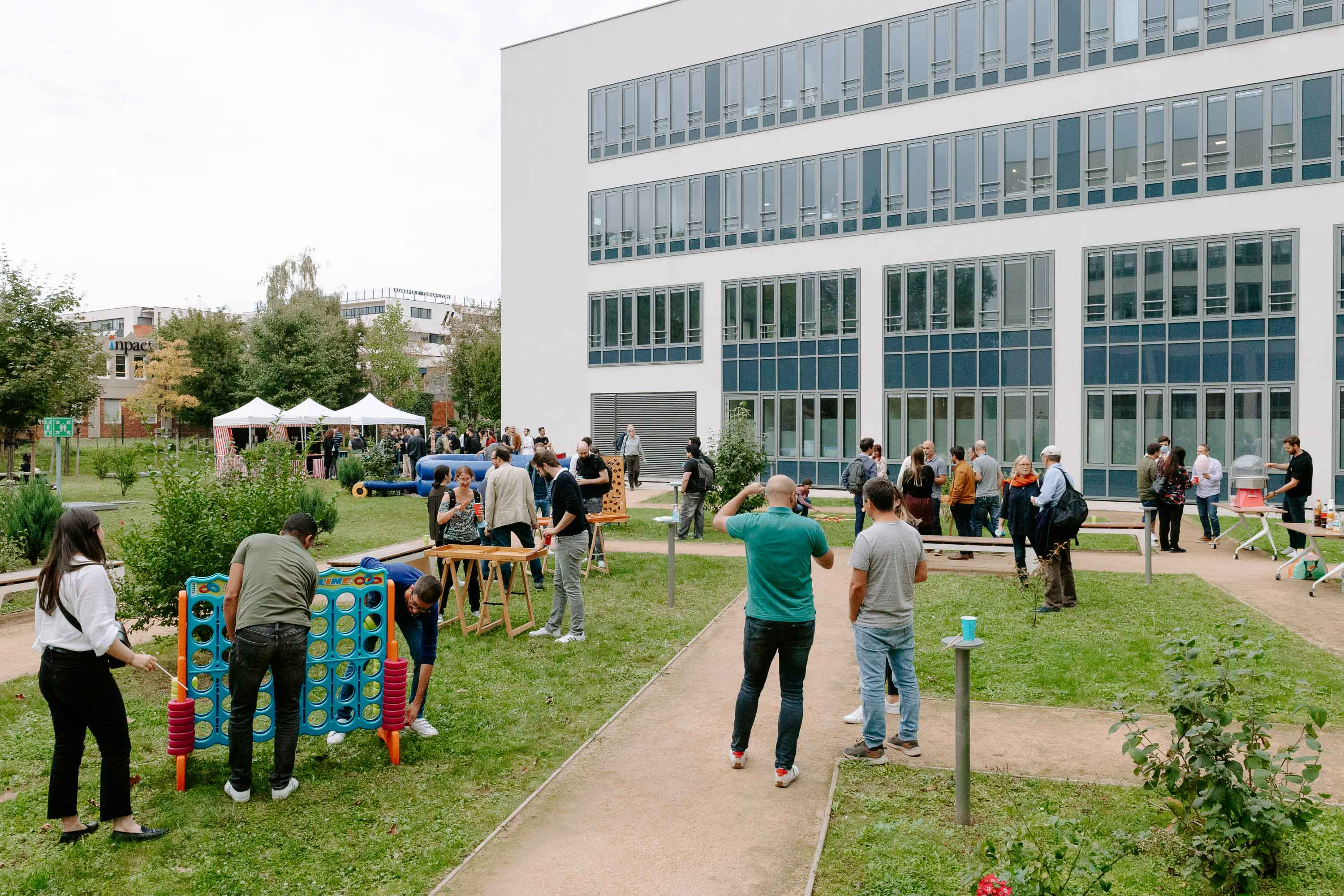
Sports Challenge – Giant Games in Montréal that teams actually buy into
INNOV'events is a event agency in Montréal specialized in structured, high-participation formats like Sports Challenge – Giant Games for corporate audiences. Typical deployments range from 20 to 800+ attendees, indoors or outdoors, with multilingual facilitation.
We handle the operational core: game design, on-site staffing, safety and traffic flow, equipment transport, scoring, and the run-of-show—so HR and Communications can focus on people, not logistics.
Sommaire
In a corporate event, entertainment isn’t “extra”—it’s the lever that turns a room of colleagues into a working network. A well-structured Sports Challenge – Giant Games in Montréal creates measurable outcomes: cross-team contact, participation rate, and a shared narrative that survives beyond the day.
Montréal organizations expect clear rules, predictable timing, and an inclusive format (different ages, mobility, languages, and comfort levels with sport). Executives also expect the day to protect the employer brand: safe, respectful, and professionally facilitated—no chaos, no awkward moments.
We operate locally with the habits of Montréal venues, loading docks, union or in-house technical teams, and weather realities. Our role is to anticipate the operational friction points early—space, sound limits, elevator access, and crowd flow—so the event runs cleanly on the day.
What Montréal decision-makers ask first: numbers, logistics, reliability
10+ years designing and producing corporate activations and team challenges across Québec and Canada, with repeat clients in HR and internal communications.
Field-proven capacity: from 20-person leadership offsites to 800+ attendee multi-rotation events with simultaneous game zones and centralized scoring.
Operational depth: a trained bench of facilitators, captains, and set-up crew; standardized checklists; and run-of-show templates built for Montréal venue constraints (access windows, elevators, dock schedules).
Safety-first execution: risk mapping per activity (impact, trip hazards, pinch points), venue walk-through protocols, and clear escalation paths with client point-of-contact.
Montréal delivery, year after year: how local teams work with us
We support Montréal-based organizations and Canadian teams with a strong footprint in the city—often in recurring cycles: annual summer party, quarterly all-hands, onboarding cohorts, or end-of-year recognition. In practice, the “same” team challenge evolves each year because your teams evolve: new managers, hybrid work patterns, new sites, new sensitivities.
Many clients come back because we document what happened: participation rates by station, pinch points (lineups, sound bleed, traffic flow), and the few moments that create friction (rules misunderstood, equipment bottlenecks, uneven team composition). That record makes next year’s planning faster and smarter, and it gives HR and Comms a defensible story when leadership asks, “What did we get for the budget?”
If you share your internal references or past vendor list, we’ll align our production approach with your standards (brand, tone, safety expectations, and accessibility). Our Montréal presence matters most here: we can do quick site visits, adjust plans to venue realities, and bring realistic solutions rather than theoretical ones.
 Besoin d’un devis rapide ?
Nous vous envoyons une première proposition sous 24h.
Why run a Sports Challenge in Montréal instead of another cocktail?
Most corporate social formats reward the same people: the extroverts and the already-connected. A Sports Challenge – Giant Games is different when it’s designed for workplace dynamics: it creates structured interaction, short cycles, and shared objectives—without requiring athletic performance. In Montréal, where teams are often bilingual, multi-site, and hybrid, structure is what makes inclusion real.
Cross-silo collaboration in a controlled setting: rotating stations force new pairings (IT with Sales, Finance with Ops) without the awkwardness of “networking.” We build team composition rules to prevent one department from dominating points.
Participation you can defend to leadership: we design for 80–95% active participation when the brief is “everyone must feel included,” using a mix of low-barrier and optional high-energy stations.
Culture signal without speeches: values like safety, respect, inclusion, and accountability show up in the game mechanics (fair play points, collaborative puzzles, volunteer roles, and clear conflict handling).
Manager enablement: managers get a ready-made, neutral context to recognize people, observe team dynamics, and create “non-work” moments that translate into everyday trust back at the office.
Employer brand protection: we avoid the common Montréal pitfalls—poor crowd flow, weather underestimation, and loud/rowdy facilitation—by building a professional run-of-show, signage, and clear rules that prevent embarrassment and complaints.
Operational efficiency: giant games are highly visible, fast to understand, and rotate well. That means you can cover a large headcount on a tight venue schedule without forcing everyone into one big mass activity.
Montréal’s business culture is pragmatic: leaders want team energy, but they also want control—clear timing, safe execution, and a format that reflects well on the organization. A properly produced sports challenge delivers that balance.
What Montréal companies expect on event day (and what can go wrong)
In Montréal, the operational reality is often more complex than the creative brief. Downtown venues have strict loading and elevator windows; old buildings can limit storage and ceiling clearance; parks and outdoor spaces introduce permitting and neighbor considerations; and weather is never a detail—it’s the plan.
From an executive and HR perspective, expectations are consistent:
- Predictable timing: leadership doesn’t want a program that “drifts.” We build a time-coded run-of-show, rotation schedules, and a hard stop that respects speeches, catering, and venue curfews.
- Inclusive participation: not everyone wants to “compete.” We include non-athletic, precision, logic, and collaboration stations, plus roles like scorekeeper or team strategist so everyone can contribute.
- Bilingual delivery: Montréal audiences often switch between English and French in the same group. We staff accordingly and design signage that avoids confusion when explaining rules under time pressure.
- Risk control: the day must be safe and respectful. We plan spacing, queue management, and clear escalation for conflicts or unsafe behavior—especially when alcohol is present later in the program.
- Brand fit: a game that feels “kid’s party” can damage credibility. We use professional-grade visuals, consistent signage, and facilitation tone aligned with your culture (startup vs financial services vs industrial).
Most event-day stress comes from small misses: a station that takes too long creates lineups; a noisy game conflicts with speeches; a floor surface makes a game unsafe; a scoreboard isn’t visible; teams don’t understand where to go next. Our Montréal approach is to anticipate these friction points during planning, not during the first rotation.
Which Giant Games work best for corporate teams in Montréal?
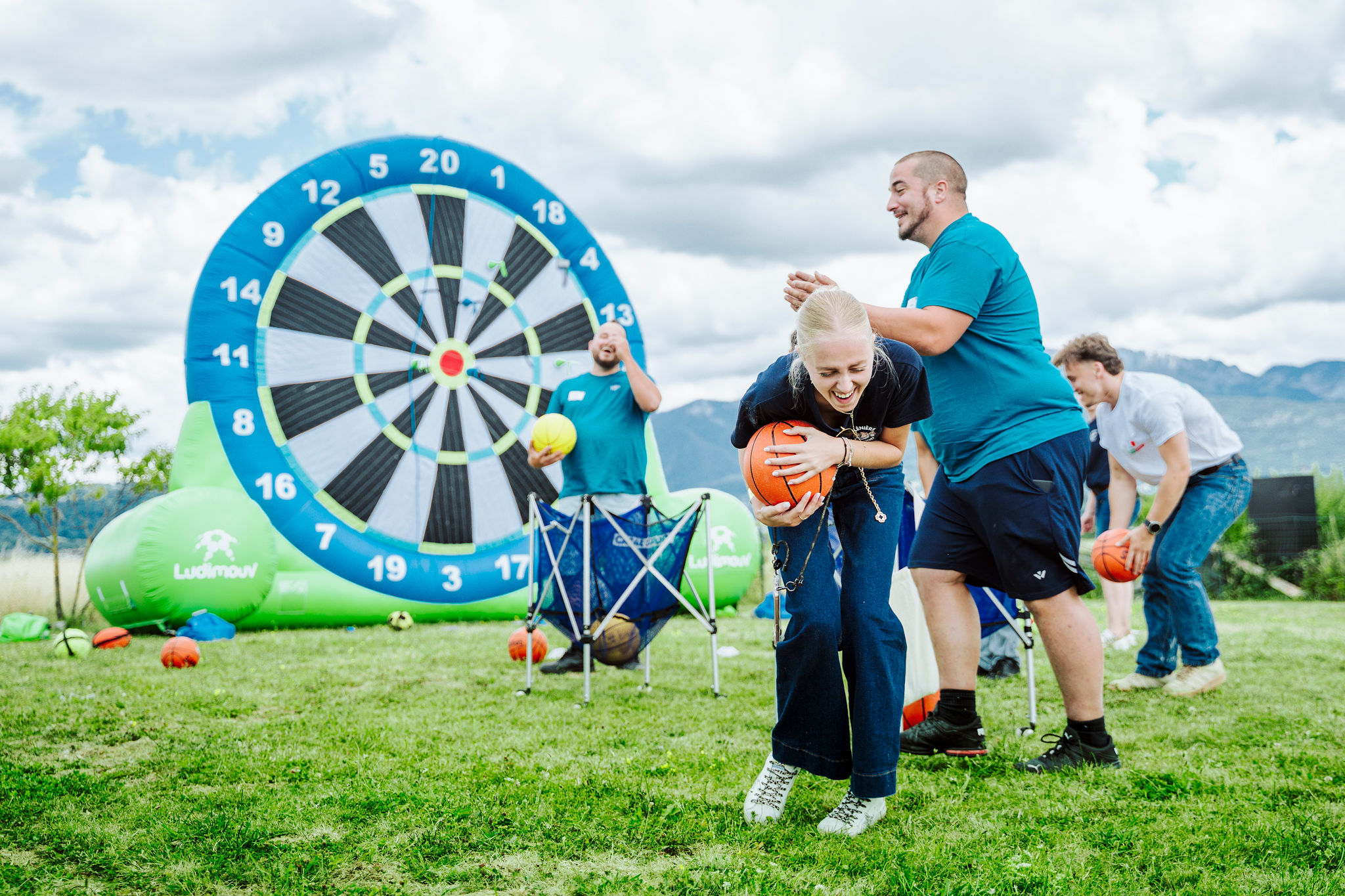
Engagement comes from clarity and quick wins, not from complexity. Giant games are effective because they are instantly understandable, highly visible, and easy to reset—ideal for corporate headcounts where you must keep everyone moving. For a Sports Challenge – Giant Games, we build a balanced menu so every profile has a station where they can contribute.
Interactive animations in Montréal
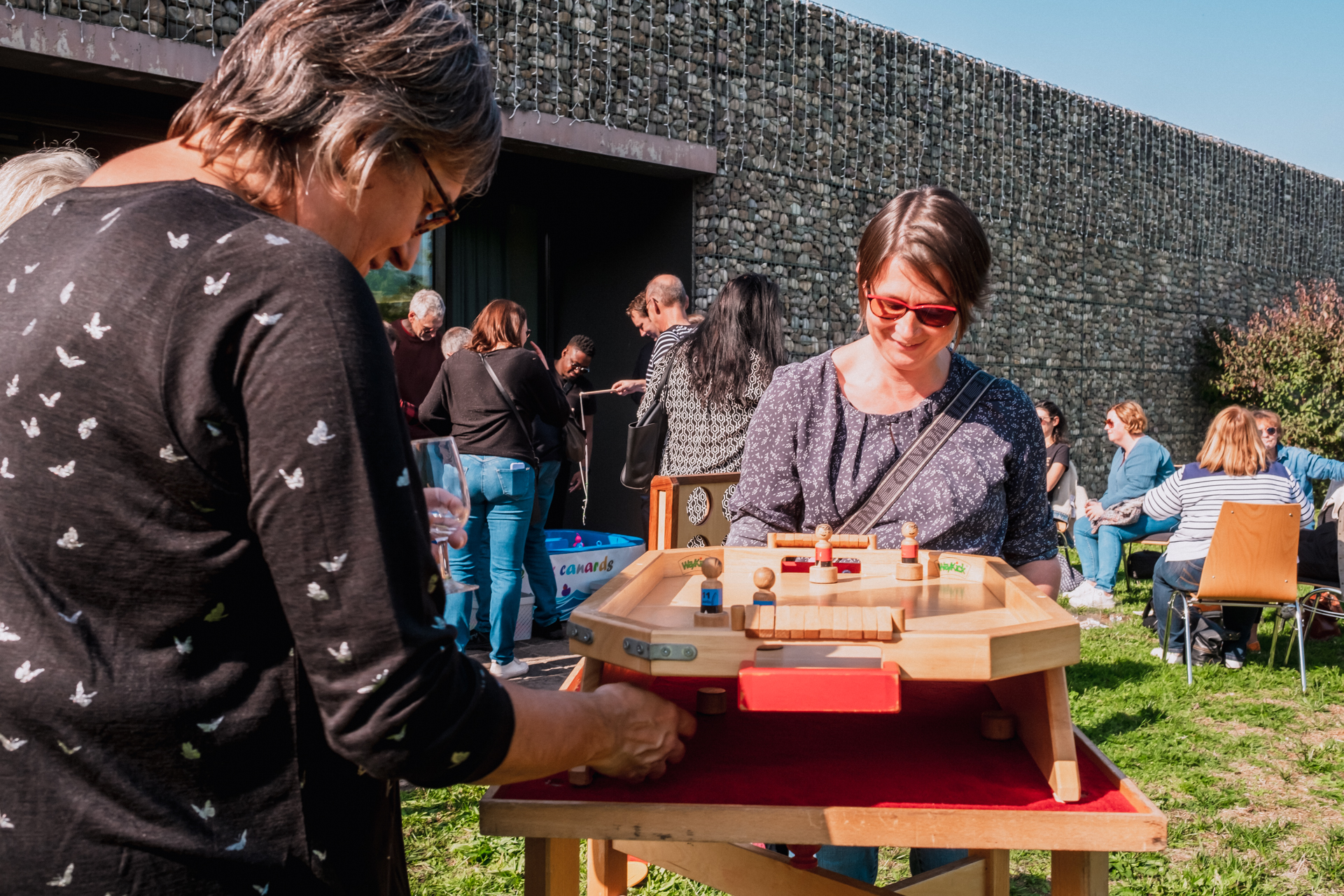
Giant table soccer (human foosball): excellent for department-vs-department matchups with short rounds. We manage safety spacing and footwear expectations, and we cap intensity to keep it inclusive.
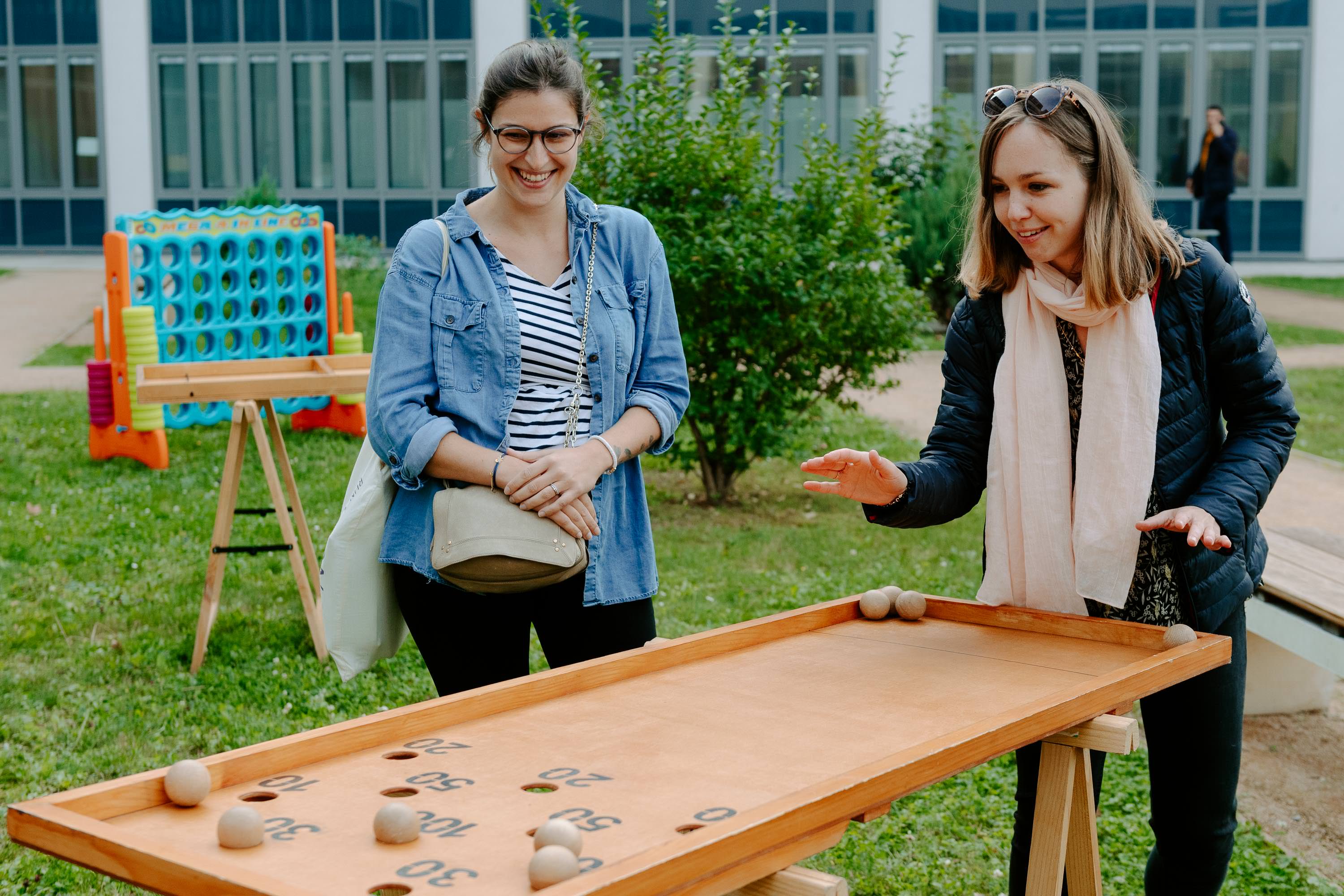
Giant connect-four / giant Jenga strategy rounds: low physical demand, high team coordination. Works well in mixed-seniority groups and in indoor Montréal venues where noise must be controlled.
Precision lane (giant cornhole / ring toss / ladder toss): consistent cycle time, easy scoring, and accessible for a wide age range. Great as an anchor station to absorb volume and prevent lineups.
Relay with role options: instead of pure running, we structure “relay legs” with choices (carry, balance, memory, logic) so participants self-select what fits them while staying on schedule.
Art animations in Montréal
Team banner + chant sprint: a short, structured creative station (10 minutes max) that gives Communications shareable content without derailing the program. We provide templates so it stays professional and not “summer camp.”
Rhythm or percussion mini-challenge: for indoor Montréal settings, we use controlled-volume formats (table percussion, body rhythm) with clear cues to avoid sound bleed into adjacent rooms.
Innovative animations in Montréal
Hydration + recovery bar: not a “treat station,” but a functional element that reduces fatigue and keeps participation high. We coordinate placement so it supports flow instead of creating a bottleneck.
Taste-and-guess micro-challenges: short, hygienic, and scalable. Useful when you need a low-exertion station or when attire doesn’t fit physical games (conference clothing, client presence).
Gourmand animations in Montréal
Live digital scoring board: QR-based team check-in and central leaderboard (screen or projection). Participants stay engaged because results are visible; HR gets clean data after the event.
Inclusion-first station design: we can integrate an “accessibility route” where teams must choose a station that emphasizes communication, planning, or observation—shifting the definition of performance beyond physicality.
Photo and micro-content capture: short, scheduled “content windows” so Communications gets usable material without disrupting gameplay or creating consent issues. We align with your internal policies.
Whatever the game mix, the real question is brand alignment. For a regulated sector, we prioritize safety, calm facilitation, and clean visuals. For a growth company, we can increase tempo and competitiveness—but always with rules and staffing that protect culture and reputation in Montréal.
Where to host Giant Games in Montréal without fighting the venue
The venue is not a backdrop—it dictates game selection, sound level, load-in time, and the overall perception of professionalism. In Montréal, the most common issues are access windows, limited storage, mixed flooring, and shared spaces where noise travels. We choose formats based on what the site can truly support, not what looks good on paper.
| Venue type | For which objective? | Main strengths | Possible constraints |
|---|---|---|---|
Large hotel ballroom / conference center | All-hands energy with controlled logistics (100–600 people) | Weather-proof, AV-ready, predictable staffing, easier bilingual facilitation on mic | Sound limits, carpet affects some games, strict load-in/load-out windows |
Outdoor park or green space (city permits) | Summer employee engagement, family-friendly extensions, high-visibility giant games | Space for multiple zones, relaxed atmosphere, strong photo/video outcomes | Permits, weather plan required, surface/uneven ground, noise and neighbor considerations |
Corporate courtyard / private terrace / rooftop | On-site culture activation, minimal travel friction, short programs (60–120 min) | Convenient for hybrid teams coming in, strong employer brand moment “at home base” | Elevator access, wind exposure, capacity limits, safety perimeter for edges and stairs |
Sports complex / gymnasium | High-energy competition with clear lanes and controlled surfaces (80–400 people) | Lines on floor help flow, high ceilings, easy to run multiple stations simultaneously | Availability, acoustics can be loud, parking/transport coordination |
We strongly recommend a site visit (or at minimum a detailed venue tech sheet + photos) before locking the game list. A 30-minute walk-through often prevents the classic Montréal issues: an elevator too small for gear, a hallway that becomes a choke point, or a room where sound bounces into the keynote next door.
What does a Sports Challenge cost in Montréal (and what drives it)?
Budget is driven less by “the games” and more by production mechanics: staffing ratios, transport complexity, time on site, and how many participants must rotate smoothly. A credible quote for a Sports Challenge – Giant Games in Montréal must specify what is included—equipment, facilitators, scoring, signage, setup/strike, and contingency planning.
Headcount and rotation design: 40 people can run with fewer stations and simpler scoring; 200–800+ requires multiple simultaneous zones, a captain structure, and tighter timing control.
Duration on site: a 90-minute activation vs a half-day challenge changes labor, equipment reset cycles, and fatigue management (including breaks and hydration).
Indoor vs outdoor: outdoor Montréal production typically adds weather contingencies, tenting options, surface adaptations, and sometimes permits or park rules.
Access constraints: downtown loading docks, long pushes, limited elevators, or strict access windows increase setup crew and time buffers.
Facilitation level: basic station supervision vs high-touch emcee + bilingual briefings + centralized scoring impacts staffing and rehearsal time.
Branding and comms requirements: professional signage, team identifiers, branded scoreboards, and photo/content coordination can be added when brand image is a key objective.
Risk profile: if the event includes alcohol afterward, VIPs, clients, or sensitive workforce dynamics, we may recommend additional supervision and stricter rules to protect the employer brand.
ROI is usually visible in participation and internal narrative: fewer “small groups in corners,” more cross-team contacts, and content HR/Comms can reuse. When leadership asks what changed, we can report on engagement indicators (participation rate, station throughput, and qualitative feedback captured on-site).
Why choose a Montréal agency for a Sports Challenge rollout?
With giant games, success is not about having a catalog—it’s about execution under Montréal conditions: tight loading windows, mixed indoor/outdoor plans, bilingual audiences, and venues with very different rules. A local team reduces uncertainty because we know what typically breaks and we design around it from the first call.
We also move faster when something shifts: a room change, a delayed access time, or weather that forces a pivot. Local production means fewer “we’ll figure it out on the day” moments—exactly what executives want to avoid.
- Faster site checks and realistic plans: we validate space, surfaces, and flow, then select games that will actually run on schedule.
- Local vendor and venue habits: coordination with in-house AV, security, or building management is smoother when you speak the same operational language.
- Staffing reliability: facilitators who understand corporate tone and can handle conflict politely but firmly—important when competition heats up.
- Weather and seasonal realism: Montréal outdoor events need a true Plan B that doesn’t feel like a downgrade.
ROI is usually visible in participation and internal narrative: fewer “small groups in corners,” more cross-team contacts, and content HR/Comms can reuse. When leadership asks what changed, we can report on engagement indicators (participation rate, station throughput, and qualitative feedback captured on-site).





What we’ve delivered in Montréal: formats that match real corporate constraints
Our Sports Challenge – Giant Games programs are built around the realities we see in Montréal organizations: mixed seniority groups, hybrid colleagues meeting in person for the first time, and leadership teams who want energy without losing control.
Examples of what this looks like operationally:
- All-hands “high throughput” format: multiple stations running simultaneously with timeboxed rotations, a central scoreboard, and a closing ceremony that fits into a strict agenda. Designed to avoid lineups and keep engagement high even with large headcount.
- Leadership + managers challenge: less noise, more coordination and strategy, with debrief prompts that managers can reuse with their teams afterward (what worked, how decisions were made, what assumptions showed up).
- Client-facing or partner-inclusive program: games chosen for professionalism and accessibility, with facilitation that protects brand image and avoids overly physical or “silly” mechanics.
- Hybrid-friendly extension: when part of the workforce is remote, we can add structured content capture (short interviews, team highlight reels) so remote staff can follow results and feel included post-event.
The common thread is controlled delivery: clear rules, clean visuals, bilingual facilitation, and a schedule that respects catering, speeches, and venue constraints.
Common mistakes we prevent for Montréal corporate giant games
Underestimating throughput: a fun station that takes 10 minutes per team can create lineups and disengagement. We design for cycle times and add buffering stations to absorb volume.
Choosing games that don’t match the floor or space: polished floors, tight columns, low ceilings, or narrow corridors can turn a safe game into a risk. We adapt the game list to real site conditions.
Over-competitive dynamics: without clear rules and facilitator authority, competition can become uncomfortable. We use fair-play scoring and escalation protocols.
Weak bilingual communication: unclear briefings cause disputes and wasted time. We script briefings and use signage that reduces repeated explanations.
Not planning for weather: hoping for the best is not a plan in Montréal. We prepare substitutions and layout changes that keep the experience credible.
Scorekeeping that becomes the bottleneck: if results aren’t captured smoothly, you lose energy. We set a simple scoring model and test it before the first rotation.
Our job is to remove these risks before you brief leadership. On the day, that translates into calm decision-making, smoother crowd movement, and a program that looks professional from the first whistle to teardown.
Why Montréal clients rebook INNOV'events for team challenges
Rebooking rarely happens because “it was fun.” It happens because the event was easy to manage internally: fewer stakeholder complaints, no safety surprises, and a clean experience that reflected well on leadership. We work in a way that protects your time and your credibility.
Typical planning timeline: 3–8 weeks depending on headcount and venue complexity; faster is possible if the site is confirmed and objectives are clear.
Recommended staffing ratios: often 1 facilitator per station plus a floor captain for 5–8 stations, adjusted to your audience profile and competitiveness level.
Participation targets: when the objective is inclusion, we design for 80–95% active participation with optional intensity layers.

Loyalty is a proof point in corporate events: it means the client trusted the plan, the day ran on time, and leadership felt comfortable attaching their name to the program. That’s the bar we aim to clear in Montréal.
How we plan a Sports Challenge in Montréal from brief to teardown
👉 Montréal discovery call: objectives, constraints, and internal politics
We start with the real decision criteria: why this event exists (engagement, retention, culture, change management), who is in the room (seniority mix, union presence, remote staff), and what must be protected (brand image, safety, schedule). We also identify constraints that often surface late: access times, noise limits, dress code, alcohol service, and bilingual requirements.
👉 Site validation in Montréal: flow, surfaces, sound, and access
We review the venue details that make or break giant games: load-in route, elevator dimensions, storage, floor type, ceiling height, washroom proximity, and emergency exits. We map the floor plan into zones with queue space and safe perimeters. If outdoors, we confirm the weather strategy and any permit rules that affect sound or setup time.
👉 Game architecture and scoring design aligned to your culture
We propose a game mix with rotation timing, staffing plan, and a scoring model that fits your organization. For some clients, competition is motivating; for others, it creates discomfort. We can incorporate teamwork points, collaboration tasks, or “wildcard stations” that level the playing field between athletic and non-athletic participants.
👉 Production plan: staffing, run-of-show, signage, and contingency
You receive a clear operational plan: time-coded schedule, station list, facilitator assignments, equipment list, and contingency options. We plan setup/strike windows and coordinate with venue contacts. This is where we protect your internal team—no last-minute surprises about power, sound, or space.
👉 Event day execution in Montréal: floor captain, quality control, and escalation
On site, we run a pre-brief with facilitators, test stations, and confirm safety perimeters. A floor captain monitors throughput and resolves issues quickly (lineups, rule disputes, timing drift). We keep the client point-of-contact informed without overwhelming them, and we end with a clean wrap-up that respects venue deadlines.
👉 Post-event wrap: what to report to leadership
We share a concise debrief: what worked, what to adjust, and what we observed about flow and engagement. If scoring data is captured digitally, we can provide results by team and station. This gives HR and Communications a clear narrative and practical recommendations for the next Montréal edition.
FAQ sur l'organisation Sports Challenge – Giant Games à Montréal
How many participants can you run in Montréal per time slot?
Commonly 20 to 800+. The key variable is throughput: with 6–10 stations and 4–7 minute cycles, we can move large groups efficiently. We confirm capacity after reviewing venue space, access, and the target duration.
Can Giant Games work indoors in Montréal in winter?
Yes. Indoor delivery is often more predictable in winter. We adapt the station list to ceiling height, flooring (carpet vs polished), and sound limits. For ball-based or impact-heavy games, we substitute safer precision and strategy stations that still feel competitive.
What’s a realistic budget range for Montréal giant games?
Most corporate deployments fall between CAD $3,500 and $18,000+, depending on headcount, number of stations, duration, staffing, access complexity, and whether you need MC/AV/branding. We provide a line-item structure so Finance understands what drives the number.
How do you ensure safety and reduce injury risk in Montréal venues?
We use activity risk mapping, safe spacing per station, clear rules, and trained facilitators who can pause play. We also adapt to surfaces (wet grass, polished floors), manage footwear expectations, and plan crowd flow to avoid collisions and congestion around popular stations.
How far in advance should we book in Montréal?
Ideally 4–8 weeks for a smooth planning cycle, especially for summer outdoor dates and peak year-end periods. For smaller groups with a confirmed venue, we can sometimes deliver in 2–3 weeks, but earlier booking improves venue options and contingency planning.
Request a Montréal quote with a plan you can defend internally
If you’re comparing agencies, we can move quickly with concrete inputs: date range, venue short list (or neighborhood), estimated headcount, audience profile (bilingual mix, mobility considerations), and your priority (inclusion vs competition vs brand content). We’ll respond with a structured proposal for Sports Challenge – Giant Games in Montréal including station mix, staffing plan, timing, and a budget range you can bring to leadership.
For best results—especially outdoors—start planning early. Montréal calendars fill fast, and a solid Plan B is what keeps the event professional when conditions change. Contact INNOV'events to schedule a short planning call and get a clear next step.
INNOV'events Montréal Agency
Thierry GRAMMER is the manager of the INNOV'events Montréal office. Reach out directly by email at canada@innov-events.ca or via the contact form.
Contact the Montréal agencyToutes nos prestations & animations Montréal, Quebec
Découvrez nos prestations événementielles
- Employee Party in Montréal
- Corporate Christmas Party in Montréal
- Networking Cocktail Event in Montréal
- Shopping Mall Activation in Montréal
- Grand Opening Event in Montréal
- Product Launch Event in Montréal
- Open House Event in Montréal
- Field Brand Activation in Montréal
- Event Catering Service in Montréal
Découvrez nos animations événementielles disponibles au Quebec
- Event Hostess in Montréal
- Escape Game in Montréal
- MasterChef-Style Cooking Workshop in Montréal
- Corporate Magician in Montréal
- Tent Rental in Montréal
- Color Analysis Workshop in Montréal
- Inflatable Games in Montréal
- Valet Service in Montréal
- Soccer Simulator in Montréal
- LED Furniture Rental in Montréal
- LED Branding Activation in Montréal
- Immersive Culinary Experience in Montréal
- Light Painting Activity in Montréal
- Immersive Mystery Night in Montréal
- Promotional Contest in Montréal
- Promotional Materials (POS) in Montréal
- Virtual Reality Experience in Montréal
- Molecular Gastronomy Workshop in Montréal
- Halloween Event in Montréal
- Fireworks Show in Montréal
- Sports Challenge – Giant Games in Montréal
- Professional Event Host in Montréal
- Photo Booth Animation in Montréal
- Santa Claus Appearance in Montréal
- Kids Entertainment in Montréal
- Guided Tour in Montréal
- Urban Rally in Montréal
- Ball Pit Activity in Montréal
- Flight Simulator in Montréal
- Food Truck Rental in Montréal
- World Record Attempt in Montréal
- Surf Simulator in Montréal
- Soccer Simulator in Montréal
- Wine Casino in Montréal
- Makeover Workshop in Montréal
- Perfume Creation Workshop in Montréal
- Acting Workshop in Montréal
- CSR Activities in Montréal
- Archery Activity in Montréal
- Event Security Guard in Montréal
- Wine Tasting Workshop in Montréal
- Mime Performance in Montréal
- TV Game Show Animation in Montréal
- Funfair Event in Montréal
- Crisis Management Workshop in Montréal
- Crisis Negotiation Workshop in Montréal
- Arcade Games in Montréal
- Indoor Skydiving Simulator in Montréal
- Ski Simulator in Montréal
- Racetrack Driving Experience in Montréal
- Introductory Flight Experience in Montréal
- Tasting Experience in Montréal
- Build Your Own Foosball Workshop in Montréal
- 2CV Rally in Montréal
- LEGO Challenge in Montréal
- Casino Night in Montréal
- Interpreter / Translator in Montréal
- Promotional Merchandise in Montréal
- Shuttle / Transportation Service in Montréal