
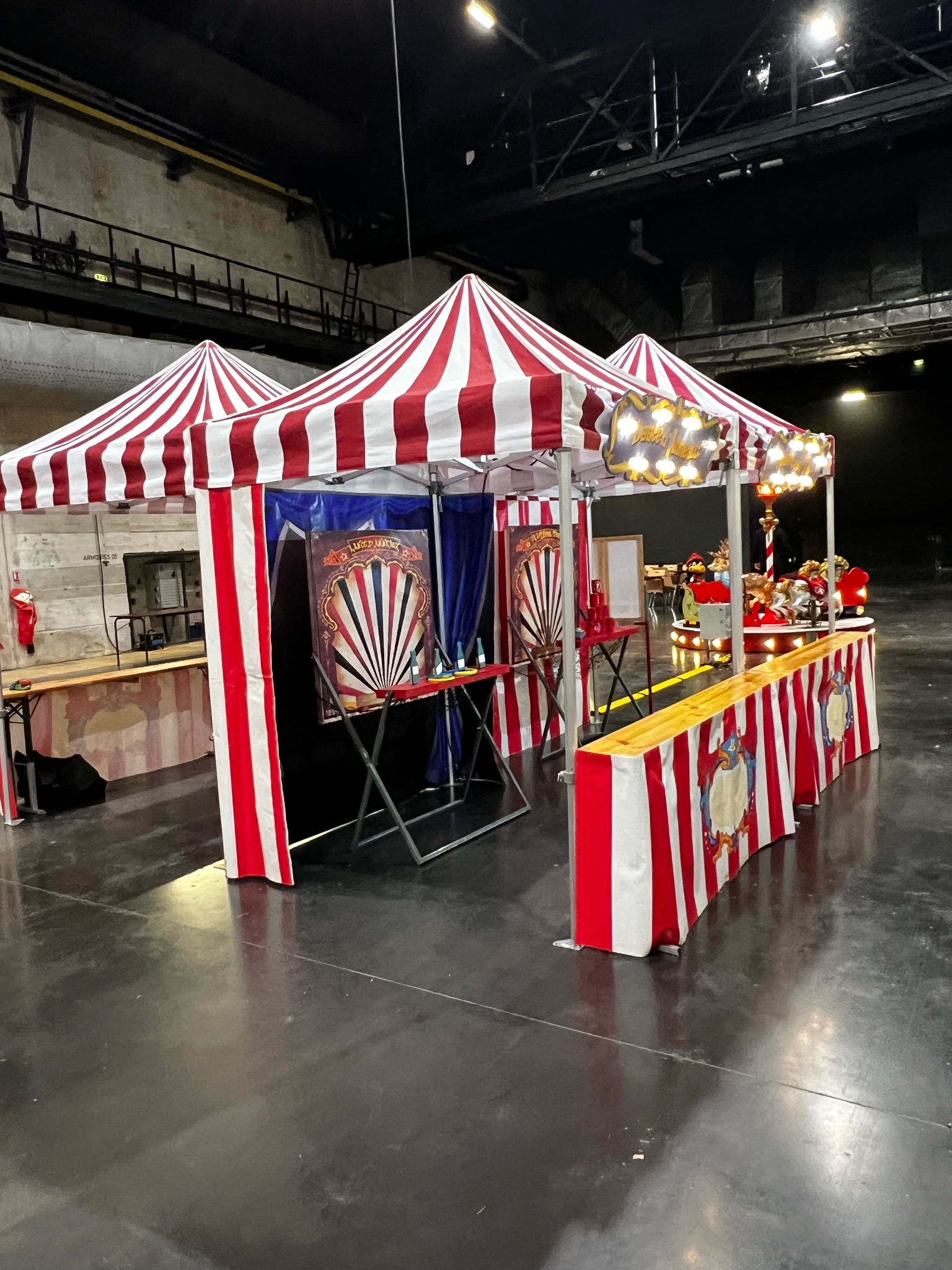
Funfair Event in Montréal that runs on time, on budget, and on brand
INNOV'events is a Montréal-based team that plans and delivers Funfair Event formats for corporate audiences from 80 to 3,000+ attendees. We manage the full chain: site selection, permits, supplier coordination, safety plan, staffing, power, load-in/out, and day-of operations so your leadership team isn’t improvising at 6:30 a.m.
Whether you’re HR aiming for retention and engagement, or Communications protecting brand standards, our approach is operational: clear schedules, documented responsibilities, and risk control—adapted to Montréal constraints (venues, bylaws, weather windows, and union rules where applicable).
Sommaire
In a corporate context, entertainment isn’t a “nice-to-have”: it’s the lever that determines participation rate, dwell time, and the quality of informal conversations that drive cohesion. A well-executed Funfair Event in Montréal gives teams a reason to stay, mingle across departments, and attach a positive memory to your employer brand—without forcing networking.
Montréal organizations typically expect a high production standard with a low tolerance for disruption: predictable schedules, sound management, traffic flow, and a plan for weather and last-minute changes. Executives want reputational control; HR wants inclusivity and accessibility; Communications wants clean visuals and consistent messaging.
We operate locally with Montréal suppliers and venue partners, and we build events with the realities of this city in mind: limited load-in docks, strict sound curfews in certain districts, bilingual signage, and the need to keep everything compliant and camera-ready.
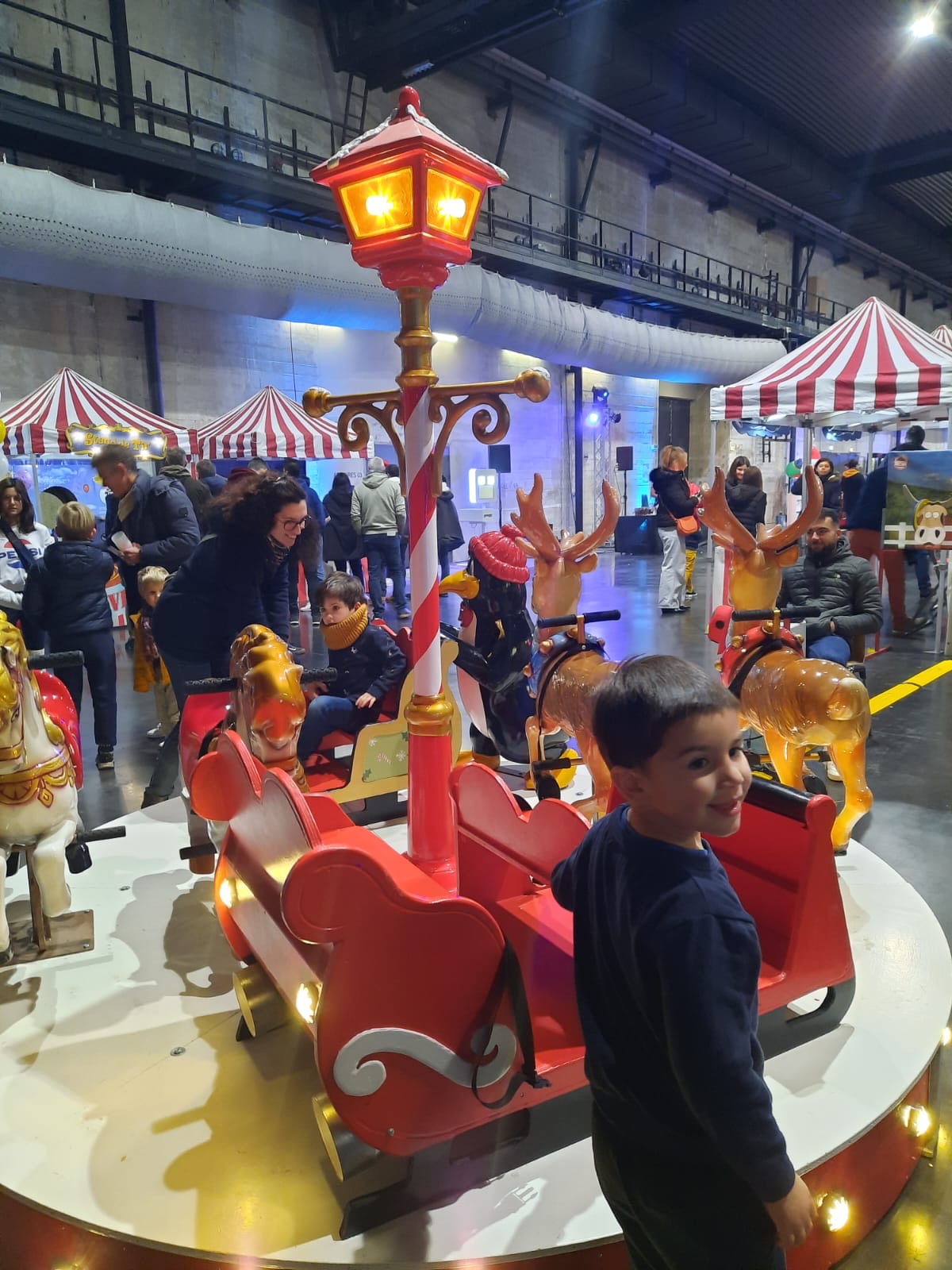
Operational credibility in Montréal: numbers decision-makers can use
10+ years delivering corporate activations and large-format employee events across Québec and Canada, with Montréal as our core market.
Network capacity to staff and supervise 15 to 80+ on-site personnel (event managers, safety marshals, queue attendants, animators, technicians) depending on attendance and footprint.
Typical planning timeline: 4 to 10 weeks for standard deployments; 12+ weeks when permits, street-side access, or complex rigging are involved.
Documented workflows: run-of-show, site map, power plan, load-in schedule, vendor SLAs, emergency procedures, and a single point of accountability on event day.
Montréal corporate references and repeat collaborations
In Montréal, many of our Funfair Event mandates come from organizations that repeat year after year because the operational stress is lower: fewer surprises with access, vendors arrive when scheduled, and the site looks as approved. We frequently support HR and internal communications teams that need a partner who can “own the field” while they focus on leadership presence and employee experience.
If you want us to include specific local references, we can share a short list of Montréal-based client contacts and comparable case profiles during the quotation phase (industry, headcount, constraints, and scope), respecting confidentiality. In practice, the strongest proof is our ability to produce clear plans you can validate internally—risk, budget, and brand—before you commit.
 Besoin d’un devis rapide ?
Nous vous envoyons une première proposition sous 24h.
What a Funfair Event changes for Montréal teams and leaders
A Funfair Event in Montréal works when it solves a management problem—not when it simply fills a calendar. In real companies, we see three recurring triggers: post-merger integration, retention pressure after a busy season, and the need to reconnect hybrid teams who rarely share informal time.
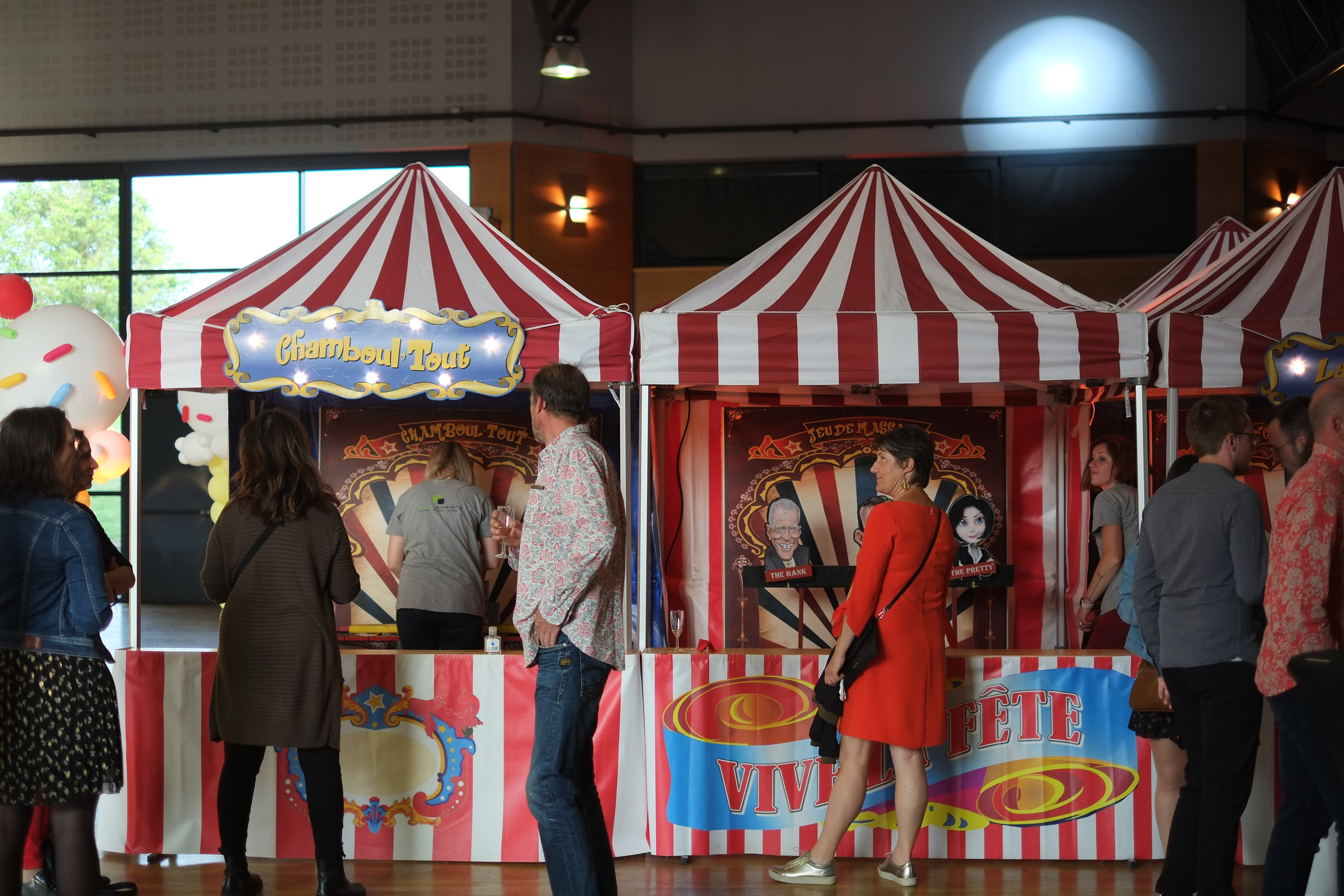
Unlike a formal gala, a funfair format creates micro-moments: quick games, short lines, food stations, and roaming interactions. That structure is particularly effective for executives who want to “walk the floor” and speak with many employees in a natural way.
Higher participation across departments: games and stations lower the barrier to entry compared to speeches or sit-down formats. This matters when you need to engage operations, IT, and support functions equally.
Measurable internal communication touchpoints: you can integrate an employer brand theme (values, safety culture, ESG actions) through signage, MC scripts, and light gamification—without turning the event into a presentation.
Better time-on-site and controlled circulation: with a mapped footprint (zones, queues, capacities), employees spread out rather than crowding a single bar area. This reduces risk and improves comfort.
Leadership visibility without a stage-heavy program: we plan executive presence with short, well-timed interventions (e.g., 4–6 minutes), and we protect the flow so it doesn’t become a “corporate meeting outdoors.”
Retention and morale effect: when the event is accessible, well-run, and inclusive (dietary options, mobility access, family-friendly hours if desired), it supports HR objectives in a concrete way.
Brand-safe content for Communications: clean visual zones, controlled sponsor/partner visibility, and photo-ready moments that don’t look improvised. We often plan a “hero area” specifically for internal social and recruitment content.
Montréal’s economic culture values both creativity and rigor. A funfair format fits that DNA—provided it’s executed with real production discipline: permits, safety, sound management, and a site plan that respects neighbors and the venue’s operating rules.
What Montréal venues and bylaws require from corporate events
Montréal is an incredible playground for corporate events, but it’s not forgiving when details are missed. A Funfair Event in Montréal often touches several compliance layers at once: venue rules, municipal bylaws, building management constraints, and sometimes unionized labor environments.
Concrete examples we plan for early:
- Load-in and truck access: many downtown venues have narrow docks, time windows, or shared access with other tenants. We schedule staggered arrivals, reserve elevators where possible, and build a realistic load-in path (including floor protection and turning radii).
- Sound and neighborhood constraints: outdoor or semi-outdoor sites can have curfews and decibel limitations. We design the entertainment program so the “peak sound” moments are timed and localized, and we position speakers to reduce spill toward residential areas.
- Power availability: funfair games, lighting, refrigeration, and audio require a real power plan. We verify amperage, panel locations, cable routes, and backup needs. This prevents the classic Montréal issue: tripped breakers mid-service.
- Weather reality: even in summer, Montréal can bring sudden heavy rain and wind. We specify tent ratings, ballast, drainage, and an indoor fallback plan (or a program pivot) rather than relying on hope.
- Bilingual experience: signage, safety instructions, MC scripts, and staff briefings should be functional in English and French. For corporate audiences, it’s also a brand respect issue.
For executives, the bottom line is predictability: you want the event to look intentional, not like a collection of rented items. That’s why our pre-production focuses on permissions, supplier confirmations, and contingency planning—before you announce the event internally.
Which Funfair Event entertainment works best in Montréal workplaces?
Engagement comes from choice and tempo. In corporate settings, the best funfair programs combine quick-win activities (2–4 minutes), a few “anchor” attractions that draw attention, and food experiences that keep people on site. In Montréal, we also design around space realities: many sites are long and narrow, have limited ceiling height, or require careful noise control.
Interactive animations in Montréal
Skill-based midway games (ring toss, ladder toss, basketball shot): strong for mixed groups because they’re easy to understand and don’t require athletic ability. We manage queue speed and prize distribution so lines stay reasonable.
Team punch-card challenges: guests collect stamps at 6–10 stations (games, photo, wellness corner, brand quiz). HR likes it because it drives cross-department mixing; Communications likes it because it structures messaging without a lecture.
Arcade and retro corner: pinball, air hockey, racing simulators. Practical when you need lower noise than a stage program and when you want steady engagement over several hours.
Interactive emcee “micro-moments”: short callouts every 20–30 minutes (not constant hype). Works well for corporate tone: energizing without feeling like a public festival.
Art animations in Montréal
Roaming performers (stilt walkers, jugglers, mime-style characters): effective for photo moments and wayfinding. We brief performers on corporate boundaries (no intrusive audience interaction, no blocking entrances).
Small-format stage sets (jazz trio, DJ with controlled SPL, percussion duo): we adapt to venue sound rules and schedule sets around speeches or key moments. For Montréal audiences, quality matters—better a smaller act well-produced than a loud stage that nobody can hear.
Live caricature or illustration: high perceived value, quiet, and inclusive. Also produces take-home items branded subtly and tastefully.
Innovative animations in Montréal
Montréal-style food stations: smoked meat sliders, poutine bar, bagels, or local micro-roastery coffee. We design service lines with throughput targets (e.g., 150–250 servings per hour per station depending on menu) to prevent bottlenecks.
Mocktail and hydration bars: increasingly requested for daytime or wellness-oriented events. Helps reduce over-reliance on alcohol while keeping the “treat” element.
Dessert carts: mini donuts, soft-serve, maple treats. Great for late-event energy and for creating a second attendance peak after speeches.
Gourmand animations in Montréal
RFID or QR-based participation tracking: useful if you want simple metrics (station visits, prize draws) without heavy data collection. We keep privacy clear and opt-in.
Photo and content zones built for internal comms: branded backdrops, controlled lighting, and a file delivery workflow. Communications teams appreciate getting usable content within 24–72 hours.
Queue design and signage system: stanchions, lane markers, and bilingual instructions. It’s not glamorous, but it’s what separates a corporate funfair from a chaotic festival line.
Every attraction choice should match your brand image and internal culture. A financial institution may prefer elegant stations, quieter entertainment, and strong crowd management; a tech or manufacturing group may want higher-energy games and larger footprints. Our job is to balance fun with control so the event looks intentional—and defensible—at executive level.
Where to host a Funfair Event in Montréal: what to choose and why
The venue is not a backdrop; it’s a constraint engine. It dictates noise tolerance, load-in access, ceiling height, power availability, and what kind of attractions are even possible. For a Funfair Event in Montréal, the right setting also influences perception: employees read it as either a serious investment or a rushed initiative.
| Venue type | For which objective? | Main strengths | Possible constraints |
|---|---|---|---|
Large indoor event halls (downtown or near major highways) | All-weather funfair; predictable schedule; high attendance | Controlled environment, solid power, easier sound management, reliable load-in | Dock time windows, union rules in some venues, parking management, premium rates in peak season |
Corporate campus / headquarters parking lots in Montréal | Employee recognition; family day; maximize participation | Convenience, strong attendance, brand control, minimal transport logistics for staff | Permits, neighborhood noise limits, need for generators, traffic plan, weather contingency |
Rooftops and terraces (semi-private venues) | Executive-forward experience; smaller footprint funfair concept | High perceived value, great visuals for Communications, natural “wow” factor | Strict capacity, wind exposure, limited load-in elevator size, sound curfews, fewer heavy attractions |
We strongly recommend a site visit (or a technical virtual walkthrough) before locking your program. In Montréal, two venues that look similar online can differ drastically in access, power, and operating rules. A 45-minute visit can save hours of event-day firefighting and avoid last-minute scope reductions.
How to budget a Funfair Event in Montréal without hidden costs
Budgets for a Funfair Event in Montréal vary widely because the cost drivers are operational, not just “entertainment.” The same set of games can cost significantly more if the site needs generators, extensive floor protection, additional security, or longer load-in windows.
As a planning reference, many corporate funfair projects land between $20,000 and $120,000+. Smaller indoor activations for 100–200 guests can be built below that range; large outdoor deployments with rides, major catering, and extensive staffing can exceed it.
Attendance and peak flow: it’s not only headcount—it’s when people arrive. If 70% of guests show up in the same 45 minutes, you need more stations, more staff, and more service speed.
Footprint and infrastructure: tenting, flooring, barricades, lighting, signage, heaters (spring/fall), and weather contingency. Montréal weather planning is a line item, not a footnote.
Power and technical production: venue power versus generators, distribution, cable ramps, safety checks, A/V needs, and technician hours.
Permits, insurance, and compliance: depending on site type, you may need additional insured certificates, safety plans, and municipal permissions. We clarify what’s required early so there are no end-of-project surprises.
Staffing model: queue attendants, ride operators (if applicable), bilingual hosts, supervisors, and security. Understaffing is one of the fastest ways to damage the guest experience.
Food and beverage throughput: menu complexity changes staffing and service time. A simple poutine bar is operationally different from multiple made-to-order stations.
Brand and communications deliverables: if you need photo/video coverage, content zones, bilingual signage, and post-event asset delivery, we plan it as a production deliverable with timelines and responsibilities.
From an executive perspective, the “ROI” is risk reduction and participation: fewer operational incidents, better attendance, and content that supports internal communications. We structure budgets so you can arbitrate: what increases engagement, what protects the brand, and what is optional.
Why hire a Montréal event agency for a Funfair Event?
On paper, a funfair looks portable. In Montréal, execution depends on local relationships and practical knowledge: which venues enforce strict load-in rules, which suppliers are reliable in peak season, and how to build a weather plan that is actually feasible.
Working with a local partner also reduces the “last 10% risk” that can hurt a corporate event: a truck arriving late because of downtown access, a generator placed incorrectly, a vendor unfamiliar with bilingual requirements, or a noise complaint because speakers were pointed the wrong way.
As an event agency in Montréal, INNOV'events can mobilize the right on-site supervision fast, coordinate with local suppliers, and solve issues with minimal escalation to your team.
- Faster approvals and smoother logistics: we anticipate venue paperwork, access windows, and the sequence of deliveries.
- Supplier accountability: local partners we know and can escalate with quickly when timelines shift.
- Bilingual operational control: staff briefings, signage, and guest-facing scripts managed consistently.
- Site realism: we design what can actually fit and operate safely in Montréal spaces, not what looks good in a generic deck.
From an executive perspective, the “ROI” is risk reduction and participation: fewer operational incidents, better attendance, and content that supports internal communications. We structure budgets so you can arbitrate: what increases engagement, what protects the brand, and what is optional.





Montréal Funfair Event scenarios we deliver in real companies
Corporate funfairs are rarely “one size fits all.” In Montréal, we regularly adapt to constraints like limited outdoor space, strict building management rules, and mixed audiences (employees, families, partners).
Examples of formats we produce:
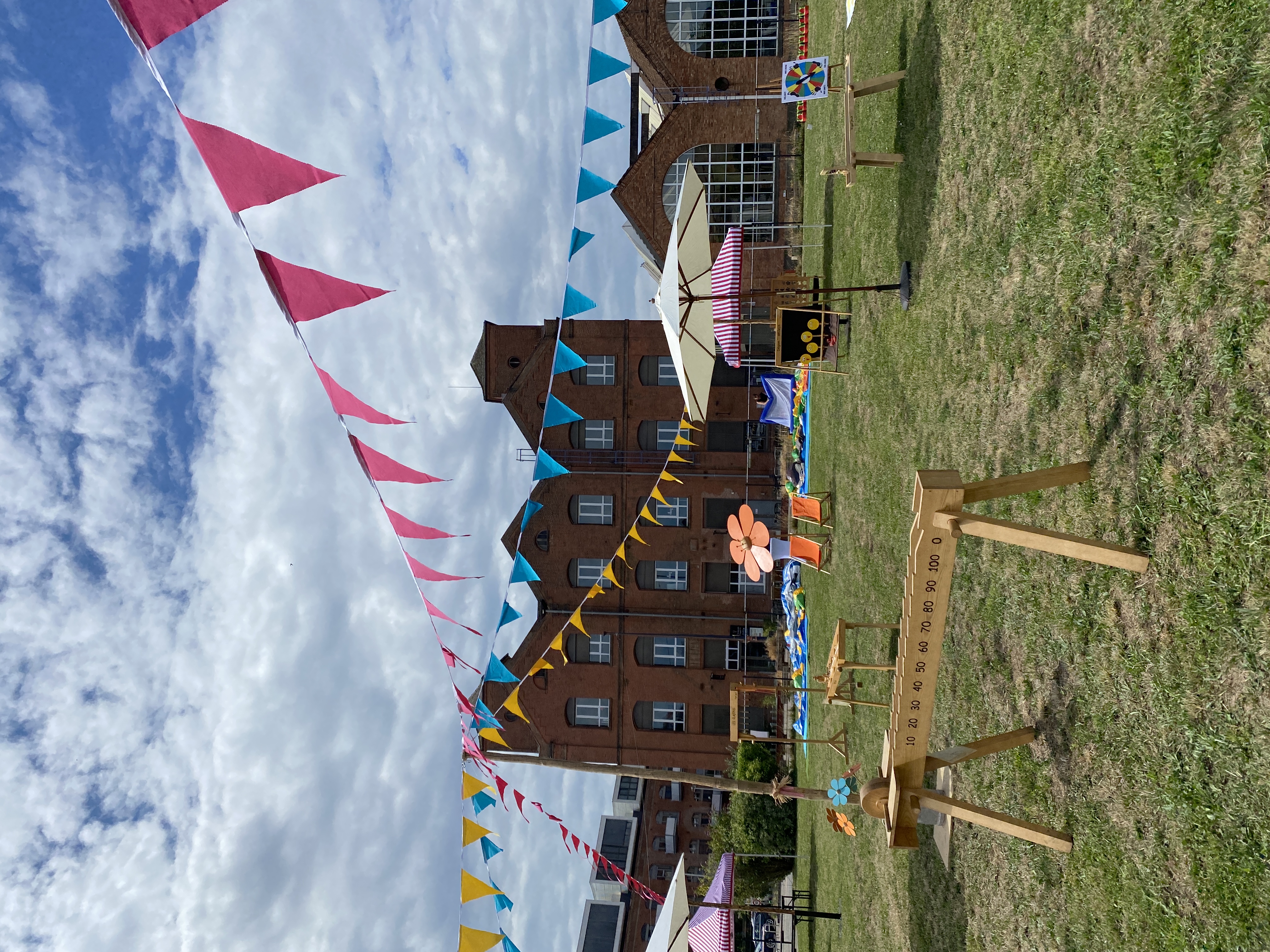
- Headquarters family day (600–1,500 people): outdoor games + food stations + kids zone + quiet zone. Key challenge: traffic flow and safety. We implement controlled entry points, wristband or ticket logic, first-aid coordination, and clear bilingual signage.
- Indoor winter funfair (250–800 people): arcade corner, skill games, roaming performers, and photo zone—built around an employee recognition moment. Key challenge: sound management and avoiding congestion near catering.
- Client + employee appreciation (150–400 people): more premium tone—smaller attractions, high-quality food, clean branding, controlled MC. Key challenge: brand image and pacing; we keep the program light and precise.
- Shift-friendly operations event: two or three waves across the day to include manufacturing or service teams. Key challenge: timing, catering throughput, and ensuring each wave feels complete rather than “second class.”
In all cases, our deliverable is not only entertainment—it’s a controlled site that protects your internal credibility. Your team should be able to host, not troubleshoot.
Common Funfair Event mistakes we prevent in Montréal
Underestimating queues: one popular station can create a 25-minute wait and kill the mood. We balance attractions by capacity and build circulation to avoid dead ends.
No power plan: plugging everything “wherever it fits” leads to breaker trips, dark zones at dusk, and vendor frustration. We map circuits and distribution in advance.
Weather contingency that isn’t operational: “we’ll move inside if it rains” doesn’t work if the indoor space isn’t booked, measured, and staged. We define a trigger time and a real pivot plan.
Not enough on-site supervision: when no one owns vendor timing, deliveries drift. We assign supervisors with checklists and radio comms.
Brand dilution: random signage, mismatched colors, and uncontrolled partner visibility can damage Communications objectives. We define brand zones and creative guardrails.
Accessibility gaps: uneven surfaces, narrow paths, or missing seating can exclude people. We plan accessible routes, rest zones, and clear information.
Sound that annoys neighbors or guests: too loud or poorly directed speakers create complaints and reduce comfort. We plan sound orientation and volume strategy.
Our role is to absorb these risks upstream—through planning, documentation, and on-site leadership—so your executives and HR team can focus on people, not problems.
Why Montréal clients repeat with INNOV'events
Repeat business in corporate events is earned in the details: predictable delivery, transparent budgets, and calm event-day leadership. Many Montréal teams come back because they can present our plans internally with confidence—and because our on-site management reduces stress for directors who are accountable for outcomes.
Single point of contact from scoping to show call: fewer internal handoffs on your side.
Planning documents delivered in advance: site plan, run-of-show, vendor list, staffing plan, and risk notes—so stakeholders can approve.
Post-event debrief with practical improvements for the next edition (flow, food throughput, timing, station mix).

Loyalty is not about habit—it’s about reduced risk. When your leadership team sees that the event runs smoothly and your staff experience is positive, the decision to repeat becomes a rational choice.
How we plan a Funfair Event in Montréal from brief to show day
👉 Montréal discovery call and constraint mapping
We confirm your objectives, audience, date windows, and success criteria. Then we identify constraints that affect feasibility: venue options, indoor/outdoor ratio, noise limits, branding requirements, accessibility needs, union considerations, and internal policies (alcohol, security, minors if families attend). Output: a concise scope and decision checklist.
👉 Concept and footprint design (capacity-first)
We propose an attraction mix based on throughput and engagement, not catalog appeal. We design a footprint with zones, circulation, and peak-hour assumptions. Output: preliminary site map, station list with capacities, and a staffing model aligned with guest flow.
👉 Budget build and options (good/better/best)
We structure the estimate with clear lines: infrastructure, entertainment, staffing, technical, catering, permits/insurance, and contingency. We include options you can arbitrate (e.g., add one food station to reduce wait time; add lighting for dusk; add a quiet zone). Output: a budget you can defend to Finance.
👉 Permits, suppliers, and production documentation
Once approved, we secure suppliers, validate technical needs, and prepare production documents: run-of-show, load-in/out schedule, power plan, signage list, and emergency procedures. We coordinate with venue management and ensure insurance certificates are ready. Output: a complete production book that reduces day-of improvisation.
👉 On-site execution and debrief
We run load-in, supervise vendors, manage queues and safety, and keep leadership informed without burdening them. After the event, we debrief on what worked, what to adjust, and what to keep for the next edition. Output: practical recommendations, not generic feedback.
FAQ sur l'organisation Funfair Event à Montréal
How far in advance should we book in Montréal?
Plan for 6–10 weeks for a standard corporate funfair. If you need outdoor permits, complex tenting, or peak-season venues, aim for 12–16 weeks. The earlier you lock the venue and load-in rules, the smoother the supplier coordination.
What budget range is realistic in Montréal for 500 employees?
Most 500-guest projects fall between $35,000 and $90,000 depending on indoor/outdoor, catering scope, staffing, and technical needs. The biggest swing factors are power/generators, tenting/weather plans, and how many stations you need to keep wait times under control.
Can a Funfair Event work indoors in Montréal winter?
Yes. Indoor funfairs often perform very well from November to March with arcade zones, skill games, roaming performers, and food stations. The keys are footprint planning (avoid choke points), sound control, and sufficient lighting for a premium look in photos.
How do you manage safety and crowd flow in Montréal?
We use a mapped site plan with capacities per zone, dedicated queue management, bilingual safety signage, and an escalation protocol (first aid, security, incident logging). For larger footprints, we deploy radio communications and assign supervisors to critical points (entry, food, anchor attractions).
Do we need permits for a corporate funfair in Montréal?
Often yes for outdoor or semi-public sites, and sometimes additional approvals even on private property (tents, generators, amplified sound, street-side access). We confirm requirements during scoping and handle the coordination so you’re not discovering obligations late in the process.
Get a Montréal quote with a clear plan, not a vague proposal
If you’re comparing agencies, we can provide a structured quote for your Funfair Event in Montréal with the information directors actually need: footprint logic, staffing approach, technical and power assumptions, realistic timelines, and budget options you can arbitrate internally.
Send us your target date(s), estimated attendance, preferred location (or constraints), and any internal policies. We’ll come back with a practical plan and a budget framework you can validate quickly—so you can announce confidently and avoid last-minute compromises.
INNOV'events Montréal Agency
Thierry GRAMMER is the manager of the INNOV'events Montréal office. Reach out directly by email at canada@innov-events.ca or via the contact form.
Contact the Montréal agencyToutes nos prestations & animations Montréal, Quebec
Découvrez nos prestations événementielles
- Employee Party in Montréal
- Corporate Christmas Party in Montréal
- Networking Cocktail Event in Montréal
- Shopping Mall Activation in Montréal
- Grand Opening Event in Montréal
- Product Launch Event in Montréal
- Open House Event in Montréal
- Field Brand Activation in Montréal
- Event Catering Service in Montréal
Découvrez nos animations événementielles disponibles au Quebec
- Event Hostess in Montréal
- Escape Game in Montréal
- MasterChef-Style Cooking Workshop in Montréal
- Corporate Magician in Montréal
- Tent Rental in Montréal
- Color Analysis Workshop in Montréal
- Inflatable Games in Montréal
- Valet Service in Montréal
- Soccer Simulator in Montréal
- LED Furniture Rental in Montréal
- LED Branding Activation in Montréal
- Immersive Culinary Experience in Montréal
- Light Painting Activity in Montréal
- Immersive Mystery Night in Montréal
- Promotional Contest in Montréal
- Promotional Materials (POS) in Montréal
- Virtual Reality Experience in Montréal
- Molecular Gastronomy Workshop in Montréal
- Halloween Event in Montréal
- Fireworks Show in Montréal
- Sports Challenge – Giant Games in Montréal
- Professional Event Host in Montréal
- Photo Booth Animation in Montréal
- Santa Claus Appearance in Montréal
- Kids Entertainment in Montréal
- Guided Tour in Montréal
- Urban Rally in Montréal
- Ball Pit Activity in Montréal
- Flight Simulator in Montréal
- Food Truck Rental in Montréal
- World Record Attempt in Montréal
- Surf Simulator in Montréal
- Soccer Simulator in Montréal
- Wine Casino in Montréal
- Makeover Workshop in Montréal
- Perfume Creation Workshop in Montréal
- Acting Workshop in Montréal
- CSR Activities in Montréal
- Archery Activity in Montréal
- Event Security Guard in Montréal
- Wine Tasting Workshop in Montréal
- Mime Performance in Montréal
- TV Game Show Animation in Montréal
- Funfair Event in Montréal
- Crisis Management Workshop in Montréal
- Crisis Negotiation Workshop in Montréal
- Arcade Games in Montréal
- Indoor Skydiving Simulator in Montréal
- Ski Simulator in Montréal
- Racetrack Driving Experience in Montréal
- Introductory Flight Experience in Montréal
- Tasting Experience in Montréal
- Build Your Own Foosball Workshop in Montréal
- 2CV Rally in Montréal
- LEGO Challenge in Montréal
- Casino Night in Montréal
- Interpreter / Translator in Montréal
- Promotional Merchandise in Montréal
- Shuttle / Transportation Service in Montréal