
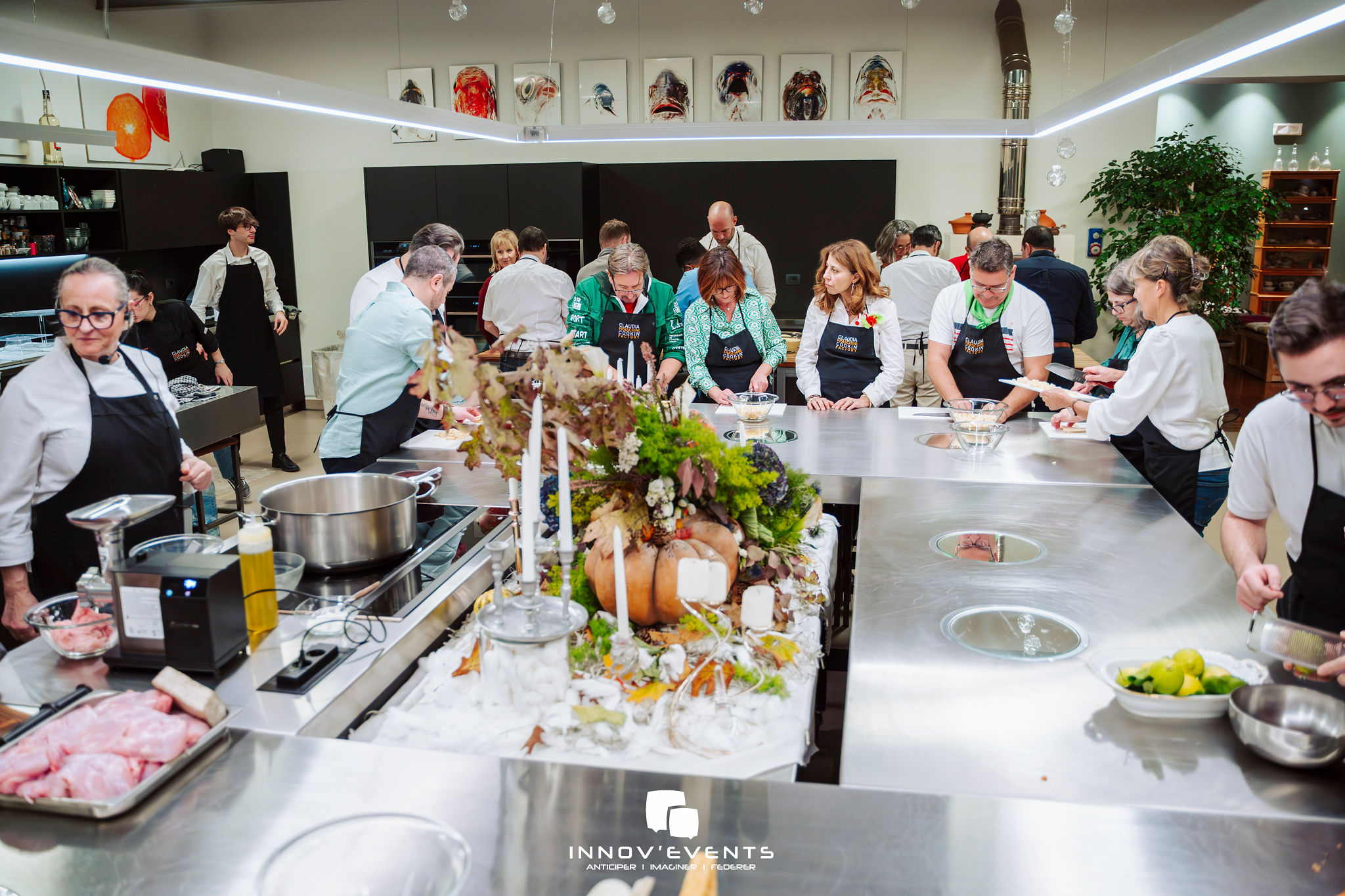
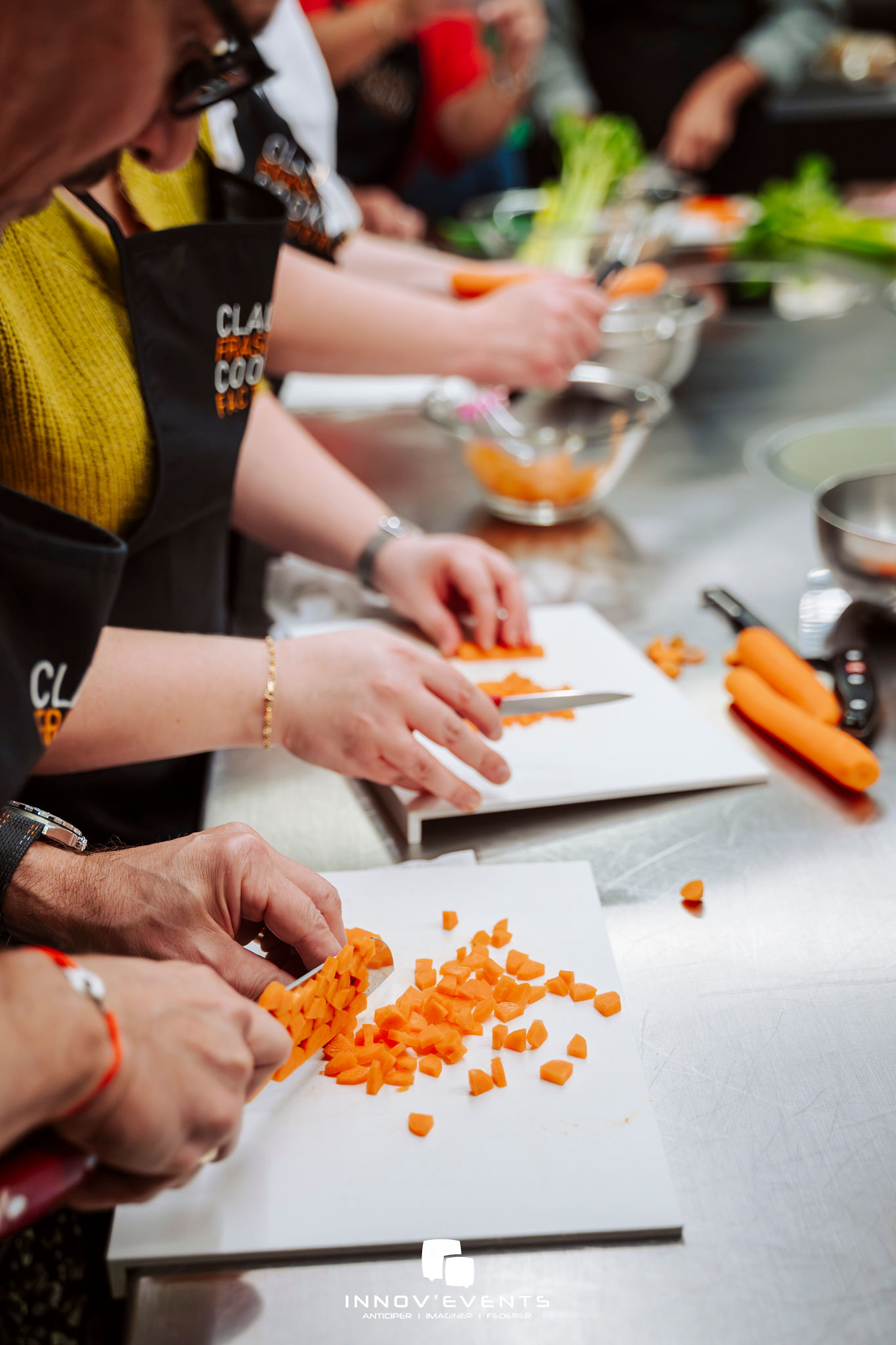
MasterChef-Style Cooking Workshop in Quebec for teams that must deliver
INNOV'events designs and runs MasterChef-Style Cooking Workshop formats for executive teams, HR and communications—typically 12 to 250 participants, in studios or on-site across Quebec. We handle the full operation: chefs, food logistics, equipment, timing, branding touchpoints, and risk management so your people can focus on the experience—not the setup.
Whether it’s an annual kickoff, leadership offsite, recognition activity or client event, we build a cooking challenge that produces measurable outcomes: faster connections, practical collaboration under time pressure, and a clean “story” you can communicate internally.
Sommaire
In a corporate agenda, entertainment is never “just a fun break.” A MasterChef-Style Cooking Workshop gives you a controlled environment where teams must coordinate, delegate, and deliver to a deadline—exactly the behaviors executives want reinforced after a reorg, merger, or major quarter.
Organizations across Quebec expect punctuality, bilingual facilitation when needed, and a level of operational polish that protects brand image. If the food is late, the stations are messy, or the judging drags, the event loses credibility instantly—especially with directors and unionized teams used to strict schedules.
Based in Montréal, INNOV'events works week-in/week-out with local venues, caterers, chefs, and technical partners. We plan like operators: load-in constraints, elevator access, MAPAQ-aligned food handling, dietary tracking, and tight run-of-show management so the event day stays calm.
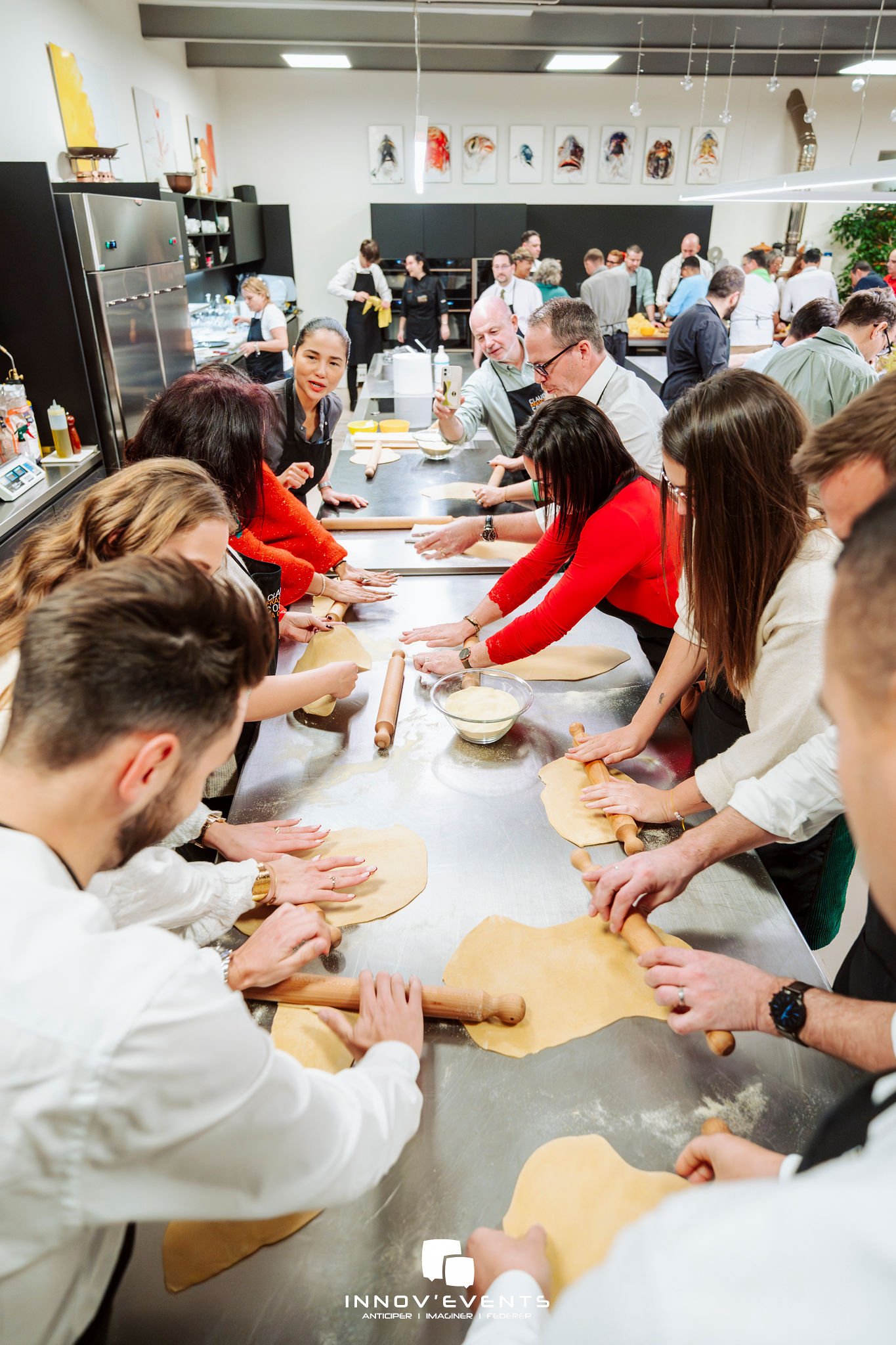
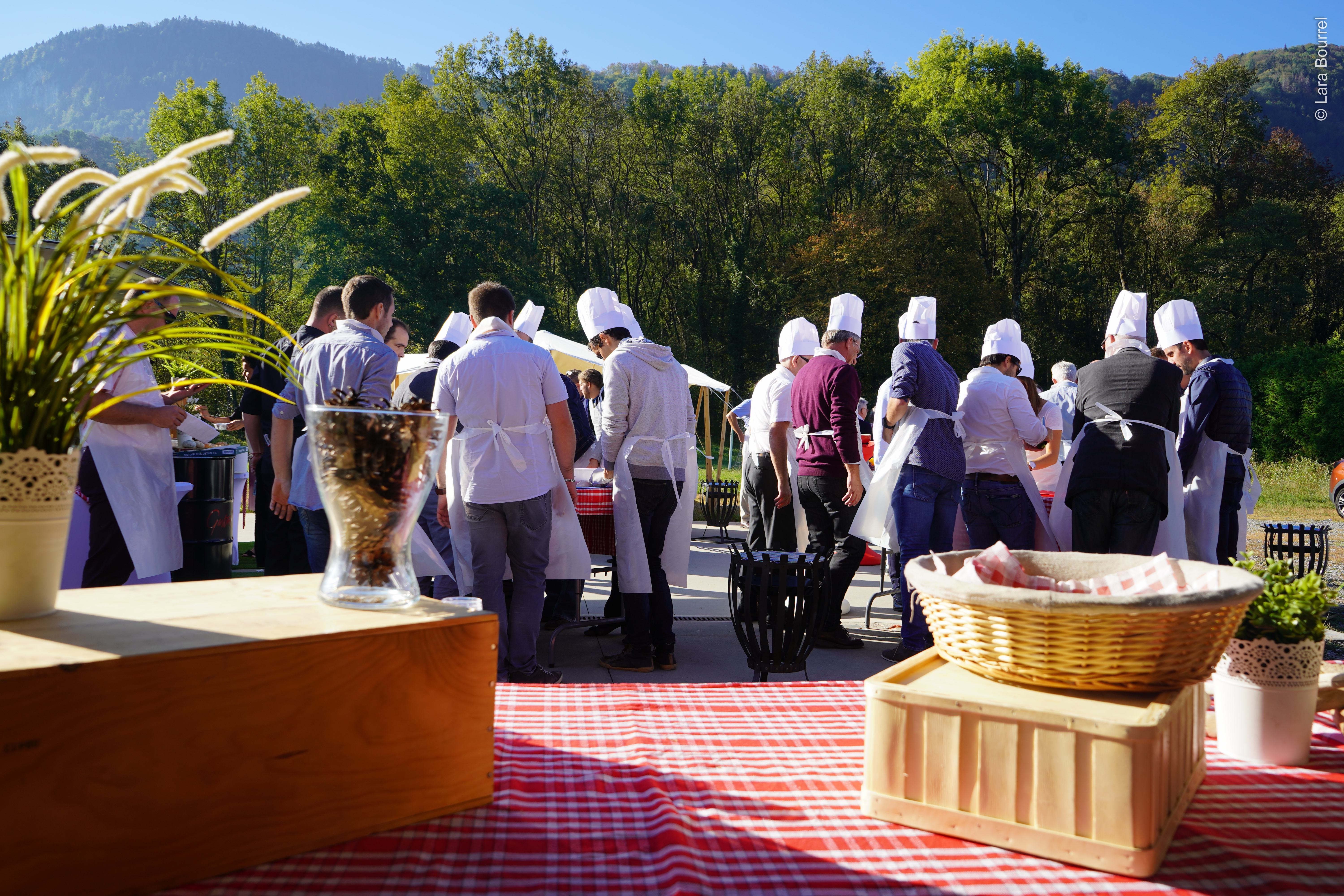
INNOV'events numbers clients in Quebec ask for before signing
10+ years delivering corporate events and team activations across Quebec, with repeat mandates from HR and internal communications teams.
Operational capacity: simultaneous deployments up to 250 participants (multi-room or staggered waves) with standardized staffing ratios and checklists.
Typical facilitation ratio: 1 chef-lead per 20–25 participants, supported by assistants and floor managers to keep timing, hygiene, and flow consistent.
Dietary coverage: we routinely manage 5 to 12 dietary constraints in the same group (vegetarian/vegan, halal options, allergies including nuts/gluten, low sodium) using pre-labeled ingredient bins.
Teams we support across Quebec, year after year
We support organizations operating across Quebec that have one thing in common: they can’t afford an event that looks improvised. Our clients include companies with distributed teams between Montréal, Québec City, Laval, the South Shore and the Eastern Townships—where travel timing, start/end discipline, and bilingual realities shape the experience.
Many of our mandates come from HR and communications teams who rebook because they want a reliable playbook: clear invitations, dietary intake forms that actually work, timing that respects unionized break rules, and an activity that lands equally well with engineers, sales, finance, and operations. When an internal brand is on the line, the trust is earned through execution—not promises.
If you’d like, we can share relevant anonymized case examples (industry, group size, constraints, outcomes) during a call, including how we handled last-minute venue changes, executive schedule shifts, and complex allergy profiles without degrading the experience.
 Besoin d’un devis rapide ?
Nous vous envoyons une première proposition sous 24h.
Why book a MasterChef cooking workshop in Quebec for leadership outcomes
A MasterChef-Style Cooking Workshop in Quebec works because it creates a safe, time-boxed “delivery pressure” that mirrors the office—without the politics. Teams must clarify roles, coordinate dependencies, and manage quality control under a deadline. For executives, that’s not abstract: it’s a practical way to observe collaboration patterns and reset habits.
We often get called after moments of change: a new VP, a restructuring, a merger integration, a post-busy-season reset, or a hybrid-work drift where people have stopped building relationships. Cooking gives you immediate feedback loops: poor communication shows up in missing ingredients and timing; good leadership shows up in calm delegation and consistent plating.
Cross-functional collaboration in real time: participants must align on a shared plan (menu, sequencing, plating) and execute with dependencies—similar to project delivery.
Role clarity without hierarchy friction: we design tasks so leadership emerges naturally (sous-chef, expediter, quality control), useful for teams where titles block initiative.
Concrete communication habits: we coach brief, operational language (“who does what by when”)—especially effective for teams spread across Quebec working remotely.
Culture reinforcement: you can embed your values into judging criteria (safety, sustainability, customer obsession, innovation) and debrief them in business terms.
Employer brand and retention: a well-run culinary challenge signals investment in people, without looking like a “forced fun” activity—important for talent markets in Montréal and Québec City.
Communications content: internal comms gets clean visuals (branded aprons, challenge boards, team names) and a narrative that supports your EVP, CSR, or leadership messaging.
Quebec has a strong “doers” culture—manufacturing, logistics, tech, finance, public sector partners—where credibility comes from being organized and on time. A cooking challenge fits that DNA: it’s hands-on, structured, and results-driven.
What Quebec organizations expect from corporate event entertainment
In Quebec, corporate groups tend to be pragmatic: they want a clear schedule, a real objective, and an experience that respects participants. That means no long speeches, no confusing rules, and no waiting around while suppliers “figure it out.” The strongest feedback we get is when employees say: “Everything was ready when we arrived, and the timing was tight.”
Local realities also matter. Many groups are hybrid or multi-site; arrival windows can be impacted by bridge traffic, winter conditions, or intercity travel between Montréal and Québec City. We build buffer time into the run-of-show, but we also design the challenge so late arrivals can integrate without penalizing a whole team.
Bilingual facilitation is another frequent requirement. We can run the event in English, French, or bilingual, but the key is not to “translate everything twice” and kill momentum. We use concise bilingual signage, chef demonstrations with visual cues, and a facilitation style that keeps pace while remaining inclusive.
Finally, risk and reputation are top of mind. A director doesn’t want the post-event conversation to be about allergies, sanitation, or a broken induction plate. Our approach is built around prevention: ingredient labeling, dedicated allergen tools, clear cleaning moments, and a tight staffing plan that keeps stations controlled.
Which MasterChef-style formats work best in Quebec corporate events?
Entertainment creates engagement when it gives participants a job to do, a time limit, and a shared finish line. A MasterChef-Style Cooking Workshop in Quebec is particularly effective because it’s tactile, social, and structured—so even reserved participants contribute. Below are formats we deploy depending on your objective, group profile, and venue constraints.
Interactive animations in Quebec
Team relay challenge (speed + coordination): teams rotate roles every 10 minutes (prep, cook, plate, expediter). This is ideal when you want people to experience handoffs—common pain points in operations and IT.
Mystery box with business constraints: each box includes “constraints” mirroring your reality (budget cut, late supplier, change request). Teams must adapt without losing quality—excellent for transformation and resilience messaging.
Judging with objective scorecards: we use transparent criteria (taste, technique, timing, cleanliness, plating). Executives appreciate fairness; participants accept outcomes because the scoring is clear.
Art animations in Quebec
Plating and visual storytelling: a short coaching segment on plating principles, then a “brand plate” prompt (e.g., reflect your company values through colors and structure). This is a powerful bridge for communications teams.
Chef demo as a keynote alternative: a concise 8–12 minute demo with a message tied to performance (prep, discipline, iteration). It replaces a long speech while keeping the room’s attention.
Innovative animations in Quebec
Local product focus: optional ingredient selection that highlights Quebec staples (seasonal produce, maple elements, regional cheeses) while staying inclusive for dietary needs. We keep it corporate: the goal is quality and logistics, not a tourism show.
Zero-waste station rules: we can integrate a measured waste challenge (weighing bins, bonus points for planning). This is relevant for ESG narratives and resonates with pragmatic teams.
Alcohol-free pairing bar: curated non-alcoholic pairings (sparkling teas, shrubs) for inclusive corporate standards, especially for daytime events or client-mix groups.
Gourmand animations in Quebec
Hybrid-ready “kitchen kit” extension: for distributed teams across Quebec, we can run an on-site competition plus a remote parallel kit (simpler recipe, coordinated timing). It keeps the experience aligned without forcing everyone to travel.
Real-time leaderboard: we can add a simple visual scoreboard (timing, cleanliness checks, bonus challenges) that increases energy while staying professional.
Micro-learning add-on: short modules on knife skills, mise en place, or food safety delivered in 3-minute bursts—useful when your HR team wants “development,” not just an activity.
Whatever the format, alignment with brand image is non-negotiable. A conservative financial institution will not want the same tone as a tech startup. We adjust language, judging style, visual branding, music levels, and photo moments so the experience supports your corporate identity in Quebec—without feeling scripted.
Where to host a cooking workshop in Quebec: venue choices that signal quality
The venue determines how professional the experience feels—often more than the menu itself. In Quebec, we see a big difference between spaces built for culinary activities and “converted” rooms that look fine on a site tour but fail under service pressure (limited sinks, poor ventilation, restricted load-in). We help you choose a setting that supports safety, timing, and executive expectations.
| Venue type | For which objective? | Main strengths | Possible constraints |
|---|---|---|---|
Professional cooking studio (Montréal / Québec City) | High-end team building, client entertaining, leadership offsite | Purpose-built stations, reliable ventilation, predictable timing, strong audiovisual options for chef demo | Fixed layout, limited branding flexibility, premium time slots book early |
Hotel event space with temporary kitchen build | Conference day + activity in same building | Single logistics footprint, easier for out-of-town attendees, strong service standards | Load-in windows, elevator access, sometimes limited sinks/three-phase power—requires detailed tech check |
On-site at your office (converted training room) | Internal culture, low travel, midday engagement | Max participation, minimal transport time, strong employer brand impact | Needs strict safety plan, waste/water management, building rules (heat/smells), security clearance for suppliers |
We strongly recommend a site visit (or at minimum a technical walkthrough) before confirming the concept. Small details—door widths for rolling racks, distance to sinks, electrical capacity, garbage staging—are what separate a clean event from a stressful one.
What does a MasterChef-Style Cooking Workshop cost in Quebec?
Budgeting for a MasterChef-Style Cooking Workshop in Quebec is mainly about operational reality: headcount, venue constraints, and the level of culinary production you expect. A serious quote should break down staffing, equipment, ingredients, venue, and management—not hide everything behind a single “per person” number.
As a reference, most corporate groups land in a range of $175 to $350+ CAD per person depending on complexity (studio vs on-site build, menu difficulty, branding, and whether you add a reception component). For executive or client-facing experiences with premium ingredients, extended service, or private venues, budgets can go beyond that range.
Group size and format: 12–30 is often one room with tight coaching; 60–150 may require multi-wave scheduling, more chefs, and additional equipment sets.
Venue type: studios include infrastructure but come with rental fees; on-site builds require transport, temporary kitchen setup, and more labor for load-in/out.
Menu and ingredient strategy: premium proteins, seasonal availability in Quebec, and allergen-free substitutions affect cost and procurement complexity.
Staffing and supervision: chef leads, assistants, floor managers, bilingual facilitators, and a show-caller to protect timing.
Dietary and allergy management: separate tools/boards, dedicated ingredient bins, labeling, and in some cases dedicated stations.
Branding and communications: aprons, signage, challenge boards, photo setup, and content capture coordination with your internal comms team.
Timing constraints: tight time windows (e.g., 90 minutes) require more prep and staffing to keep quality high.
ROI is not theoretical: when the activity is designed correctly, you reduce “soft costs” like disengagement at the kickoff, weak cross-team ties, and post-event cynicism. For HR and executives, the win is a credible moment that supports culture and execution—without creating operational headaches.
Why choose an event agency in Quebec for a cooking workshop?
Because the risks are local and operational. Food logistics, venue rules, labor timing, and winter travel realities don’t forgive remote planning. As an event agency in Quebec, we maintain relationships with culinary venues, chefs, rental suppliers, and technicians who can respond fast when the plan changes—because in real life, it does.
We also understand the internal dynamics of organizations here: bilingual groups, mix of HQ + regional sites, and leadership teams who want outcomes, not “activities.” That affects how we brief, how we facilitate, and how we report back after the event.
If you’re comparing agencies, ask who owns the run-of-show on-site, who carries liability, and who manages food safety and allergen controls. Our clients choose us because we can answer those questions clearly, in writing, and operationalize them on the floor.
For teams planning in the Québec City corridor, you can also explore our reference page for an event agency in Quebec and how we support corporate groups locally.
- Faster issue resolution: local supplier network for last-minute equipment replacement, ingredient sourcing, and staffing reinforcement.
- Venue realism: we know which spaces handle induction loads, ventilation, and load-in without slowing your schedule.
- Compliance mindset: written hygiene protocols, allergen labeling process, and clear responsibilities on-site.
- Bilingual execution: signage, facilitation and team dynamics managed without killing pace.
ROI is not theoretical: when the activity is designed correctly, you reduce “soft costs” like disengagement at the kickoff, weak cross-team ties, and post-event cynicism. For HR and executives, the win is a credible moment that supports culture and execution—without creating operational headaches.





Examples of cooking workshops delivered in Quebec corporate contexts
We deliver culinary challenges for a wide range of corporate realities in Quebec: leadership offsites where the CEO needs a controlled, high-quality experience; HR-driven team building after a restructuring; sales kickoffs where energy must be high but timing cannot slip; and client events where the brand must look premium and discreet.
In practice, the difference is in the constraints. We’ve built on-site kitchens in office towers with strict security and limited loading access, where every crate had to be pre-approved and timed to an elevator schedule. We’ve run multi-wave sessions for 180+ participants to respect room capacity and ensure everyone cooks rather than watches. We’ve also managed groups with complex dietary profiles by pre-building clearly labeled ingredient sets per station, plus a dedicated “allergen-safe” prep flow.
We adapt the narrative to your organization: a manufacturing group may focus on standard work and quality checks; a tech group may focus on iteration and sprint roles; a professional services firm may focus on communication clarity and client-facing polish. The activity stays the same; the business message becomes precise.
Common mistakes companies make with cooking events in Quebec
Underestimating venue constraints: not enough sinks, weak ventilation, or insufficient electrical capacity leads to delays and quality issues.
Choosing recipes that don’t match the time box: ambitious dishes create stress, uneven results, and frustration—especially for participants who are not comfortable in a kitchen.
Loose allergen handling: vague “we’ll manage it” is a liability. You need a documented labeling and tool-separation process.
Over-talking the briefing: long instructions kill momentum. We keep it short, visual, and role-based.
Unfair judging: if criteria aren’t transparent, you create skepticism. Scorecards and consistent judges matter.
No debrief: without a structured close, leadership loses the opportunity to connect behaviors to business outcomes.
Our role is to prevent these risks before they become visible. We plan with checklists, technical validations, and clear accountability so your event in Quebec looks deliberate from arrival to wrap-up.
Why Quebec clients rebook INNOV'events for culinary team building
Repeat business is rarely about “creativity.” It’s about operational trust: executives want to know the event will start on time, look professional, and land with the right tone for their culture. HR wants fewer issues to manage and a partner who can absorb complexity—dietary, scheduling, and internal approvals—without escalating every detail.
We earn loyalty by documenting what worked and reusing the right parts: staffing ratios, venue learnings, recipe timing, and participant communications. Each iteration becomes smoother, not “different for the sake of being different.” That’s what directors look for when they compare agencies.
High repeat rate: many clients rebook within 12 to 18 months for another team, another site, or an annual moment (kickoff, recognition, leadership day).
Operational predictability: standardized prep lists and run-of-show templates reduce decision fatigue for HR and office managers.
Stakeholder alignment: we’re used to working with Communications, HR, and an executive sponsor at once—so approvals don’t drift.

Loyalty is the clearest proof point in corporate events. In Quebec, where networks are tight and reputations travel fast, our priority is to deliver work that people feel comfortable recommending internally.
How we plan your MasterChef-Style Cooking Workshop in Quebec
👉 Quebec scoping call: objectives, constraints, and success metrics
We start with a structured briefing with HR and/or the executive sponsor: purpose (integration, recognition, leadership behaviors), audience profile, bilingual needs, budget range, desired tone, and hard constraints (venue, timing, dietary). We also define what “success” means: participation rate, collaboration behaviors, internal comms outputs, or a clean schedule with no overruns.
Deliverable: a written summary with recommended format options and a preliminary run-of-show aligned to your Quebec context (travel windows, winter contingencies, room turnaround times).
👉 Venue and technical validation in Quebec
We validate the site like operators: power capacity, ventilation, sinks, load-in access, staging space, garbage flow, and any building rules that affect cooking. If it’s a studio, we confirm station counts and equipment. If it’s on-site, we map the temporary kitchen layout and safety perimeter.
Deliverable: a technical checklist and layout plan that prevents day-of improvisation.
👉 Menu design, procurement, and dietary control
We propose menus that balance challenge and feasibility. We select ingredients that are reliable to source in Quebec and build substitution logic for dietary constraints. We collect restrictions through a clean process (form + cut-off date) and prepare labeled ingredient bins per station to reduce cross-contact risk.
Deliverable: menu sheet, allergen notes, and ingredient workflow.
👉 Production plan: staffing, timing, and brand touchpoints
We staff according to headcount and complexity: chef-leads, assistants, a show-caller, and support for check-in and room flow. We build a minute-by-minute run-of-show and identify where branding makes sense (aprons, signage, challenge boards) without cluttering the room.
Deliverable: final run-of-show, staffing plan, and brand integration plan.
👉 Event-day execution and structured debrief
On the day, we manage load-in, station readiness, participant flow, and timing. We keep the energy high while protecting safety and cleanliness. Judging uses clear scorecards, and we end with a concise debrief tied to your business language—so HR and executives can reuse the learnings internally.
Deliverable: post-event recap (what worked, what to improve, optional photo/content handoff coordination).
FAQ sur l'organisation MasterChef-Style Cooking Workshop à Quebec
How long is a MasterChef workshop in Quebec normally?
Most corporate groups in Quebec choose 2 to 3 hours door-to-door: 10–15 minutes briefing, 75–105 minutes cooking, 20–30 minutes judging, and a 10-minute business debrief. For leadership offsites, we can extend to 3.5 hours with deeper coaching.
What group size works best in Quebec cooking venues?
The sweet spot is 16 to 60 participants in one wave. We can scale to 120 to 250 with multi-wave scheduling or multi-room setups, but the venue must support station count, ventilation, and turnaround logistics.
Can you run a bilingual cooking workshop in Quebec?
Yes. We run English, French, or bilingual sessions across Quebec. The key is operational signage and facilitation design: concise bilingual instructions, visual demos, and team roles that keep pace without repeating every message twice.
How do you manage allergies at Quebec corporate cooking events?
We use a cut-off date for restrictions, then prepare pre-labeled ingredient bins, separate tools when required, and an allergen-aware workflow (including nut/gluten handling). If the risk profile is high, we add a dedicated station or simplified menu to keep safety and enjoyment compatible.
Can we host the cooking workshop at our office in Quebec?
Often yes, if the space supports power, ventilation, and safe circulation. We typically convert a training room or cafeteria and bring induction equipment, prep tables, and sanitation points. Expect a setup/teardown window of 3 to 5 hours total depending on headcount and building access rules.
Get a Quebec quote with a clear plan and real operational answers
If you’re comparing agencies, we can make your decision easier with a practical proposal: recommended format options, staffing ratios, timing, venue requirements, and a transparent budget structure for a MasterChef-Style Cooking Workshop in Quebec. Share your target date, city, headcount range, and any constraints (bilingual, dietary, timing), and we’ll come back with a plan that protects your brand and your schedule.
For best venue availability—especially in peak periods (September–December and late winter)—we recommend starting 4 to 8 weeks ahead. If your timeline is tighter, tell us; we’ll confirm feasibility quickly and propose a realistic path.
INNOV'events Quebec Agency
Thierry GRAMMER is the manager of the INNOV'events Quebec office. Reach out directly by email at canada@innov-events.ca or via the contact form.
Contact the Quebec agencyToutes nos prestations & animations Quebec, Quebec
Découvrez nos prestations événementielles
Découvrez nos animations événementielles disponibles au Quebec
- Event Hostess in Quebec
- Escape Game in Quebec
- MasterChef-Style Cooking Workshop in Quebec
- Corporate Magician in Quebec
- Tent Rental in Quebec
- Color Analysis Workshop in Quebec
- Inflatable Games in Quebec
- Valet Service in Quebec
- Soccer Simulator in Quebec
- LED Furniture Rental in Quebec
- LED Branding Activation in Quebec
- Immersive Culinary Experience in Quebec
- Light Painting Activity in Quebec
- Immersive Mystery Night in Quebec
- Promotional Contest in Quebec
- Promotional Materials (POS) in Quebec
- Virtual Reality Experience in Quebec
- Molecular Gastronomy Workshop in Quebec
- Halloween Event in Quebec
- Fireworks Show in Quebec
- Sports Challenge – Giant Games in Quebec
- Professional Event Host in Quebec
- Photo Booth Animation in Quebec
- Santa Claus Appearance in Quebec
- Kids Entertainment in Quebec
- Guided Tour in Quebec
- Urban Rally in Quebec
- Ball Pit Activity in Quebec
- Flight Simulator in Quebec
- Food Truck Rental in Quebec
- World Record Attempt in Quebec
- Surf Simulator in Quebec
- Soccer Simulator in Quebec
- Wine Casino in Quebec
- Makeover Workshop in Quebec
- Perfume Creation Workshop in Quebec
- Acting Workshop in Quebec
- CSR Activities in Quebec
- Archery Activity in Quebec
- Event Security Guard in Quebec
- Wine Tasting Workshop in Quebec
- Mime Performance in Quebec
- TV Game Show Animation in Quebec
- Funfair Event in Quebec
- Crisis Management Workshop in Quebec
- Crisis Negotiation Workshop in Quebec
- Arcade Games in Quebec
- Indoor Skydiving Simulator in Quebec
- Ski Simulator in Quebec
- Racetrack Driving Experience in Quebec
- Introductory Flight Experience in Quebec
- Tasting Experience in Quebec
- Build Your Own Foosball Workshop in Quebec
- 2CV Rally in Quebec
- LEGO Challenge in Quebec
- Casino Night in Quebec
- Interpreter / Translator in Quebec
- Promotional Merchandise in Quebec
- Shuttle / Transportation Service in Quebec