
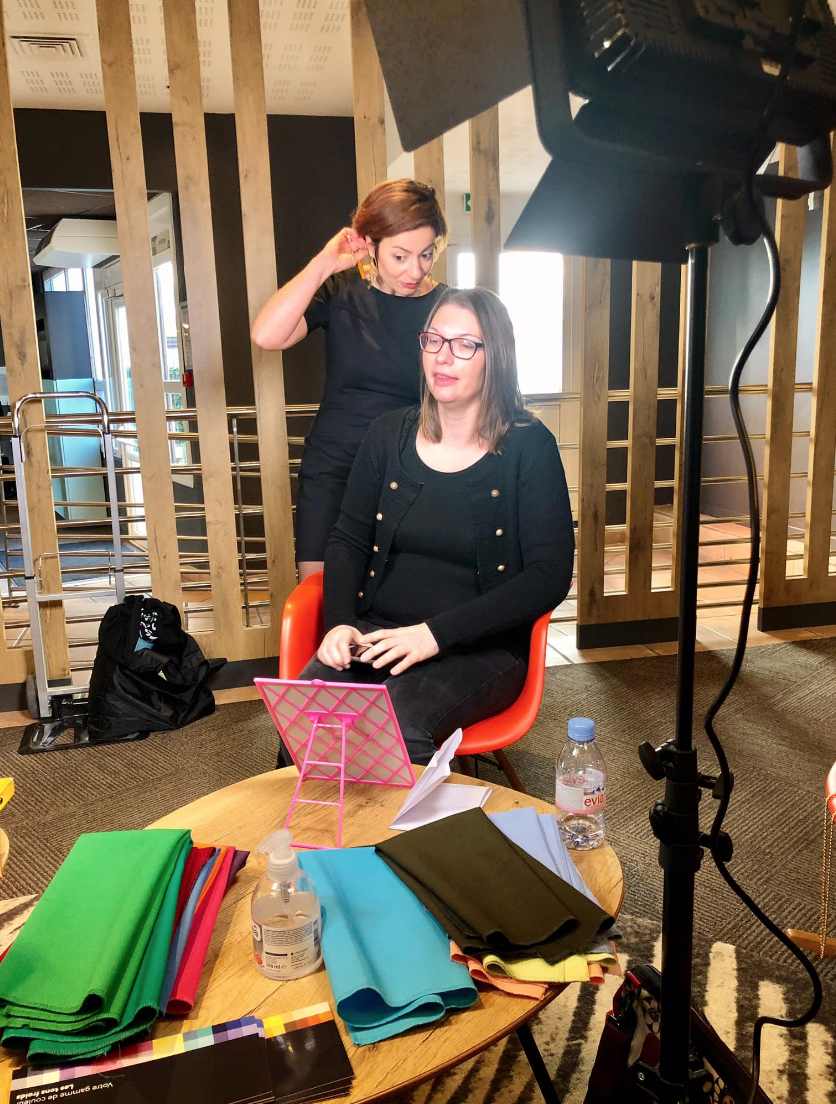
Color Analysis Workshop in Montréal for confident, brand-aligned teams
INNOV'events designs and delivers Color Analysis Workshop formats for executives, HR and communication teams in Montréal, typically for 15 to 150 attendees. We manage the full production: facilitator selection, participant flow, venue fit, timing, and on-site coordination—so your team gets a measurable outcome, not a “nice activity.”
Whether your objective is leadership presence, client-facing consistency, or employee confidence, we structure the workshop to fit your schedule constraints (lunch-and-learn, half-day, or integrated into a conference agenda) and your brand rules.
Sommaire
In a corporate agenda, entertainment is only strategic when it removes friction: hesitation in front of clients, inconsistent visual codes, or lack of confidence on stage. A Color Analysis Workshop becomes a practical tool when it is aligned with roles (sales, execs, spokespeople) and translates into behaviors people can apply the next morning.
In Montréal, organizations expect efficiency, bilingual facilitation when needed, and a format that respects brand standards and diverse identities. Decision-makers also want predictable timing, clean logistics, and a workshop that won’t derail the rest of the event run-of-show.
INNOV'events is an event agency in Montréal with field experience in corporate environments: tight schedules, sensitive brand considerations, and the pressure of event day. We design the workshop like a project deliverable—clear scope, defined outputs, and professional on-site execution.
INNOV'events credibility benchmarks in Montréal
10+ years coordinating corporate activations and learning experiences in Québec, including executive offsites, internal conferences, and client events.
200+ facilitated sessions delivered through our network of vetted facilitators (image consultants, stylists, corporate trainers), with standardized briefing and quality controls.
15 to 1,200 attendees managed across formats—small leadership cohorts to multi-track conferences—using the same discipline: run-of-show, risk register, and on-site coordination.
On-site coverage: typically 1 coordinator per 40–60 attendees for workshop-type flows, so participant movement and timing stay under control.
Montréal corporate references and long-term partnerships
We support organizations across Montréal that run recurring internal moments—leadership days, recognition events, annual kickoffs—where consistency matters more than novelty. Several clients renew year after year because the operational load is real: stakeholder alignment, procurement, union/venue rules, AV constraints, and last-minute changes that can’t be “winged.”
You mentioned sharing reference names; once you provide them, we can integrate them transparently in this section (for example: “supported communications teams at X, Y, Z in downtown Montréal and the West Island”). In the meantime, our approach stays the same: we operate with a documented scope, pre-event testing, and a clear escalation path on event day—so your internal team is not forced into troubleshooting mode.
If your organization has brand governance (communications approval, wardrobe guidelines for spokespeople, or DEI considerations), we adapt the workshop content and deliverables to meet those standards without putting participants in uncomfortable situations.
 Besoin d’un devis rapide ?
Nous vous envoyons une première proposition sous 24h.
Why run a Color Analysis Workshop in Montréal for leaders
A Color Analysis Workshop in Montréal is most valuable when you treat it as a capability-building module, not a “fun add-on.” We see it work particularly well for executives, HR and communications teams because it touches three real corporate levers: presence (how leaders are perceived), coherence (brand and message alignment), and confidence (how comfortable people feel in client-facing situations).
In practice, organizations come to us when they are dealing with concrete issues: executives preparing for media appearances, sales teams attending major trade events, a rebrand that introduced new visual standards, or simply a desire to strengthen inclusion by giving everyone tools that respect different skin tones and styles.
Stronger executive presence for presentations and media: participants learn to choose colors that support clarity on camera and under stage lighting (common issue: colors that look fine in office light but wash out on video).
Better alignment between personal image and corporate brand: communications teams appreciate when spokespeople’s wardrobe choices stop fighting the brand palette, especially during client events, keynote panels, and investor meetings.
Practical onboarding and confidence for client-facing roles: new managers and account teams often ask “what’s appropriate?” The workshop provides a repeatable decision framework rather than subjective opinions.
DEI-sensitive approach to style guidance: a well-run color analysis avoids one-size-fits-all rules; it recognizes diverse undertones and personal expression while staying professional.
Measurable outcomes for HR: you can capture outputs such as a personal palette card, do/don’t guidelines, and a post-workshop checklist—useful for ongoing coaching or leadership programs.
Reduced last-minute stress before major events: we often hear, “Our executives were scrambling for outfits the week before.” A structured workshop reduces that scramble ahead of conferences or photo shoots.
Montréal is a relationship-driven market where brand perception travels quickly across networks. When your leaders and client-facing teams look coherent and confident, it supports credibility—not only at the event, but in the meetings that follow.
What Montréal organizations expect from corporate entertainment
Local teams are demanding for good reasons: venues in Montréal have strict load-in windows, downtown traffic affects arrival times, and bilingual audiences are common even in internal events. For a workshop like color analysis, the expectation is also about psychological safety—participants must feel respected, never judged. That’s where facilitation quality matters.
On the ground, we see three recurring constraints:
- Agenda compression: leadership teams want a high-value module in 45 to 90 minutes, sometimes between plenary sessions. The workshop must be designed to deliver outputs fast, with no time wasted on vague theory.
- Brand and reputational risk: communications directors will not accept advice that clashes with corporate dress codes, brand guidelines, or public positioning. We brief facilitators on your constraints and validate examples in advance.
- Operational predictability: HR needs clean participant flow (check-in, small groups, timeboxing) and a format that scales without chaos. We structure stations and rotations so no one is left waiting, and we protect the schedule.
Finally, many Montréal organizations prefer vendors who understand local realities—unionized venues, supplier access rules, and how quickly conditions change during winter months. We plan with buffers and contingency options so the event day remains calm.
Which workshop formats work best in Montréal corporate events
Entertainment creates engagement when it helps people do something better at work. In a Color Analysis Workshop, that engagement comes from relevance: leaders immediately see how color choices affect authority, approachability, and clarity—especially under stage lights, in board photos, and on video calls. Below are formats we deploy in Montréal depending on your objectives and time available.
Interactive animations in Montréal
Executive presence clinic (45–60 min): a tight format built for leadership teams—quick analysis, camera/stage guidance, and a “what to wear for key moments” checklist (town hall, media, client pitch).
Small-group palette stations (90–120 min): participants rotate through stations with timed slots. Best when you need individualized attention without extending the agenda.
Brand palette alignment lab (60–90 min): communications + spokespeople map personal palettes to corporate brand colors and identify safe combinations for events, panels, and photos.
Virtual pre-assessment + on-site optimization: for distributed teams, we do a structured intake (photos + questionnaire) before the event and use on-site time for validation and application.
Art animations in Montréal
Color storytelling for speakers (30–45 min add-on): a short module for presenters on how color supports message hierarchy and perceived credibility during keynotes.
Professional headshot coordination: when combined with photography, we create guidance so wardrobe choices work with backdrop, lighting, and brand visuals—reducing retouching needs.
Innovative animations in Montréal
Palette-to-table pairing (optional): catering and staging can echo the event color story (without being gimmicky). We coordinate subtle details—napkins, florals, signage—so the room reads “coherent” in photos.
Networking lounge with guided prompts: a structured networking corner where participants compare “work staples” and share practical tips; effective for HR engagement in recognition events.
Gourmand animations in Montréal
Digital palette card and wardrobe planner: participants receive a QR-linked summary with recommended neutrals, accent colors, and shopping guidelines aligned to Montréal retail realities (availability, seasonality).
On-camera test booth: quick before/after clips under controlled lighting to demonstrate how color impacts perception. Useful for communications teams preparing leaders for video content.
Inclusive facilitation protocol: language and approach designed to avoid judgment, respect cultural expression, and keep guidance professional—particularly important in diverse Montréal teams.
Whatever the format, we keep the same rule: the workshop must reinforce your brand image. That means no improvised advice, no fashion “opinions,” and no aesthetics that conflict with your organization’s positioning. We align examples, vocabulary, and outputs with what your leaders are expected to embody in the market.
Where to host a workshop in Montréal for the right impact
Venue choice changes how a Color Analysis Workshop in Montréal is perceived. A boardroom suggests executive rigor; a studio space supports lighting accuracy; a hotel meeting room offers predictable service levels. The wrong room creates operational problems: mixed lighting, lack of mirrors, noise spillover, and participant congestion.
| Venue type | For which objective? | Main strengths | Possible constraints |
|---|---|---|---|
| Downtown hotel meeting room (Ville-Marie) | Integrate the workshop into an offsite or conference agenda | Predictable service, controlled timing, nearby transit, easy add-on AV | Lighting may be mixed; may require supplemental lamps and blackout control |
| Corporate office boardroom in Montréal | Executive team session, comms/spokesperson alignment | High privacy, minimal travel, aligns with leadership tone | Room size limits station rotation; security access and freight elevator rules |
| Photo/creative studio (Plateau / Mile End) | High-accuracy color diagnosis + content capture (headshots/video) | Best lighting control, professional mirrors, seamless backdrops | Requires logistics planning for catering and accessibility; parking constraints |
| Old Montréal event space | Client-facing event with premium brand perception | Strong ambiance and photo value; good for hosted experiences | Heritage spaces can have limited load-in windows and acoustic challenges |
We strongly recommend a site visit (or at minimum a technical walkthrough) before confirming the setup. For color analysis, details matter: window exposure, bulb temperature, mirror placement, and flow between stations. A 30-minute visit can prevent hours of event-day adjustments.
What does a Color Analysis Workshop cost in Montréal
Pricing for a Color Analysis Workshop in Montréal depends on format, level of personalization, and operational complexity. The main cost driver is not “the idea,” but the number of skilled facilitation hours and the station design needed to serve your group without rushing.
As a planning reference, corporate workshops in the city typically fall in these ranges:
- $2,500 to $5,000 for a compact session (15–25 people) with one senior facilitator and standard deliverables.
- $5,000 to $12,000 for a scalable station format (30–80 people) with multiple facilitators, rotations, and robust participant materials.
- $12,000 to $25,000+ when integrating photography/video, bilingual facilitation, premium venue requirements, or high-touch executive customization.
Headcount and time per person: the difference between a quick group-based approach and individualized analysis is significant in staffing and schedule design.
Number of stations and facilitators: to avoid queues, we size staffing based on target throughput (e.g., 8–12 minutes per participant at diagnosis).
Deliverables: printed palette cards, digital summaries, wardrobe checklists, and any branded materials.
Venue and lighting requirements: if we need to bring lighting, mirrors, or partitions to create privacy, it impacts costs.
Bilingual delivery: bilingual facilitation and materials (EN/FR) require preparation and proofreading, not just live translation.
Integration with other event elements: if the workshop is part of a larger program, we coordinate run-of-show, AV, and transitions (often where agencies prevent costly delays).
From an ROI perspective, executives usually justify this workshop when it reduces prep time before major moments (conferences, media, investor meetings) and improves consistency in public-facing interactions. The value is not theoretical: fewer last-minute purchases, fewer “wardrobe emergencies,” and stronger visual coherence in photos and videos that live long after the event.
Why choose a Montréal agency for this workshop
For HR and communications teams, the stress is rarely about the concept—it’s about execution under real conditions. Working with an agency established in Montréal means faster site access, stronger local supplier coordination, and facilitators who understand the cultural expectations of Québec workplaces.
We operate with the discipline your leadership expects: documented run-of-show, staffing plan, and a clear division of responsibilities with your internal stakeholders. When a room change happens, a VIP arrives late, or the agenda shifts, we manage the impact on flow so your team doesn’t lose control of the day.
- Local venue fluency: we anticipate load-in windows, building access rules, and downtown timing constraints that can derail workshops.
- Vetted Montréal facilitator network: image consultants and trainers who can deliver professionally in corporate environments (not retail-style advising).
- Operational reactivity: same-week site visits, backup staffing options, and on-the-ground coordination.
- Brand governance comfort: we are used to working with communications approvals, executive assistants, and risk-sensitive leadership contexts.
From an ROI perspective, executives usually justify this workshop when it reduces prep time before major moments (conferences, media, investor meetings) and improves consistency in public-facing interactions. The value is not theoretical: fewer last-minute purchases, fewer “wardrobe emergencies,” and stronger visual coherence in photos and videos that live long after the event.









What we’ve delivered in Montréal and what it proves
Across Montréal, we deliver projects where the common requirement is control: timing, brand integrity, and participant experience. In practice, a color analysis workshop often sits inside a larger program—leadership summit, client conference, employer branding event—and has to fit the machine without disrupting it.
Examples of real corporate situations we routinely manage:
- Leadership offsite with tight scheduling: the CEO wanted a practical module between strategy sessions. We structured a 60-minute executive clinic with pre-intake, so the on-site segment stayed focused and ended exactly on time.
- Communications team preparing spokespeople: the goal was consistency across events and video content. We aligned personal palettes with brand constraints, and built a simple “approved combinations” guide used for months after.
- Recognition event with mixed seniority levels: HR needed a format that felt inclusive and professional. We created multiple stations and a privacy-first layout to avoid participants feeling judged in front of peers.
- Conference add-on with photography: we coordinated wardrobe guidance with the photographer’s lighting plan to reduce retouching and produce consistent headshots for internal directories and LinkedIn.
What this proves is not creativity; it’s repeatability. We design workshops that survive real-world constraints: late arrivals, room changes, bilingual needs, and high expectations from leadership.
Common mistakes we prevent in Montréal workshops
Underestimating time per participant: a workshop collapses when you try to serve 60 people with one station. We model throughput and staff accordingly.
Using unsuitable lighting: mixed daylight and warm bulbs distort color perception. We assess and control lighting so recommendations are credible.
No privacy plan: people disengage when the analysis feels like public judgment. We design layouts with partitions and respectful facilitation.
Generic advice that conflicts with brand standards: communications teams lose trust immediately. We align guidance with dress codes, brand palette, and role expectations.
Overloading the agenda: if the workshop competes with keynotes or awards, it creates resentment. We integrate it into the run-of-show with clean transitions.
Skipping participant intake: without knowing roles and needs, the content becomes superficial. A short pre-event questionnaire improves relevance dramatically.
Our role is to remove these risks before they show up on event day. That’s what executives pay for: predictable delivery, professional tone, and outputs that stand up to scrutiny.
Why Montréal clients renew with INNOV'events
Renewal happens when an agency reduces your internal workload and protects your reputation. In Montréal, many organizations operate with lean HR and communications teams; they can’t afford a vendor who requires constant supervision. We build long-term relationships by being consistent: clear scopes, reliable staffing, and no surprises.
Most recurring clients work with us for at least 2 to 4 internal events per year, often mixing learning modules, recognition moments, and leadership programming.
Repeat formats: workshops that generate usable deliverables (palette cards, spokesperson guidelines, wardrobe checklists) are the ones clients bring back, sometimes with new cohorts every quarter.
Operational continuity: we document setup, timings, and lessons learned so the next edition is smoother and usually shorter to plan.

Loyalty is not about habit; it’s about risk reduction. When your directors know the workshop will run on time, respect the brand, and leave participants with practical tools, renewing becomes the rational choice.
How we run a Color Analysis Workshop project in Montréal
👉 Scope and stakeholder alignment in Montréal
We start with a short working session with HR and communications to define the objective (executive presence, spokesperson coherence, onboarding, recognition). We confirm constraints: dress code, brand palette, DEI considerations, bilingual needs, and timing. Output: a written scope with success criteria, target audience, and a draft run-of-show.
👉 Facilitator selection and corporate briefing in Montréal
We propose facilitators based on your audience and tone expectations (executive coaching style vs. more general employee format). We brief them with your brand constraints and event context. Output: facilitator plan (who does what), language approach, and sample guidance aligned to your organization.
👉 Venue and technical setup planning in Montréal
We validate the room for lighting, mirrors, privacy and flow. If needed, we specify supplemental lighting, partitions, and signage. Output: a layout plan, equipment list, load-in schedule, and a staffing ratio matched to throughput.
👉 Participant intake and personalization for Montréal teams
We run a short pre-event questionnaire to capture roles, use cases (client meetings, on-camera, stage), and any sensitivities. For high-touch formats, we can also pre-sort participant slots. Output: participant plan that improves relevance and reduces event-day time loss.
👉 On-site delivery and run-of-show control in Montréal
On event day, our coordinator manages check-in, rotations, timing, and any escalations. We protect the schedule and participant experience, and we adapt calmly to real-time changes (late arrivals, room swaps, VIP time constraints). Output: smooth delivery with documented timings and issues resolved without involving your leadership.
👉 Post-event deliverables and reuse in Montréal programs
We distribute palette cards or digital summaries, and we can provide a simple internal guide for HR/comms to reuse (e.g., “camera-safe options,” “client meeting staples,” “approved brand-aligned combinations”). Output: assets that extend the value beyond the event day.
FAQ sur l'organisation Color Analysis Workshop à Montréal
How long should a Color Analysis Workshop in Montréal last?
Most corporate formats run 45 to 120 minutes. For executives with tight schedules, 45–60 minutes works if you pre-collect needs. For individualized analysis in larger groups, plan 90–120 minutes with multiple stations.
How many facilitators do we need in Montréal for 60 people?
For 60 participants, we typically plan 2 to 4 facilitators depending on the depth of analysis and time available. A common operational target is 8–12 minutes per participant at the diagnosis station, plus time for explanation and Q&A.
Can the workshop be bilingual in Montréal (EN/FR)?
Yes. We can deliver bilingual facilitation and bilingual materials. Expect some additional prep time for terminology consistency and examples that work in both languages; it’s not just live translation.
What setup is required for accurate color analysis in Montréal venues?
You need consistent lighting, mirrors, and a layout that supports privacy. We assess the room’s light temperature and window exposure; if needed we add supplemental lighting. We also plan partitions and rotation space so participants aren’t analyzed in a crowded line.
Is a Color Analysis Workshop appropriate for client events in Montréal?
It can be, if positioned professionally and aligned to your brand. For client-facing formats, we recommend a shorter, polished experience (often 30–60 minutes) with optional individual mini-sessions, clear brand alignment, and discreet facilitation to protect participant comfort.
Request a quote for a Color Analysis Workshop in Montréal
If you’re comparing agencies, we suggest starting with three inputs: headcount, time slot (45/60/90/120 minutes), and the business objective (executive presence, spokesperson alignment, onboarding, or recognition). With those, we can recommend the right format, staffing, and venue setup—without overscoping.
Contact INNOV'events to plan your Color Analysis Workshop in Montréal. The earlier we lock the venue and staffing, the easier it is to guarantee lighting accuracy, smooth rotations, and an experience that reflects your brand standards.
INNOV'events Montréal Agency
Thierry GRAMMER is the manager of the INNOV'events Montréal office. Reach out directly by email at canada@innov-events.ca or via the contact form.
Contact the Montréal agencyToutes nos prestations & animations Montréal, Quebec
Découvrez nos prestations événementielles
- Employee Party in Montréal
- Corporate Christmas Party in Montréal
- Networking Cocktail Event in Montréal
- Shopping Mall Activation in Montréal
- Grand Opening Event in Montréal
- Product Launch Event in Montréal
- Open House Event in Montréal
- Field Brand Activation in Montréal
- Event Catering Service in Montréal
Découvrez nos animations événementielles disponibles au Quebec
- Event Hostess in Montréal
- Escape Game in Montréal
- MasterChef-Style Cooking Workshop in Montréal
- Corporate Magician in Montréal
- Tent Rental in Montréal
- Color Analysis Workshop in Montréal
- Inflatable Games in Montréal
- Valet Service in Montréal
- Soccer Simulator in Montréal
- LED Furniture Rental in Montréal
- LED Branding Activation in Montréal
- Immersive Culinary Experience in Montréal
- Light Painting Activity in Montréal
- Immersive Mystery Night in Montréal
- Promotional Contest in Montréal
- Promotional Materials (POS) in Montréal
- Virtual Reality Experience in Montréal
- Molecular Gastronomy Workshop in Montréal
- Halloween Event in Montréal
- Fireworks Show in Montréal
- Sports Challenge – Giant Games in Montréal
- Professional Event Host in Montréal
- Photo Booth Animation in Montréal
- Santa Claus Appearance in Montréal
- Kids Entertainment in Montréal
- Guided Tour in Montréal
- Urban Rally in Montréal
- Ball Pit Activity in Montréal
- Flight Simulator in Montréal
- Food Truck Rental in Montréal
- World Record Attempt in Montréal
- Surf Simulator in Montréal
- Soccer Simulator in Montréal
- Wine Casino in Montréal
- Makeover Workshop in Montréal
- Perfume Creation Workshop in Montréal
- Acting Workshop in Montréal
- CSR Activities in Montréal
- Archery Activity in Montréal
- Event Security Guard in Montréal
- Wine Tasting Workshop in Montréal
- Mime Performance in Montréal
- TV Game Show Animation in Montréal
- Funfair Event in Montréal
- Crisis Management Workshop in Montréal
- Crisis Negotiation Workshop in Montréal
- Arcade Games in Montréal
- Indoor Skydiving Simulator in Montréal
- Ski Simulator in Montréal
- Racetrack Driving Experience in Montréal
- Introductory Flight Experience in Montréal
- Tasting Experience in Montréal
- Build Your Own Foosball Workshop in Montréal
- 2CV Rally in Montréal
- LEGO Challenge in Montréal
- Casino Night in Montréal
- Interpreter / Translator in Montréal
- Promotional Merchandise in Montréal
- Shuttle / Transportation Service in Montréal