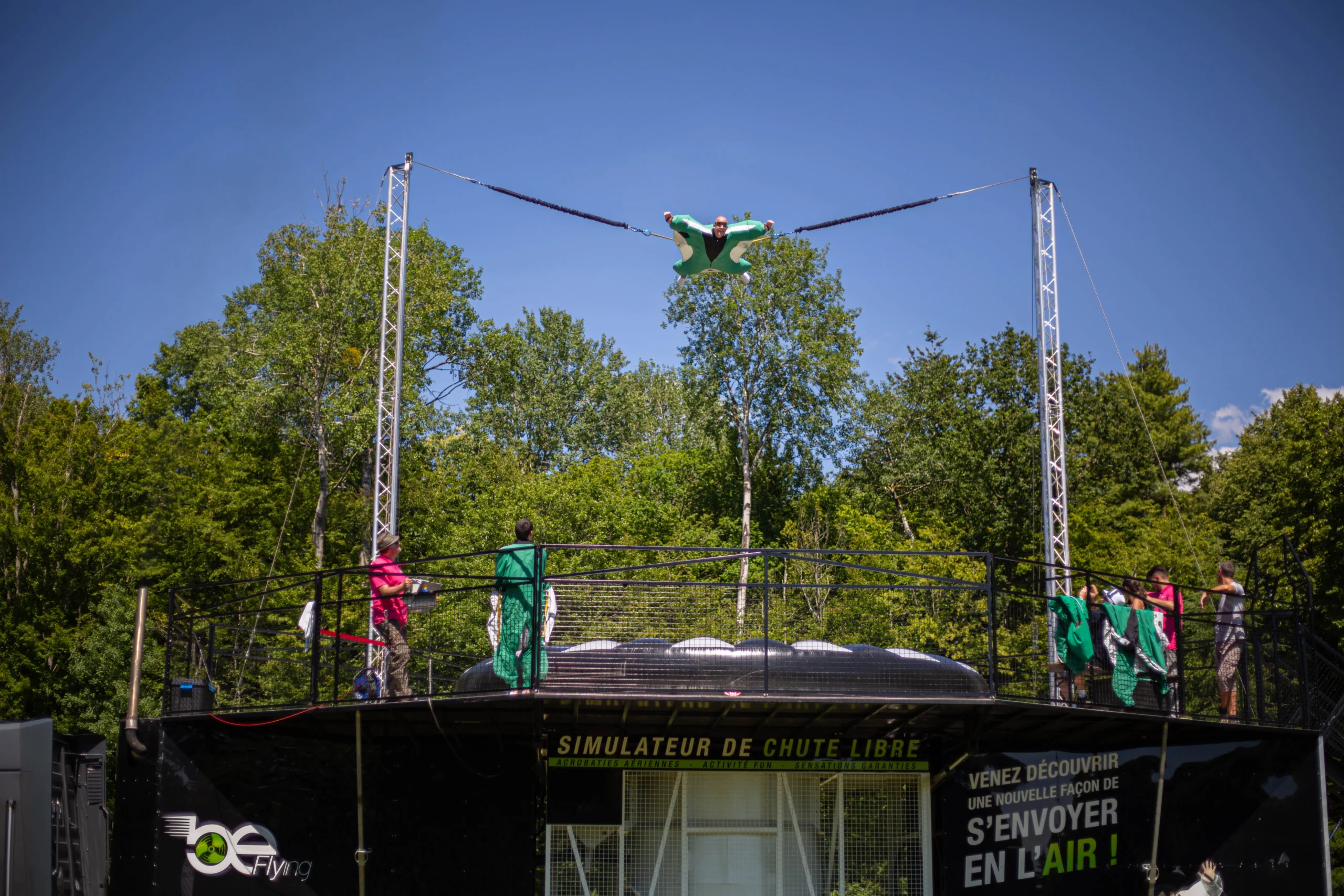
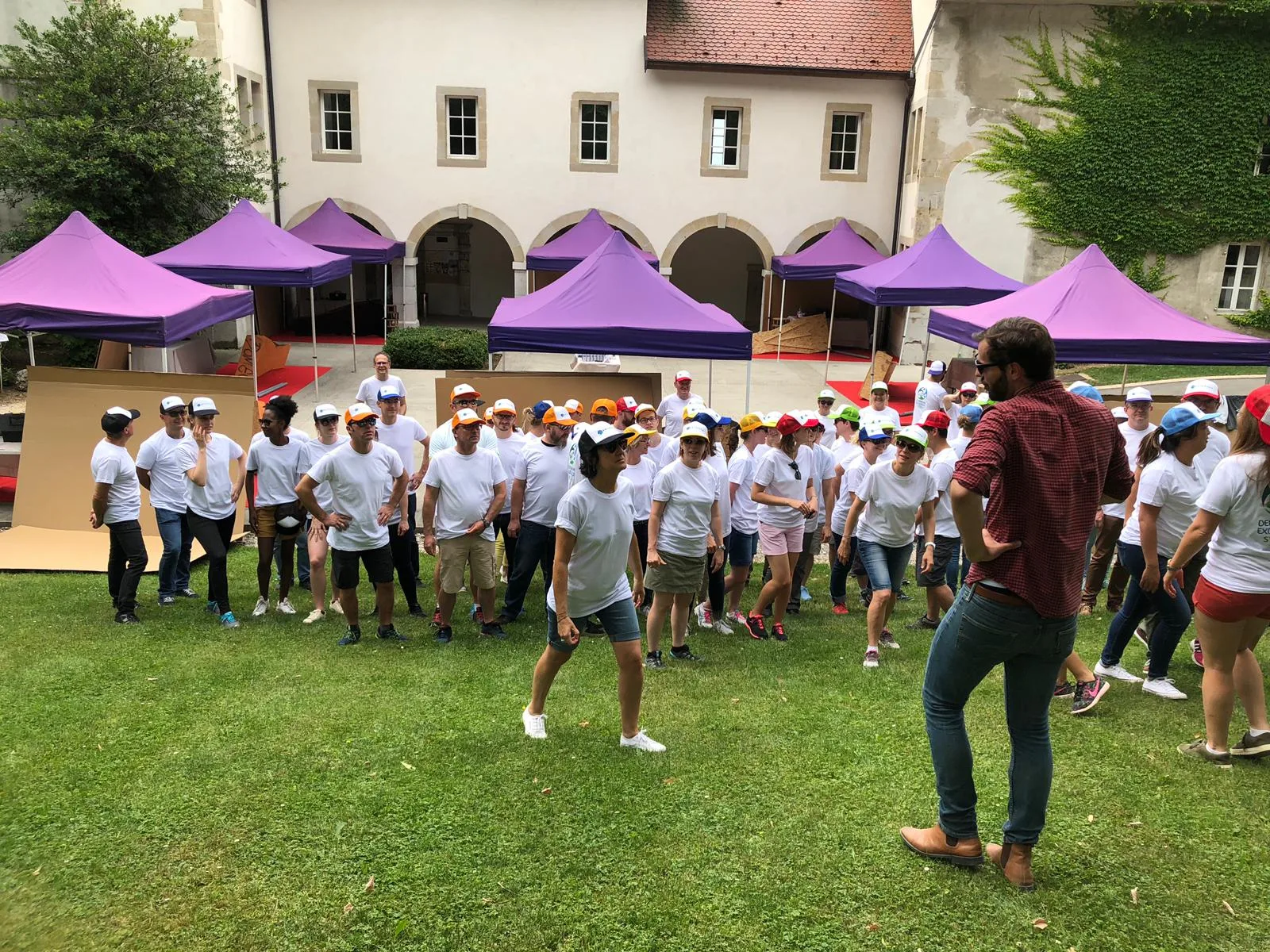
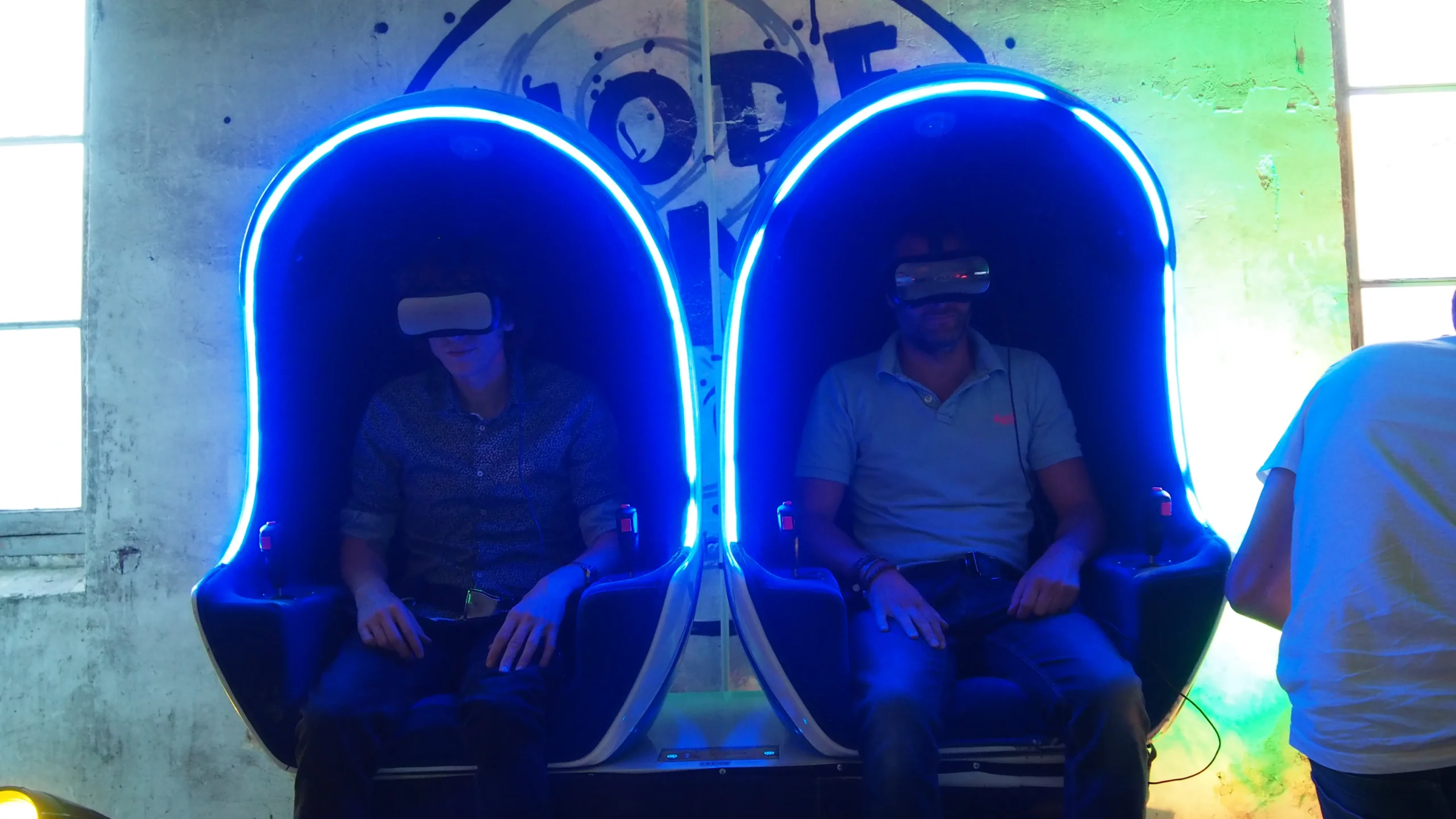
At INNOV'events, we integrate an Indoor Skydiving Simulator into corporate agendas in Montréal for 30 to 600+ attendees, from leadership offsites to client events.
We handle feasibility, permits, venue coordination, staffing, crowd flow, and brand integration—so your executives can focus on outcomes, not operations.
In a corporate event, entertainment is not a “nice-to-have”: it’s a lever for attention, message retention, and cross-team interaction—especially when your agenda includes strategic priorities (culture, transformation, safety, performance). A well-executed simulator becomes a structured moment that moves people from passive listening to active participation.
Montréal organizations typically expect three things: rigorous safety standards, predictable run-of-show timing, and an experience that fits corporate codes (no “circus effect”). If the activity slows down the evening, creates long waits, or looks off-brand, it works against you—our job is to prevent that.
We’re a local team used to Montréal constraints: union/venue rules, loading docks, bilingual signage, winter logistics, and building access. Our approach is operational first—site visit, risk assessment, throughput model—then creative, so it lands with executives and employees alike.
10+ years coordinating corporate activations and complex event logistics across Québec and Canada.
200+ corporate events delivered (team building, internal comms, client evenings, recruitment, product launches).
Typical simulator throughput planning: 45–90 participants/hour depending on briefing format, rotation design, and photo/video workflow.
On-site structure designed for predictability: 1 project lead + 1 technical lead + 2–6 facilitators depending on attendance and venue.
INNOV'events works with Montréal-based organizations and national teams that regularly host internal events in the city—some returning annually because they need a partner who remembers their brand constraints, stakeholder expectations, and approval pathways.
If you share the list of reference clients you want us to publish (names you provided), we will integrate them here in a compliant way (e.g., “supported teams at…”) and align the wording with your legal/communications guidelines. In Montréal, this matters: many brands have strict rules on co-branding, image rights, and internal safety messaging, and we’re used to building programs that pass comms and risk review without last-minute rewrites.
Our local value is continuity: we keep your venue preferences, supplier standards, and run-of-show habits on file, so your next edition is faster to validate and easier to execute.
Nous vous envoyons une première proposition sous 24h.
For executives and HR teams, the goal is rarely “fun.” The goal is to create conditions where people connect across silos, participate in the narrative, and leave with a stronger sense of belonging—without exposing the organization to operational or reputational risk. The Indoor Skydiving Simulator in Montréal works when it’s framed as a structured, safe, and measurable activation.
Accelerate cross-team interaction in a controlled setting: the simulator naturally creates micro-queues and rotation groups. When we design the flow properly (briefing groups, observation zones, post-flight debrief prompts), it becomes a networking engine—useful for post-merger integration, multi-site teams, or new leadership cohorts.
Support culture and values with a clear storyline: safety briefing + progressive challenges align well with themes like operational excellence, disciplined execution, and learning mindset. We often connect it to internal messages such as “prepare, communicate, execute,” which resonates in engineering, manufacturing, tech, and financial services.
Create content that your comms team can actually use: with proper lighting, brand backdrops, and consent workflow, you get short-form footage for internal channels. We plan shot lists and approvals to avoid unusable content (poor framing, messy backgrounds, or logos in conflict).
Offer an inclusive challenge: unlike many “sportsy” activities, a simulator can be staged as progressive participation—spectator-friendly, optional intensity, and facilitation that respects comfort levels. That’s critical for HR when the audience spans ages, roles, and physical confidence.
Reduce the risk of agenda drift: compared to dispersed activities, a single activation zone allows tight time control. With a real throughput model, we avoid the classic issue: “half the room didn’t get to participate,” which is often what undermines perceived fairness.
Montréal’s economic culture is pragmatic: people expect experiences to be well-managed, safe, and worth the time away from operations. When the simulator is integrated with disciplined logistics, it reads as modern, intentional, and executive-approved—not as an afterthought.
In Montréal, approvals often involve multiple voices: HR (inclusion and employee experience), Communications (brand and optics), Facilities/Venue (access and load-in), and sometimes Health & Safety (risk review). The Indoor Skydiving Simulator is straightforward to justify when the plan is concrete—less so when it’s presented as “entertainment.”
What we typically see in real corporate decision cycles:
Our role is to translate these expectations into a production plan that you can forward internally with confidence.
The simulator performs best when it’s part of a wider engagement architecture: pre-brief, participation, and post-moment content. In corporate contexts, we pair it with complementary activations that reduce downtime, spread the crowd, and reinforce your narrative—especially when you have executives and clients in the same room.
Timed team challenges with a live leaderboard: we can structure participation as departments vs. departments (or mixed teams), using objective metrics (stability time, posture accuracy, reaction tasks). This is effective for sales kickoffs and transformation programs because it creates measurable, talkable outcomes.
Executive “first flight” window: a scheduled 10–15-minute segment where leadership participates early. In practice, it sets the tone: employees interpret it as “approved and safe,” which increases opt-in without pressure.
Smart queue engagement: short, low-friction interactions while waiting (two-question pulse survey on culture priorities, QR-based raffle tied to participation, quick coaching tips screens). The point is to turn waiting time into productive time without turning it into a marketing kiosk.
MC with corporate tone control: not a hype host—someone who can keep energy up while respecting brand standards (regulated industries, formal galas). We script announcements aligned with your key messages and avoid jokes that can backfire in diverse audiences.
Ambient sound design that respects speeches: a controlled music bed and timed cues so the activation feels premium without fighting your program. This matters in Montréal venues with strict dB limits or close neighbors.
Montréal-style cocktail pairing near the viewing zone: we often position a compact bar or tasting station adjacent to the spectator area to keep non-participants engaged without crowding the flight zone. It’s a practical way to manage flow, not just add “food.”
Staggered service coordination: we synchronize participation waves with canapé service to avoid a rush where your catering team can’t keep up and guests feel the event is disorganized.
Photo/video pipeline with consent management: branded backdrop, lighting, and a quick approval workflow so comms teams get usable assets within 24–72 hours. We can also segment deliverables (internal-only vs. public) to respect employer branding and privacy requirements.
Brand-safe set design: clean barriers, signage, and uniforms that match your identity. In Montréal, many corporate events share venues with other functions—professional staging prevents your activation from looking temporary or improvised.
Whatever you add, alignment with brand image is non-negotiable: the simulator zone must look and feel like your organization—disciplined, safe, and intentional. That’s how you protect reputation while still creating energy.
The venue determines feasibility, safety perimeter, and attendee perception. For a simulator, we look for ceiling height, power access, load-in constraints, and whether the space can support a controlled queue and spectator zone. Choosing the wrong room is the fastest way to create delays and visible stress on event day.
| Venue type | For which objective? | Main strengths | Possible constraints |
|---|---|---|---|
Convention center / large ballroom | Large attendance, high throughput, multi-zone corporate program | Strong crowd flow options, back-of-house resources, clear staging areas | Union rules, fixed load-in windows, stricter technical approvals |
Corporate HQ atrium / office common space | Culture activation, employer branding, internal comms content | High relevance to employees, easy access for staff, strong brand control | Elevator/load limits, building insurance requirements, noise management during work hours |
Industrial/event warehouse-style venue | Product launches, modern brand positioning, evening events | Flexible layout, easier perimeter control, “event-ready” feel | Power distribution planning, heating in winter, permitting depending on borough |
We strongly recommend a site visit before confirming: in Montréal, two venues can look similar on paper but behave very differently on load-in, power, and fire egress. A 45-minute walkthrough often prevents hours of troubleshooting on event day.
Budgeting is easier when you separate the simulator itself from the event production around it. Pricing depends on footprint, staffing, duration, throughput expectations, and how “corporate-finished” you need the activation to look. We build quotes that make these lines explicit so Finance and Procurement can validate quickly.
Duration on-site: a 3–4-hour activation is priced differently than a full evening or multi-day conference. Setup and teardown are often the hidden variable—especially in Montréal venues with strict access windows.
Expected throughput: planning for 60 participants versus 250 participants changes staffing, briefing approach, and queue management tools. If you need high participation fairness, we design a more structured rotation model.
Technical requirements: power distribution, flooring protection, barriers, signage, and sound control. In some buildings, additional electrical work or certified supervision is required.
Branding and content: backdrops, lighting, photo/video capture, editing, and consent workflow. Communications teams often prefer fewer but higher-quality assets, which impacts the setup.
Risk and compliance: insurance certificates, security staffing, and venue-required documentation. Regulated industries tend to request more detailed safety documentation and on-site governance.
Access complexity: downtown Montréal load-ins, limited dock time, elevator dependencies, and winter conditions can increase labor time and contingency planning.
From an ROI standpoint, the right benchmark isn’t “cost per hour,” it’s cost per engaged participant and the value of content + interaction created across teams. We’ll help you decide whether to optimize for maximum participation, premium look-and-feel, or a balanced approach.
When you’re accountable to executives, the risk isn’t the idea—it’s execution. A local partner reduces uncertainty because we know how Montréal venues behave, how suppliers perform under time pressure, and which constraints appear late (loading docks, security requirements, signage rules, or last-minute program changes).
As an event agency in Montréal, we don’t just “book” an activation; we integrate it into your event system: run-of-show, brand standards, stakeholder approvals, and contingency planning. That’s what protects your credibility on event day.
From an ROI standpoint, the right benchmark isn’t “cost per hour,” it’s cost per engaged participant and the value of content + interaction created across teams. We’ll help you decide whether to optimize for maximum participation, premium look-and-feel, or a balanced approach.
Our projects range from internal culture nights to client-facing receptions where brand control is tight and timing is non-negotiable. In practice, the same pattern comes back: the more visible the activation, the more it must behave like a professional production.
Examples of real situations we plan for:
Our adaptability comes from process: clear roles on-site, a real run-of-show, and decision points agreed in advance with your internal owner.
Underestimating space and perimeter: without a proper buffer, queues spill into cocktail zones and create the impression of disorder. We map footprints and circulation early.
No throughput model: “we’ll see on-site” leads to unfair participation. We set targets (participants/hour), define group sizes, and align expectations with leadership.
Briefing repeated too often: re-explaining instructions to each person kills the schedule. We design group briefings and quick individual checks.
Branding as an afterthought: an activation can clash with corporate image if signage and staff presentation are inconsistent. We plan visual standards like any other brand touchpoint.
Content capture without consent: comms teams end up with unusable footage. We implement consent signage and a simple workflow for employee privacy.
Ignoring venue rules: power, noise, load-in windows, or security requirements can derail setup. We confirm constraints in writing and build a technical sheet.
Your stakeholders won’t remember the behind-the-scenes effort—they’ll remember whether it felt controlled and fair. Our role is to anticipate these risks and remove them before they reach the event floor.
Repeat business happens when the agency makes the internal owner’s life easier: fewer surprises, clearer approvals, and a team that understands the organization’s tone. We earn loyalty by being operationally reliable and transparent—especially when executives are in the room.
Planning lead time we recommend: 4–8 weeks for a clean approval cycle (venue, H&S, comms) and supplier scheduling; 8–12 weeks for complex conferences or tight downtown access.
Event-day governance: one accountable decision-maker on our side, one on yours, with pre-agreed escalation rules to avoid “committee decision-making” during peak moments.
Post-event deliverables: recap including participation estimates, operational notes, and recommendations for the next edition—useful for HR reporting and budget defense.
Loyalty is a measurable signal: when teams come back, it’s because the experience was not only appreciated— it was delivered without reputational risk and without draining internal time.
We validate the venue and the simulator’s footprint: ceiling height, power, load-in route, security requirements, noise constraints, and emergency egress. We also align on participation goals (how many people should fly, and what “success” means for HR/Comms/Executives). Output: a clear feasibility note and a first throughput scenario.
We build the rotation model: briefing group size, flight duration, queue system, VIP windows, and integration with speeches/meal service. Output: run-of-show, staffing plan, and a floor plan that the venue can approve.
We align visual standards (signage, barriers, staff presentation), draft bilingual guidance if needed, and set the content capture plan (shot list, consent, delivery timeline). Output: brand integration checklist and content workflow that your communications team can validate.
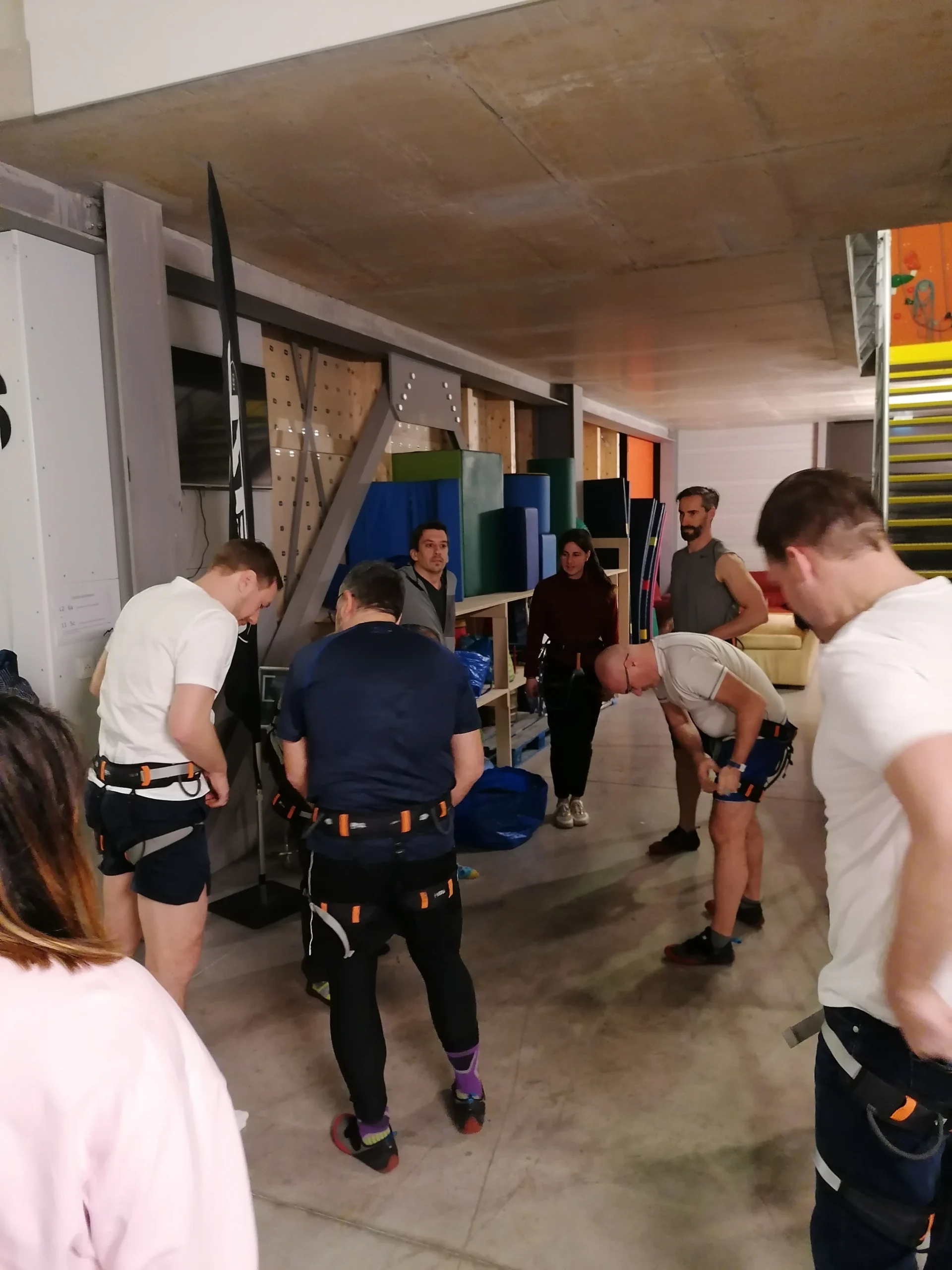
We arrive with a technical lead, manage setup with the venue, run safety checks, and operate the activation with a clear chain of command. We monitor throughput in real time and adjust (pause windows, staffing shifts, queue rerouting) to protect the event’s overall pacing.
We coordinate teardown within venue constraints, deliver content assets as agreed, and provide a concise recap: what worked, what to optimize, and recommendations if you repeat the activation at the next Montréal edition.
Plan 45–90 participants/hour depending on flight time per person, group briefing method, and whether you include photo/video steps. We model throughput upfront so leadership expectations stay realistic.
It depends on the equipment model and safety perimeter, but you should expect a dedicated zone plus a managed queue and spectator area. In practice, we plan for a clean footprint that includes: activation space, briefing corner, and a buffer so the line doesn’t spill into catering or registration.
Yes—when operated with a documented safety plan: controlled perimeter, trained facilitators, clear participant criteria, and an emergency stop protocol. We also align with the venue’s requirements and provide insurance documentation as needed.
Often yes, but it must be planned. We coordinate sound levels, position the activation to protect speech zones, and schedule brief pauses during key moments (awards, announcements). Some venues have strict dB policies—this is why a site/tech check matters.
For most corporate events, aim for 4–8 weeks. For large conferences, complex downtown load-ins, or peak periods (fall and holiday season), 8–12 weeks is safer to secure the right venue approvals and staffing.
If you’re comparing options for corporate event entertainment in Montréal, we’ll make it easy to decide: we’ll propose a simulator scenario with a participation model, staffing plan, venue requirements, and a clean budget structure.
Send us your date range, estimated headcount, venue (or shortlist), and the role of the event (internal, client, recruitment, leadership). We’ll come back with a concrete recommendation and the operational details your stakeholders will ask for—before you commit.
Thierry GRAMMER is the manager of the INNOV'events Montréal office. Reach out directly by email at canada@innov-events.ca or via the contact form.
Contact the Montréal agency