
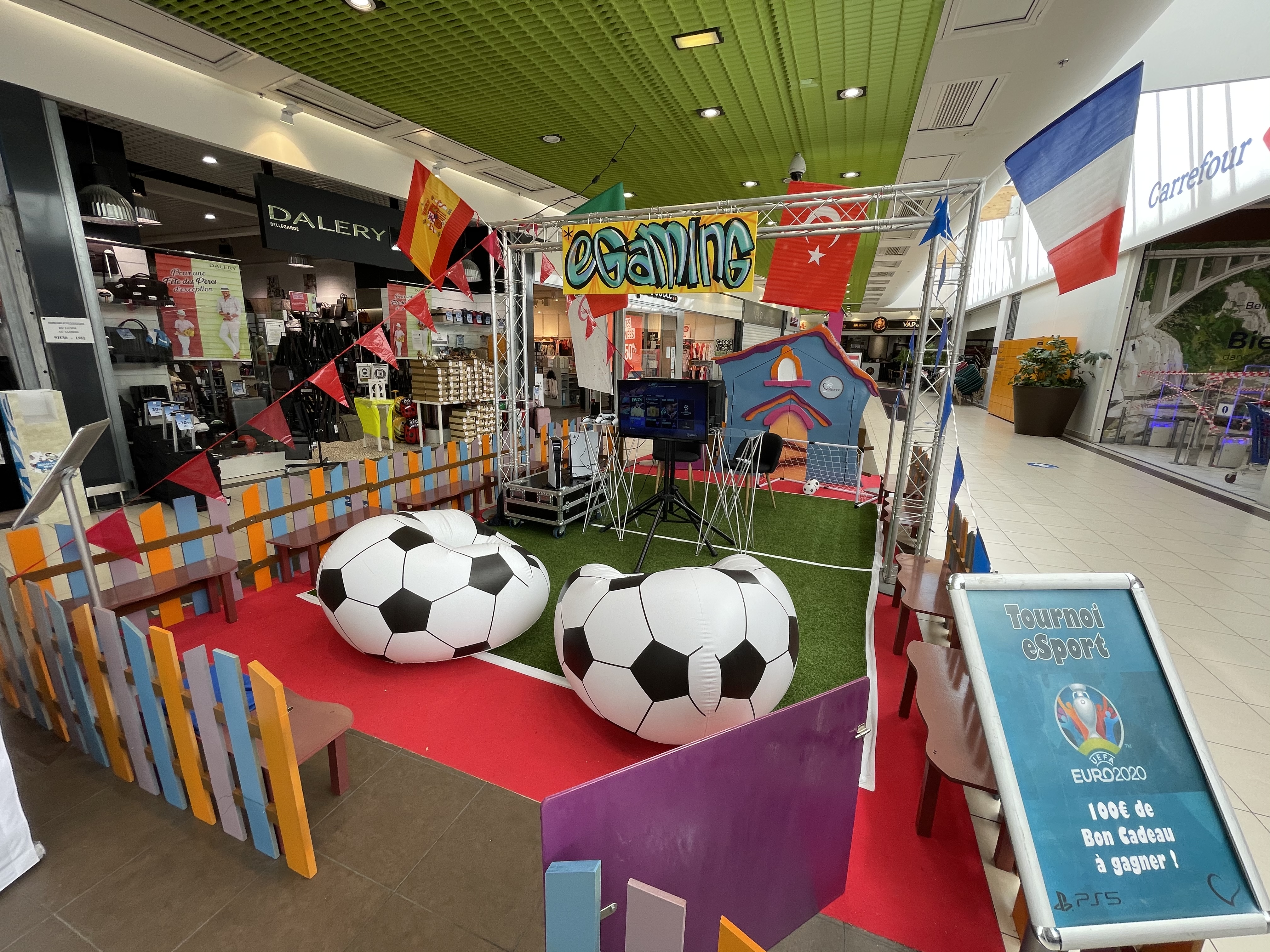
Soccer Simulator in Quebec for corporate events that need real participation
Sommaire
In a corporate event, entertainment is not “extra”—it’s a management tool. A Soccer Simulator gives you a structured, repeatable way to create interaction between departments, increase dwell time in a sponsor/brand zone, and reduce the “small-talk only” dynamic that often happens in cocktail formats.
Organizations in Quebec expect smooth operations: clear schedules, bilingual facilitation when needed, and a setup that respects venue rules (freight elevators, noise limits, floor protection). Executives also expect measurable outcomes: participation rate, queue time control, and a professional look aligned with employer brand.
We’re an event agency based in Montréal, and we deliver on the ground across the province with the same operational standards you’d expect for a board-level town hall: pre-event technical checks, tight load-in/load-out planning, and staff who know how to manage crowds without creating friction.
INNOV'events in numbers in Quebec
10+ years supporting corporate events and brand activations across Quebec, with repeat mandates from HR and communications teams.
300+ corporate events delivered (team-building, conferences, holiday parties, product launches) with standardized production checklists and on-site supervision.
Operational capacity for 50 to 2,000+ attendees through scalable staffing, queue management, and multi-station formats.
Turnkey delivery: equipment transport, installation, power planning, bilingual animation, and teardown—one accountable team from brief to debrief.
Who we support year after year in Quebec
We work with organizations across Quebec—from fast-growing tech teams to established industrial and financial groups—where the same reality comes back: limited event time, high expectations from leadership, and zero tolerance for improvisation on event day.
Several clients renew annually because the operational load is real: venue coordination, security rules, union constraints in certain halls, and the need for bilingual guest experience. Our role is to make the entertainment component as reliable as the catering or AV: confirmed timelines, documented requirements, and a single production lead accountable on site.
If you have internal references you want us to align with (brand guidelines, DEI posture, health & safety standards, procurement constraints), we integrate them early—before we propose the final Soccer Simulator in Quebec format and staffing plan.
 Besoin d’un devis rapide ?
Nous vous envoyons une première proposition sous 24h.
Why book a Soccer Simulator in Quebec for an HR objective?
Most corporate events fail to create real cross-team interaction because guests stay within their usual circles. A Soccer Simulator works because it gives people a reason to engage, a clear “start/finish” moment, and a topic to talk about afterward—without forcing anyone into an uncomfortable icebreaker.
Engagement you can see and measure: participation count, peak times, and average throughput per hour—useful when HR and Communications need to justify the spend.
Inclusive competition: the activity can be set up with difficulty levels (power shot vs. precision) so it’s not only for athletes. We regularly structure it as “best of 3 kicks” with accessible scoring.
Culture reinforcement: you can map the rules to your values—team points, department leagues, or charity conversions (e.g., every goal triggers a donation amount). It’s concrete and easy to communicate internally.
Employer brand content: the simulator zone creates a controlled visual environment for photo/video (backdrop, lighting considerations, logo placement). HR teams appreciate content that looks professional without renting a full studio.
Better flow in cocktail and networking formats: a well-placed activation reduces congestion at bars and food stations by distributing guests across zones. This is particularly useful in Montréal venues where circulation can be constrained.
In the Quebec business culture—where relationships and credibility matter—an activation that is well-run, respectful, and easy to join supports leadership visibility and strengthens internal cohesion without feeling forced.
What Quebec companies expect on event day in Montréal
In Montréal and across Quebec, corporate event stakeholders typically share the same pressure points: the venue has strict access windows, the AV supplier has its own schedule, and leadership wants the room ready early for walk-through and last-minute adjustments. A Soccer Simulator must fit into that reality—no “we’ll figure it out on site.”
We plan around local constraints we see every month: limited dock access downtown, elevator bookings, protective floor coverings in hotels, and noise policies in mixed-use buildings. If your event is in a convention-style venue, we align with the building’s power distribution rules and cable management requirements. If it’s in a heritage space, we adapt with low-impact installation methods.
We also plan for bilingual guest experience when your audience includes clients from outside Québec or teams from other provinces: signage, host scripts, and simple instructions that avoid confusion in a busy cocktail environment.
What to pair with a Soccer Simulator in Quebec to modernize your event
A Soccer Simulator in Quebec works even better when it’s part of a broader engagement plan. The goal is not to stack activities—it’s to create complementary touchpoints that serve different personalities: competitive guests, observers, and people who prefer conversation.
Interactive animations in Quebec
Leaderboards by department (with guardrails): we often implement a friendly “top 5” board without public shaming—only highlight strong results and keep the rest anonymous. It’s a small detail that protects morale.
QR-based registration: optional check-in to collect participation data (useful for HR engagement metrics) while remaining compliant with your internal privacy guidelines.
Short-format tournament blocks: for 150–300 guests, we schedule 15–20 minute rounds to create “peaks” during the evening and avoid one long, static queue.
Art animations in Quebec
MC or bilingual host: not a nightclub vibe—more like a conference moderator who can keep the pace, announce finals, and support leadership moments (short speeches, awards).
Photo corner with brand-safe lighting: we often add a controlled photo zone near the simulator so guests who don’t want to play still participate in content creation.
Innovative animations in Quebec
Mocktail or espresso station near the activation: this reduces “dead zones” in the room and improves circulation. It’s also practical in Montréal winters when guests naturally cluster near warmth and service points.
Team-themed tasting tokens: each goal earns a token redeemable for a small bite—simple mechanics that increase participation without adding complexity.
Gourmand animations in Quebec
CSR overlay: connect goals to a donation meter displayed on-screen (example: $2–$5 per goal up to a cap). This works well for companies with strong community commitments in Quebec.
Hybrid-friendly recap: if you have remote employees, we can structure a quick highlight reel and share results post-event so the “moment” extends beyond the room.
The key is alignment: the tone of the animation, the visual setup, and the rules must match your brand image and the event’s purpose (recognition night vs. client reception vs. internal kick-off). We challenge formats that look fun but create operational friction or brand inconsistency.
Which Quebec venues work best for a Soccer Simulator setup?
Venue choice directly impacts participation and perceived professionalism. A Soccer Simulator needs clear sightlines, controlled lighting, and enough space for safe kicks and spectators. In Quebec, we often adapt the setup depending on whether the event is downtown, in an industrial area, or in a hotel ballroom with strict load-in rules.
| Venue type | For which objective? | Main strengths | Possible constraints |
|---|---|---|---|
| Hotel ballroom (Montréal / Québec City) | Holiday party, leadership town hall, awards night with structured timing | Reliable power, predictable access, built-in staffing, easy guest flow with signage | Strict load-in/out windows, floor protection requirements, noise limits after certain hours |
| Convention centre / large event hall | Conference entertainment zone, sponsor activation, high attendee volume | Capacity for multi-station layout, professional rigging options, strong crowd management | Union/approved vendor rules, longer approval cycles, higher ancillary costs (power drops, internet) |
| Corporate office / campus atrium | Employee engagement day, recruitment event, internal launch | Low venue cost, strong employer-brand authenticity, easier access for staff | Ceiling height and space constraints, building security approvals, noise management during business hours |
We strongly recommend a site visit (or at minimum a detailed technical call with photos and measurements). Small venue details in Quebec—like door widths, elevator availability, or where guests naturally circulate—often determine whether the simulator becomes the night’s anchor or an underused corner.
What does a Soccer Simulator cost in Quebec for a corporate event?
Pricing in Quebec depends less on the “game” itself and more on the production conditions: duration, staffing, transport, venue constraints, and how brand-integrated you want the zone to be. A quote should clearly separate equipment, labor, and add-ons so Finance can validate the logic.
Event duration and access time: a 2–3 hour cocktail setup is different from a full-day conference with multiple peak moments and a longer staff shift.
Throughput requirements: if you want high participation (e.g., 300+ plays), we may recommend additional facilitation or a second activity point to avoid long queues.
Venue logistics: downtown load-in constraints, long pushes from dock to room, elevator bookings, and union conditions can materially change labor time.
Branding level: basic logo placement vs. a fully designed backdrop, signage, and on-screen visuals aligned to brand guidelines.
Risk management: added barriers, floor protection, and supervision ratios for family days or mixed audiences.
From an ROI perspective, we encourage clients to compare cost against measurable outcomes: participation rate, internal content captured, and the ability to keep guests engaged through key programming moments. A well-operated corporate event entertainment in Quebec component often reduces the need for additional “fill” activities because it actually holds attention.
Why choose a local event agency in Quebec for this activation?
When your audience includes executives, clients, and employees, reliability matters more than novelty. Working with an agency established in Quebec means you get people who understand local venues, supplier norms, and the operational realities that can derail a schedule.
We’re often brought in after a company has tried to coordinate entertainment internally: the activity arrives late, the room layout is wrong, the line becomes chaotic, and your communications lead ends up acting as on-site coordinator. Our role is to protect your team from that—by managing vendors, documentation, and execution with one accountable production lead.
If your event is outside Montréal, we can coordinate the province-wide logistics with the same rigor. For teams planning in Capitale-Nationale, our network includes the right contacts and local operational habits via our event agency in Quebec presence.
- Faster approvals and fewer surprises: we know what venues typically ask for (insurance, floor plans, load-in schedules) and we prepare the documents early.
- Supplier accountability: one point of contact who manages arrival times, staffing, and contingency planning.
- Realistic scheduling: we plan around Montréal traffic patterns, winter conditions, and typical access constraints—so your event timeline stays credible.
- Bilingual execution: staffing and signage options that reflect the reality of audiences in Quebec.
From an ROI perspective, we encourage clients to compare cost against measurable outcomes: participation rate, internal content captured, and the ability to keep guests engaged through key programming moments. A well-operated corporate event entertainment in Quebec component often reduces the need for additional “fill” activities because it actually holds attention.








What we’ve delivered in Montréal with competitive interactive zones
Our projects range from end-of-year celebrations to internal kick-offs and client receptions. The common denominator is operational control: clear run-of-show, documented responsibilities, and an activation that supports the event’s objective—rather than competing with it.
We’ve built interactive zones where the simulator is the anchor, supported by structured mini-challenges and a results moment that fits the executive agenda (for example, announcing finalists right before a leadership message to keep the room present). We’ve also delivered quieter versions for higher-end client evenings, where the design emphasis is on aesthetics, discreet facilitation, and a clean brand environment.
We adapt to constraints we routinely see in Montréal: narrow load-in paths, tight room turnovers between daytime conferences and evening receptions, and the need to keep sound levels appropriate for networking. That field experience is what makes the difference when the schedule is non-negotiable.
Common mistakes we prevent for Quebec corporate events
Underestimating queue time: without a clear participation format, you get long lines, guest frustration, and low overall engagement. We design throughput intentionally.
Poor placement in the room: if the simulator is placed where guests don’t naturally circulate—or blocks catering/egress—it becomes a problem. We map traffic patterns with the venue plan.
Mismatch with event tone: a loud hype-style animation can clash with a client reception. We calibrate facilitation style to your brand and audience.
Ignoring venue constraints: ceiling height, floor type, power availability, and access windows are not details. We confirm technical feasibility before event day.
No contingency plan: late deliveries, last-minute room changes, or leadership schedule shifts happen. We plan buffers and have an on-site decision process.
Our job is risk prevention. In Quebec, where many events have tight venue windows and senior stakeholders present, we treat the entertainment zone with the same discipline as AV and catering—because it affects the overall perception of your organization.
Why Quebec clients keep INNOV'events on their preferred list
Repeat business is rarely about “fun.” It’s about predictability, accountability, and the ability to protect internal teams from operational load. HR and Communications come back when they know they’ll get a clean plan, a realistic timeline, and an on-site lead who can make decisions quickly.
Many corporate clients renew on an annual cycle (holiday party, summer event, kick-off) because we keep documentation from year to year: venue lessons learned, preferred formats, and brand requirements.
We track operational indicators internally (setup time, peak participation windows, incident logs even when zero) to improve each new edition.

Loyalty is proof of quality in Quebec: when teams invite you back, it’s because the event ran smoothly and leadership noticed the difference.
Our Soccer Simulator delivery process in Quebec
👉 1) Brief aligned to your business objective (Quebec context)
We start with practical questions executives care about: What outcome do you want—engagement, recognition, client relationship building, recruitment visibility? We confirm audience profile, bilingual needs, event timing, and the non-negotiables (leadership run-of-show, brand rules, privacy constraints). Then we propose a Soccer Simulator format that matches capacity and tone.
👉 2) Technical validation with venue and stakeholders in Montréal
We collect measurements, access rules, power availability, and any building constraints. We produce a placement plan: simulator orientation, spectator zone, queue lane, signage, and any floor protection required. If your venue has strict loading rules, we build a detailed load-in schedule that integrates with AV and catering.
👉 3) Production planning and staffing
We confirm staffing roles (facilitator, technical lead, floating support if required) and define the guest flow rules: number of attempts, scoring method, and how winners are announced. For corporate settings, we prioritize fairness and pace—so the activation doesn’t create friction.
👉 4) Event-day execution and real-time adjustments
We arrive within the approved venue window, install, test, and perform a readiness check before guests enter. During the event, our lead monitors queue time and participation and adjusts the format if needed (for example, shifting from 3 kicks to 2 during peak). We coordinate with your on-site contact so you’re never managing operational issues alone.
👉 5) Teardown, reporting, and next-steps
We respect venue teardown rules and leave the space compliant. If you want, we provide a short debrief: participation estimates, peak times, what worked, and recommendations for the next edition in Quebec. This is particularly useful for HR teams building an annual engagement plan.
FAQ sur l'organisation Soccer Simulator à Quebec
How many guests can play per hour in Quebec events?
As a planning range, expect 20–40 participants per hour per station, depending on whether you run 2 kicks, 3 kicks, or a short “best-of” format. For 300+ guests with high participation expectations, we often structure timed rounds or add complementary activities to avoid long queues.
What space do you need for a Soccer Simulator in Montréal?
Plan for a clear zone that includes the kick area, the target/screen area, and a safe spectator buffer. In practical terms, many corporate setups work best when you can dedicate roughly 12'–20' wide and 15'–25' deep, plus circulation space for a queue. We validate based on the specific simulator model and venue constraints.
Is a Soccer Simulator safe for corporate events in Quebec?
Yes, when it’s set up with proper boundaries and supervision. We implement ball containment, define a spectator line, secure cables, and adapt rules for the audience. For family days or mixed groups, we adjust difficulty and increase supervision to reduce risk.
Can we brand the Soccer Simulator for a Quebec product launch?
Yes. Typical options include branded backdrops, on-screen visuals, signage, and a scoring moment aligned with your campaign message. We’ll ask for brand guidelines and deliver a clean integration that photographs well for internal and external communications.
How far in advance should we book in Quebec City?
For peak periods (holiday season and late spring), we recommend 6–10 weeks. For standard dates, 3–6 weeks can work if the venue logistics are straightforward. If your venue has union rules or complex access, earlier is safer to lock the schedule.
Request a Soccer Simulator quote in Quebec
If you’re comparing agencies, we can provide a clear, decision-ready proposal: recommended format, staffing plan, venue requirements, and a transparent budget structure. Share your event date, city in Quebec, estimated headcount, and venue (if known), and we’ll come back with practical options that fit your agenda and brand standards.
The earlier we validate logistics, the easier it is to secure the right setup window and avoid last-minute compromises. Contact INNOV'events to plan a Soccer Simulator in Quebec that performs operationally and supports your HR and communications objectives.
INNOV'events Quebec Agency
Thierry GRAMMER is the manager of the INNOV'events Quebec office. Reach out directly by email at canada@innov-events.ca or via the contact form.
Contact the Quebec agencyToutes nos prestations & animations Quebec, Quebec
Découvrez nos prestations événementielles
Découvrez nos animations événementielles disponibles au Quebec
- Event Hostess in Quebec
- Escape Game in Quebec
- MasterChef-Style Cooking Workshop in Quebec
- Corporate Magician in Quebec
- Tent Rental in Quebec
- Color Analysis Workshop in Quebec
- Inflatable Games in Quebec
- Valet Service in Quebec
- Soccer Simulator in Quebec
- LED Furniture Rental in Quebec
- LED Branding Activation in Quebec
- Immersive Culinary Experience in Quebec
- Light Painting Activity in Quebec
- Immersive Mystery Night in Quebec
- Promotional Contest in Quebec
- Promotional Materials (POS) in Quebec
- Virtual Reality Experience in Quebec
- Molecular Gastronomy Workshop in Quebec
- Halloween Event in Quebec
- Fireworks Show in Quebec
- Sports Challenge – Giant Games in Quebec
- Professional Event Host in Quebec
- Photo Booth Animation in Quebec
- Santa Claus Appearance in Quebec
- Kids Entertainment in Quebec
- Guided Tour in Quebec
- Urban Rally in Quebec
- Ball Pit Activity in Quebec
- Flight Simulator in Quebec
- Food Truck Rental in Quebec
- World Record Attempt in Quebec
- Surf Simulator in Quebec
- Soccer Simulator in Quebec
- Wine Casino in Quebec
- Makeover Workshop in Quebec
- Perfume Creation Workshop in Quebec
- Acting Workshop in Quebec
- CSR Activities in Quebec
- Archery Activity in Quebec
- Event Security Guard in Quebec
- Wine Tasting Workshop in Quebec
- Mime Performance in Quebec
- TV Game Show Animation in Quebec
- Funfair Event in Quebec
- Crisis Management Workshop in Quebec
- Crisis Negotiation Workshop in Quebec
- Arcade Games in Quebec
- Indoor Skydiving Simulator in Quebec
- Ski Simulator in Quebec
- Racetrack Driving Experience in Quebec
- Introductory Flight Experience in Quebec
- Tasting Experience in Quebec
- Build Your Own Foosball Workshop in Quebec
- 2CV Rally in Quebec
- LEGO Challenge in Quebec
- Casino Night in Quebec
- Interpreter / Translator in Quebec
- Promotional Merchandise in Quebec
- Shuttle / Transportation Service in Quebec