
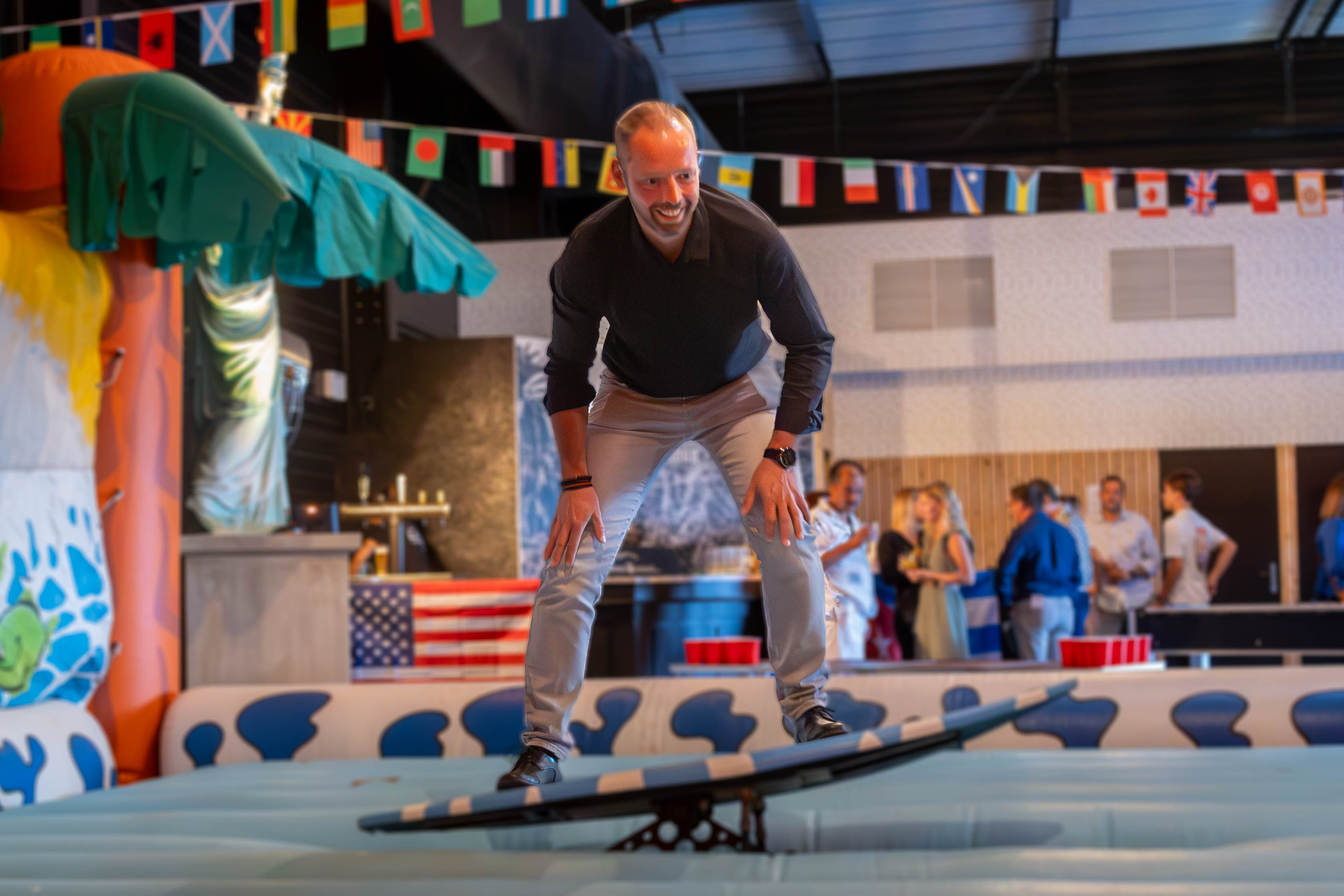
Surf Simulator in Quebec for corporate events that need real engagement
INNOV'events is a Montréal-based agency that delivers a professional Surf Simulator activation across Quebec, from internal celebrations to public brand events. We typically support formats from 50 to 1,000+ attendees, with clear guest flow, trained attendants, and venue-ready technical planning. You keep your agenda and brand image under control; we handle the ride, safety, staffing, timing, and on-site coordination.
Sommaire
In a corporate event, entertainment is not “nice to have”: it’s a lever to create cross-team interaction fast, reduce social silos, and give your leadership a concrete moment to anchor key messages. A Surf Simulator works because it’s instantly understood, easy to comment on, and generates a natural crowd without forcing participation.
Organizations in Quebec expect operational discipline: punctual load-in, clean branding, bilingual guest handling when needed, and an activity that respects the venue’s risk rules. Executives also want measurable outcomes—participation rate, dwell time, and a format that doesn’t disrupt the program or AV schedule.
Our team plans these activations with the reality of Québec venues in mind (loading docks, ceiling heights, union or in-house technical teams, and winter logistics). You get one accountable partner, local production reflexes, and an event-day team trained to protect your schedule, your people, and your reputation.
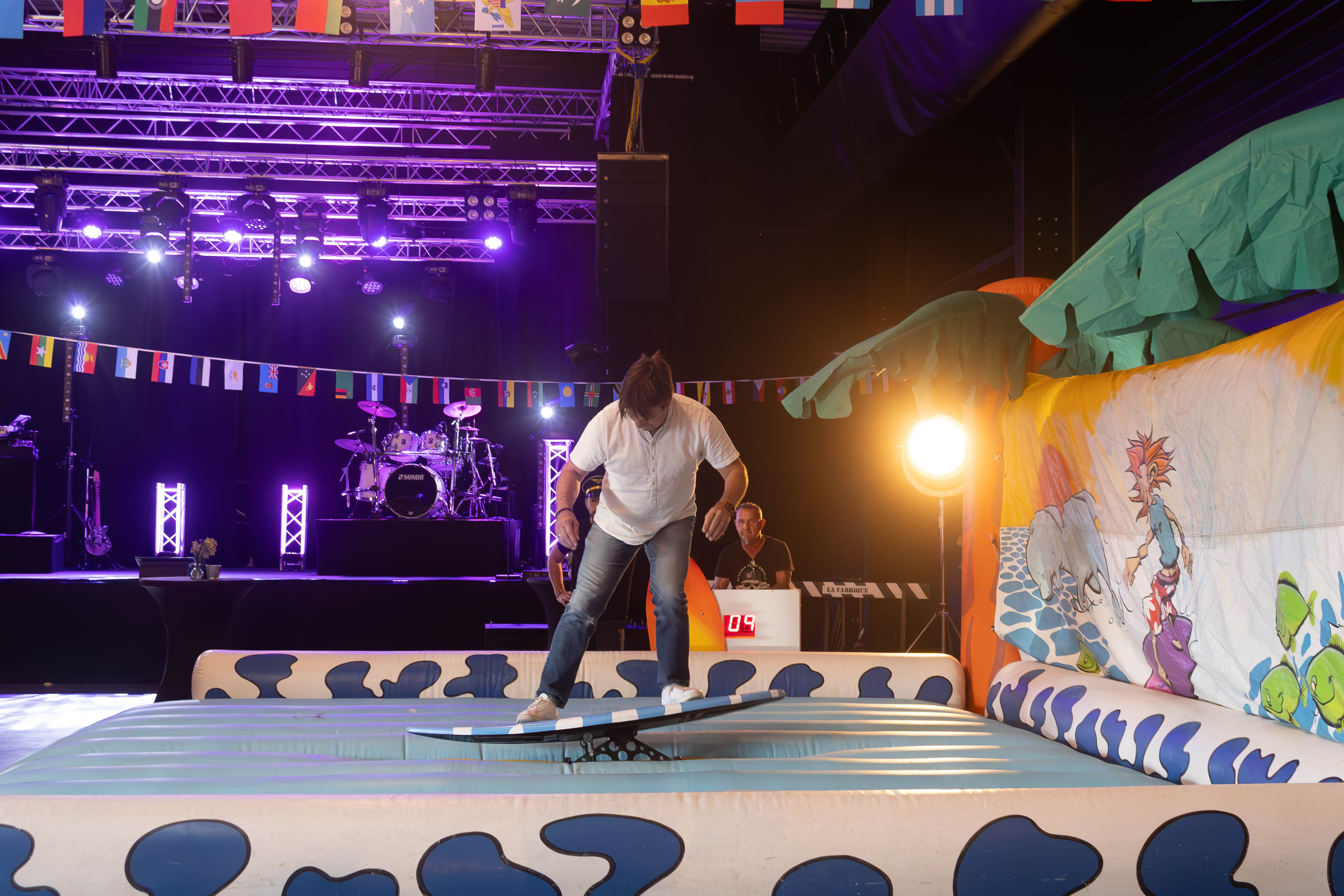
Operational credibility across Quebec in a few numbers
10+ years delivering corporate activations and event production in Quebec, with repeat clients who expect consistent execution.
Typical deployment capacity: 1 to 3 simulators in parallel, with 2–6 attendants depending on throughput targets and risk profile.
On-site flow targets commonly achieved: 25–40 riders/hour per simulator (depending on ride settings, guest profile, and whether you run a leaderboard format).
Standard planning lead time: 2–6 weeks. Rush options possible in Montréal/Québec City corridors when venue constraints allow.
Quebec references that reflect real corporate constraints
We support companies and institutions across Quebec that run events under real pressure: end-of-year parties with leadership speeches, HR-driven culture initiatives, sales kickoffs, and public-facing activations where brand control is non-negotiable. Many of our clients come back year after year because they need a partner who understands internal approvals, venue rules, and the “no surprises” expectation on event day.
If you want, we can share relevant case examples during a call (industry, attendance, venue type, and risk constraints) so you can compare apples to apples with other suppliers. Our approach is to validate feasibility early—access routes, electrical capacity, ceiling clearances, noise limits, insurance requirements—before confirming the final format.
 Besoin d’un devis rapide ?
Nous vous envoyons une première proposition sous 24h.
Why book a Surf Simulator in Quebec for a corporate event?
A Surf Simulator in Quebec is a practical tool for engagement because it creates a shared focal point without needing a long explanation or a “game master” energy that can feel forced in corporate settings. Done right, it becomes a controlled micro-experience: short cycles, visible excitement, and structured participation that respects your agenda and your brand standards.
HR & culture: a quick way to mix departments. We often see Finance and Operations mingle when there’s a visible challenge and a simple queue system—especially effective for organizations with hybrid teams who don’t interact daily.
Employee recognition: you can operationalize recognition with a leaderboard, “rookie of the day,” or team-based heats. This creates recognition moments that feel earned, not scripted.
Internal communications: the simulator gives you a reason to capture content (short clips, photo ops, a branded backdrop) that employees actually share. This improves internal reach versus generic photo booths.
Leadership visibility: executives can participate or host a short award moment around the activation without hijacking the program. It’s a natural “gathering point” for a 3–5 minute leadership touchpoint.
Measured participation: with a simple wristband/check-in or manual tally, you can report participation rate, peak times, and average rides/hour—useful for post-event reporting and budget justification.
In Quebec, where events often blend performance expectations with a strong social culture, the simulator format works because it’s energetic but still manageable: it respects safety, timing, and the professional tone many organizations need.
What Quebec decision-makers expect from corporate entertainment
In the field, we see the same non-negotiables from executives, HR, and communications teams in Quebec: reliability, risk control, and brand alignment. The entertainment must land on time, run smoothly through peak traffic, and integrate with the event’s narrative (values, employer brand, or client experience) rather than feeling like a random add-on.
There are also practical Québec realities that change the plan: winter load-ins that affect delivery windows and equipment acclimatization, venues with strict floor protection rules, and sites that require specific insurance language or named additional insured parties. In Montréal especially, downtown venues can impose time-restricted access, freight elevator booking, and noise constraints that affect where you place the simulator.
Finally, bilingual service matters more often than people assume. Even when the event is officially in English, the guest mix frequently includes French-first employees or partners. We staff accordingly and build signage that stays consistent with your communications standards.
What other corporate entertainment pairs well in Quebec with a Surf Simulator?
Entertainment creates engagement when it’s designed like a system: one hero activation (the Surf Simulator), plus supporting stations that absorb overflow and keep different personality types involved. In Quebec corporate events, we often build an “engagement zone” so guests can choose their intensity level while staying in the same branded environment.
Interactive animations in Quebec
Leaderboard + time slots: we can run heats by department or table numbers, with a simple schedule announced by the MC. This prevents crowding and gives HR a clean structure.
Reaction wall or digital reflex game: ideal as a secondary activity for guests who prefer short, low-risk participation while waiting for the simulator.
Branded photo/video corner: placed at the exit of the simulator so riders capture the “I did it” moment. Works well for internal comms recap and recruitment content.
Art animations in Quebec
DJ with programmed energy curve: we align music intensity with ride cycles and key program moments (speeches, awards, dinner service) to avoid sound conflicts.
Live percussion or sax guest set: as a short feature to reset attention mid-evening without taking over the whole room.
Innovative animations in Quebec
Mocktail bar with batch service: reduces line time and keeps the activation area clean—important near moving equipment and mats.
Late-night snack station: placed away from the simulator perimeter to avoid spills and slipping risks.
Gourmand animations in Quebec
RFID or QR participation tracking: useful when you need reporting (participation rate by time slot) or want to run a prize draw with compliance-friendly terms.
Brand storytelling overlays: signage and emcee script that ties the surfing theme to your message (agility, balance, resilience) without sounding cheesy—especially relevant for change management events.
The key is alignment: entertainment should reinforce your employer brand and the tone your leadership wants. We’ll recommend formats that fit your culture—whether you’re a conservative financial organization in downtown Montréal or a fast-moving tech team in a more casual venue.
Which Quebec venues work best for a Surf Simulator setup?
The venue drives perception and feasibility. A Surf Simulator in Quebec needs a controlled footprint, spectator clearance, and a load-in path that doesn’t compromise the schedule. We validate constraints early (access hours, dock booking, elevator size, floor protection requirements, and power availability) so your team isn’t negotiating technical details at the last minute.
| Venue type | For which objective? | Main strengths | Possible constraints |
|---|---|---|---|
| Convention center / large ballroom | High-volume employee events, conferences, large holiday parties | Strong ceiling height and clear floor space; easier crowd circulation; often better power distribution | Strict load-in windows; union/in-house labor rules; placement must respect fire lanes and AV rigging |
| Hotel event space (mid-size) | Sales kickoff, partner event, leadership offsite with entertainment | On-site services and known processes; easier to integrate with catering and program timing | Freight elevator limits; noise management with other guests; floor protection and insurance requirements can be tighter |
| Industrial loft / converted venue | Brand-forward events, creative company culture, content capture | Strong visual identity; flexible layouts; great for branded zones and video content | Access constraints (stairs, narrow doors); variable power; must confirm floor load, heating/AC, and neighbor noise limitations |
We strongly recommend a site visit or at minimum a technical walkthrough with photos, measurements, and a venue contact. It’s the fastest way to de-risk load-in, confirm the simulator footprint, and avoid program delays.
What does a Surf Simulator cost in Quebec for a corporate event?
Pricing for a Surf Simulator in Quebec depends on operational parameters more than the ride itself. A quote should clearly separate equipment, staffing, transport, and venue-related constraints so you can understand what drives cost and what is optional.
Duration on site: a 2–3 hour activation is not priced like an all-evening open run. Longer hours typically require staffing rotations and additional supervision.
Throughput target: if you want to move 300 riders through in a short window, you’ll need tighter cycle timing, more attendants, and sometimes a second unit.
Venue constraints: limited access hours, long pushes from dock to ballroom, freight elevator booking, or mandatory in-house labor can change production time and cost.
Risk and compliance: insurance requirements, additional insured language, or higher coverage levels can affect the overall package, especially for public events.
Branding and content: branded backdrops, signage, leaderboard screen, or an on-site videographer for recap assets add cost but often increase internal comms ROI.
Travel within Quebec: Montréal/Québec City is different from remote regions due to transport time, lodging, and schedule constraints.
From an ROI perspective, the right benchmark is not “cost per hour,” but cost per engaged participant and the quality of content you capture for internal and employer-brand use. We can help you model this during planning, based on your attendance and agenda.
Why choose a Quebec event agency instead of coordinating suppliers yourself?
When an executive team asks for an activation like a Surf Simulator, the risk is rarely the idea—it’s the integration. A local agency reduces friction because we’re used to Quebec venue rules, load-in realities, and the pace of corporate approvals. We also know how to protect your internal teams: HR shouldn’t be troubleshooting power drops, and Communications shouldn’t be managing crowd control.
We coordinate the full chain: technical validation, vendor alignment, staffing plans, signage, timing with your show flow, and a single point of accountability on site. If your event is in the Québec City area, you can also reference our broader support as an event agency in Quebec with field experience across different venue ecosystems.
- Fewer operational blind spots: we pre-empt issues like insufficient ceiling clearance, poor queue placement, or load-in conflicts with catering.
- Brand control: we align attire, signage, scripts, and photo angles with your corporate standards—especially important for public-facing events.
- Risk management: documented safety perimeter, attendee briefings, and incident-prevention routines that stand up to venue scrutiny.
- Time protection: your internal stakeholders get decisions, not details—clear options, clear trade-offs, and a run-of-show that holds.
From an ROI perspective, the right benchmark is not “cost per hour,” but cost per engaged participant and the quality of content you capture for internal and employer-brand use. We can help you model this during planning, based on your attendance and agenda.
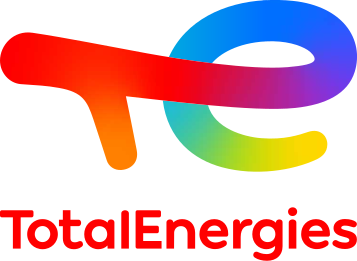




Examples of Surf Simulator deployments delivered in Quebec contexts
In practice, we deploy the Surf Simulator in several recurring corporate scenarios across Quebec. For an end-of-year party, the priority is smooth throughput and low risk: we run conservative settings, short ride cycles, and a queue system that prevents crowding near the perimeter while keeping spectators engaged. For a sales kickoff, the activation becomes a structured challenge: scheduled heats, a visible scoreboard, and a short awards moment that leadership can use to reinforce performance themes without dragging the program.
For public or client-facing activations, the focus shifts to brand perception and compliance. We plan a cleaner visual footprint (backdrop, stanchions, branded operator position), define a content capture angle that avoids filming minors or non-consenting guests, and ensure bilingual guest handling. In trade show environments, we often add a “fast lane” for VIPs or key partners to avoid reputational friction when the line builds.
Across these formats, what matters is not the novelty of the equipment; it’s the event engineering around it: where it sits, how it sounds, how it looks on camera, and how it behaves under peak load.
What goes wrong with Surf Simulators in Quebec events—and how we prevent it
Underestimating footprint and clearance: the simulator needs space for the unit, safety perimeter, and spectator flow. We validate dimensions early and avoid last-minute relocation that disrupts AV or catering.
Queue chaos: without stanchions, signage, and an attendant managing turns, the activation becomes a bottleneck and frustrates guests. We design a simple, visible system that keeps the line moving.
Wrong difficulty settings: too aggressive settings reduce participation, especially for mixed audiences. We tune for corporate participation first, then add “challenge rounds” for those who want it.
Floor and spill risks: food and drinks too close to the activity area create slipping hazards. We position bars/snacks strategically and enforce a clean perimeter.
Load-in timing surprises: downtown Montréal access restrictions, dock schedules, or shared elevators can compress setup time. We plan buffers and coordinate with venue ops in advance.
Unclear accountability: when multiple suppliers are involved, no one owns the integration. We act as the single operational conductor so your team isn’t stuck arbitrating on site.
Our role is to prevent these risks before they appear. That means asking the “annoying” questions early—access, power, insurance, flow, audience profile—so the event day is execution, not improvisation.
Why Quebec clients keep INNOV'events on their vendor list
Repeat business is earned when the planning is clear and the event day is calm. Many organizations in Quebec return to us because we document decisions, communicate trade-offs, and show up with the right team size—no understaffed activations that look amateur, and no overbuilt solutions that waste budget.
Planning clarity: a single consolidated production plan (timings, access, staffing, safety perimeter, signage) shared with stakeholders.
Event-day discipline: a named on-site lead plus attendants who understand corporate etiquette and guest service.
Post-event usefulness: if desired, we provide participation estimates, peak periods, and recommendations for the next edition.

Loyalty is the most credible proof in this industry: if a client brings you back, it’s because you protected their brand, their people, and their schedule when it mattered.
How we deliver Surf Simulator activations across Quebec from A to Z
👉 Quebec feasibility check and objectives alignment
We start with your constraints: attendance, agenda, audience profile, and what success looks like (participation rate, content capture, VIP engagement, or pure celebration). Then we confirm feasibility with venue realities in Quebec: access route, setup window, ceiling height, floor protection, and electrical needs. You receive clear options, not assumptions.
👉 Layout, safety perimeter, and guest flow design
We produce a practical layout: simulator placement, operator position, queue line, spectator zone, and signage points. We define cycle time targets and a queue management approach (open line vs. time slots vs. department heats). This is where we prevent bottlenecks and ensure the activity enhances—not disrupts—your program.
👉 Staffing plan and show-flow integration
We size staffing based on throughput and risk: attendants for briefing, queue, and perimeter. We also align with your run-of-show: speeches, awards, dinner service, and AV cues. If you have an MC or host, we provide a short script and timing recommendations so announcements feel integrated.
👉 Branding and communications readiness
We validate branding touchpoints: backdrop, signage, operator attire, and optional leaderboard screen. For communications teams, we confirm where content will be captured, what angles are best, and how to avoid cluttered backgrounds. If bilingual signage is needed, we plan it upfront.
👉 Event-day execution and contingency management
We manage load-in, setup, testing, and safety checks before guests arrive. During operation, we adjust settings to match the crowd, maintain a clean perimeter, and keep the line moving. If the venue requests changes (noise, placement, traffic lanes), we handle it without escalating to your executives.
👉 Wrap-up and post-event debrief
After teardown, we close out with a short debrief: what worked, peak periods, any friction points, and concrete recommendations for the next event in Quebec. If you need internal reporting, we provide the operational inputs you can actually use.
FAQ sur l'organisation Surf Simulator à Quebec
How much space is needed for a Surf Simulator in Quebec?
Plan for a clear footprint of roughly 6 m x 6 m for the unit plus a safety perimeter and queue area. In practice, we recommend reserving 40–70 m² total depending on how you want spectators to circulate and whether you add stanchions and branding.
How many attendees can ride per hour in Quebec events?
Most corporate formats achieve 25–40 riders per hour per simulator, depending on ride difficulty, briefing time, and guest profile. If you need higher throughput (e.g., 300+ riders in a short window), we’ll propose shorter cycles, tighter queue management, or a second unit.
What power requirements should Quebec venues expect?
Power needs vary by model, but you should plan for a dedicated electrical circuit and confirm access to the right outlets near the placement area. We validate this with the venue during planning and coordinate with in-house technicians when required, especially in larger Montréal and Québec City venues.
Is a Surf Simulator safe for corporate events in Quebec?
Yes, when operated with trained attendants, a defined perimeter, and appropriate ride settings. We run mandatory briefings, manage the queue to prevent crowding, and adjust difficulty to your audience. If your venue requires specific insurance language, we handle documentation as part of the production process.
How far in advance should we book in Quebec?
For the best venue coordination and staffing, book 2–6 weeks ahead. For peak periods (holiday season, major conference weeks), 6–10 weeks is safer. Short-notice requests can be possible in the Montréal corridor depending on venue access and schedule.
Request a Surf Simulator quote in Quebec with a real plan
If you’re comparing agencies, we suggest a quick working call to validate feasibility before you lock the program. Share your venue (or shortlist), attendance range, and schedule, and we’ll come back with a clear recommendation: footprint, staffing, timing, and a transparent budget structure for your Surf Simulator in Quebec.
The earlier we align on access windows and placement, the smoother the event day will be—especially in high-constraint venues. Contact INNOV'events to reserve your date and build an activation that performs under real corporate conditions.
INNOV'events Quebec Agency
Thierry GRAMMER is the manager of the INNOV'events Quebec office. Reach out directly by email at canada@innov-events.ca or via the contact form.
Contact the Quebec agencyToutes nos prestations & animations Quebec, Quebec
Découvrez nos prestations événementielles
Découvrez nos animations événementielles disponibles au Quebec
- Event Hostess in Quebec
- Escape Game in Quebec
- MasterChef-Style Cooking Workshop in Quebec
- Corporate Magician in Quebec
- Tent Rental in Quebec
- Color Analysis Workshop in Quebec
- Inflatable Games in Quebec
- Valet Service in Quebec
- Soccer Simulator in Quebec
- LED Furniture Rental in Quebec
- LED Branding Activation in Quebec
- Immersive Culinary Experience in Quebec
- Light Painting Activity in Quebec
- Immersive Mystery Night in Quebec
- Promotional Contest in Quebec
- Promotional Materials (POS) in Quebec
- Virtual Reality Experience in Quebec
- Molecular Gastronomy Workshop in Quebec
- Halloween Event in Quebec
- Fireworks Show in Quebec
- Sports Challenge – Giant Games in Quebec
- Professional Event Host in Quebec
- Photo Booth Animation in Quebec
- Santa Claus Appearance in Quebec
- Kids Entertainment in Quebec
- Guided Tour in Quebec
- Urban Rally in Quebec
- Ball Pit Activity in Quebec
- Flight Simulator in Quebec
- Food Truck Rental in Quebec
- World Record Attempt in Quebec
- Surf Simulator in Quebec
- Soccer Simulator in Quebec
- Wine Casino in Quebec
- Makeover Workshop in Quebec
- Perfume Creation Workshop in Quebec
- Acting Workshop in Quebec
- CSR Activities in Quebec
- Archery Activity in Quebec
- Event Security Guard in Quebec
- Wine Tasting Workshop in Quebec
- Mime Performance in Quebec
- TV Game Show Animation in Quebec
- Funfair Event in Quebec
- Crisis Management Workshop in Quebec
- Crisis Negotiation Workshop in Quebec
- Arcade Games in Quebec
- Indoor Skydiving Simulator in Quebec
- Ski Simulator in Quebec
- Racetrack Driving Experience in Quebec
- Introductory Flight Experience in Quebec
- Tasting Experience in Quebec
- Build Your Own Foosball Workshop in Quebec
- 2CV Rally in Quebec
- LEGO Challenge in Quebec
- Casino Night in Quebec
- Interpreter / Translator in Quebec
- Promotional Merchandise in Quebec
- Shuttle / Transportation Service in Quebec