
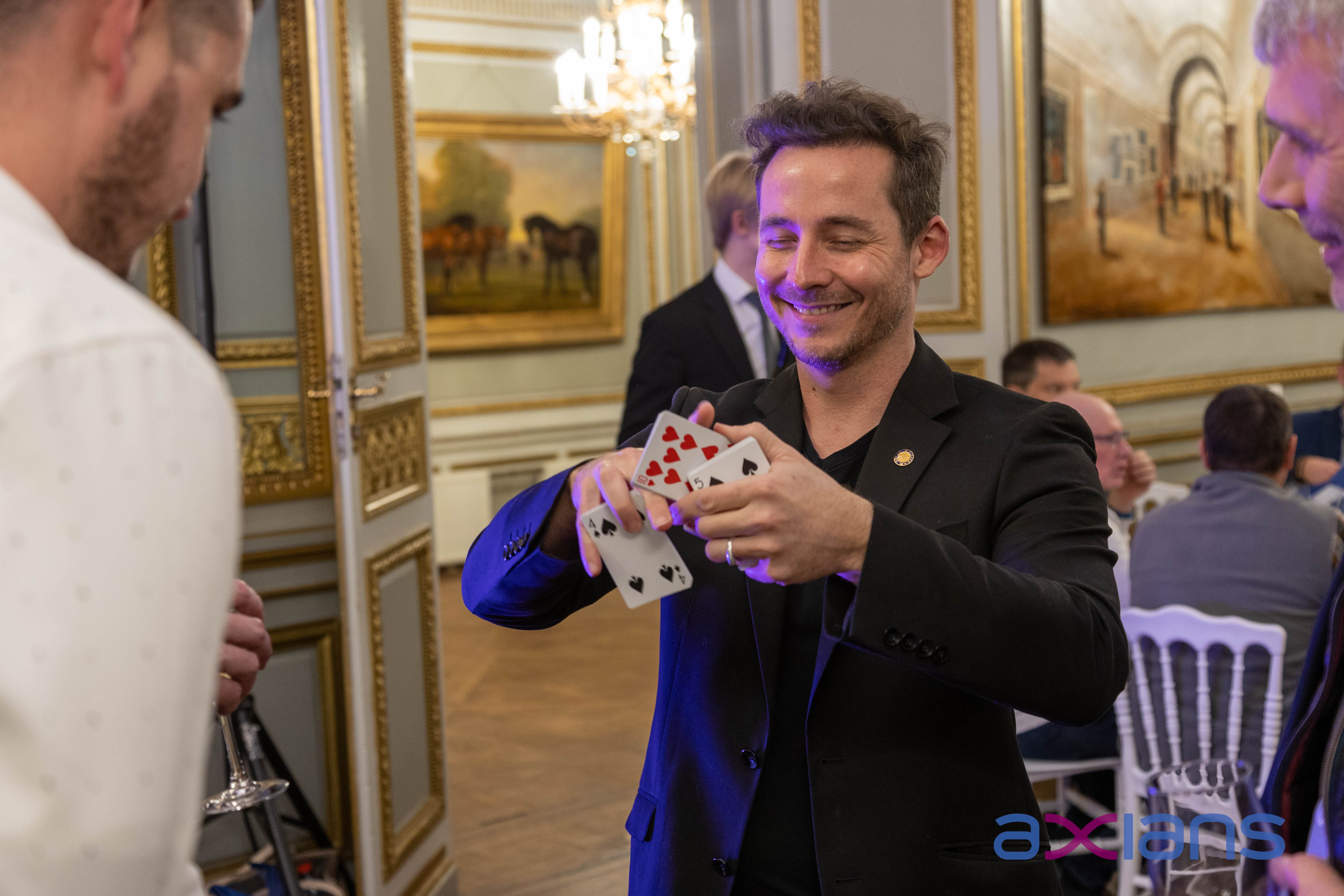
Corporate Magician in Quebec for executive-level events that stay on schedule
INNOV'events in Montréal books and manages Corporate Magician performances across Quebec, from 30 to 2,000+ attendees. We handle artist selection, technical needs, run-of-show, and on-site coordination so your leadership team can focus on hosting—not firefighting.
Whether it’s a sales kick-off, a holiday party, a client summit or an internal recognition night, we integrate the magic into the event’s objectives: networking, message retention, or energizing a tired room—without hijacking your brand or your timing.
Sommaire
In a corporate event, entertainment is not a “nice-to-have”; it’s a lever to keep attention and protect the flow of the evening. When a room is half on their phones after a long day of meetings, a structured intervention by a Corporate Magician in Quebec can reset energy, create shared talking points, and reopen conversations between teams and clients.
Organizations in Quebec typically expect three things: professional pacing (no delays before speeches), bilingual comfort (FR/EN without awkward switches), and a respectful tone aligned with corporate culture. HR and Comms teams also need content that won’t generate complaints the next morning—no intrusive humor, no “gotcha” moments, and no employee being put on the spot without consent.
INNOV'events is an event agency based in Montréal with a field team used to venue constraints, union rules, and tight load-in windows across the province. We work with vetted magicians who understand corporate environments: dress codes, confidentiality, executive presence, and the reality of “the show must end at 9:00 because transportation is booked.”
INNOV'events track record across Quebec
10+ years coordinating corporate events and entertainment logistics in Quebec (Montréal, Québec City, Laval, Estrie, Outaouais and beyond).
300+ corporate activations produced or supervised through our network (magicians, hosts, DJs, technical crews, venues).
48-hour sourcing window when a speaker cancels or your entertainment falls through—subject to availability and venue constraints.
FR/EN-ready roster: bilingual performers and hosts to match mixed audiences without slowing the run-of-show.
Local coordination in Quebec that fits how companies operate
In Quebec, corporate events are often judged on operational discipline as much as creativity. A VP notices if the soundcheck overruns cocktail hour, if the stage cue is missed before awards, or if the entertainment blocks service staff in a ballroom. That’s why our approach starts with your agenda, your room, and your internal stakeholders—not the performer’s “standard package.”
We regularly support companies that repeat year after year for seasonal parties, leadership offsites, and client appreciation formats because the execution is predictable: call times are respected, tech riders are verified, and the performer is briefed on what to avoid (confidential info, sensitive reorganizations, layoffs, ongoing negotiations, union discussions, etc.).
If you have internal brand rules (logo usage on screen, tone-of-voice, DEI requirements, alcohol policy, consent policy for volunteers), we integrate them into the briefing. For many HR and Comms teams, that’s the difference between a smooth evening and an escalation to leadership the day after.
 Besoin d’un devis rapide ?
Nous vous envoyons une première proposition sous 24h.
Why book a corporate magician in Quebec for business outcomes
When you bring people together in person, the real value happens between the formal segments: during the first 20 minutes of cocktail, right after a difficult quarterly update, or when new hires meet executives for the first time. A Corporate Magician is effective when used as a facilitation tool—structured, timed, and aligned with your goals.
Protect networking time without forcing it: close-up magic creates natural “micro-groups” around tables and bar areas, giving people a reason to stay engaged instead of defaulting to their phones.
Bridge departments and hierarchies: we often see finance and operations teams mingle more easily when there’s a shared interaction that doesn’t require small talk. It reduces the social friction of mixed groups.
Increase message recall: when you integrate key themes (safety, customer commitment, innovation pillars) into a short mentalism or storytelling segment, your leadership messages are remembered beyond the slide deck—without turning the performance into a commercial.
Support HR objectives: for recognition nights, a magician can be used as a “buffer” between awards blocks to keep momentum. This is especially helpful when you have many categories and need to avoid audience fatigue.
Manage room energy after dense content: after compliance updates, KPI reviews or a long day of training, a 10–15 minute stage segment can reset attention before the next speech or before the DJ starts.
Reinforce brand perception with executive-safe humor: the right performer uses inclusive language, avoids politics and stereotypes, and adapts to formal or creative cultures—critical in conservative industries (finance, public sector, manufacturing).
The economic culture in Quebec values authenticity and competence: people quickly spot entertainment that feels disconnected from the company’s reality. When it’s planned with the agenda and the venue in mind, the magician becomes a credible part of the experience—not a distraction.
What Quebec organizations expect from corporate entertainment
We see recurring expectations across corporate clients in Quebec, especially when the audience includes executives, clients, and employees at the same time.
1) Bilingual delivery without friction. In Montréal and many provincial events, you’ll often have a mix of francophones, anglophones, and international colleagues. The best solution is not always fully bilingual scripting; sometimes it’s a bilingual host, visual segments that require minimal language, or an MC who bridges transitions while the magician keeps the performance mostly visual and interactive.
2) Respect for corporate timing. Your catering schedule, speeches, award blocks, and transport are fixed. We plan magic segments around service: close-up during cocktail or between courses; stage performance between dessert and awards; short “stingers” of 3–5 minutes to fill unavoidable transitions (AV resets, CEO arrival, late seating).
3) Discretion and consent. In a workplace environment, no one should feel forced into participation. We brief performers: volunteers are invited, never pressured; content avoids sensitive personal topics; no jokes about appearance, accents, religion, or politics. This is not about being “sterile”—it’s about being professional.
4) Venue and union constraints. Some rooms in Quebec have strict load-in rules, limited backstage space, or unionized technical crews. A professional performer will provide a clean tech rider (mic type, lighting needs, cue format) and will not improvise with unsafe setups.
5) Stakeholder management. HR wants a safe experience, Comms wants brand coherence, executives want pace and impact, and the venue wants smooth service. Our job is to reconcile these expectations with a clear run-of-show and one accountable point of contact.
Which corporate magician formats work best in Quebec events
Entertainment creates engagement when it supports what you’re trying to achieve: networking, retention of key messages, or simply keeping a room attentive through a long program. Below are formats we deploy with Corporate Magician in Quebec talent, depending on audience size and the “moment” in your agenda.
Interactive animations in Quebec
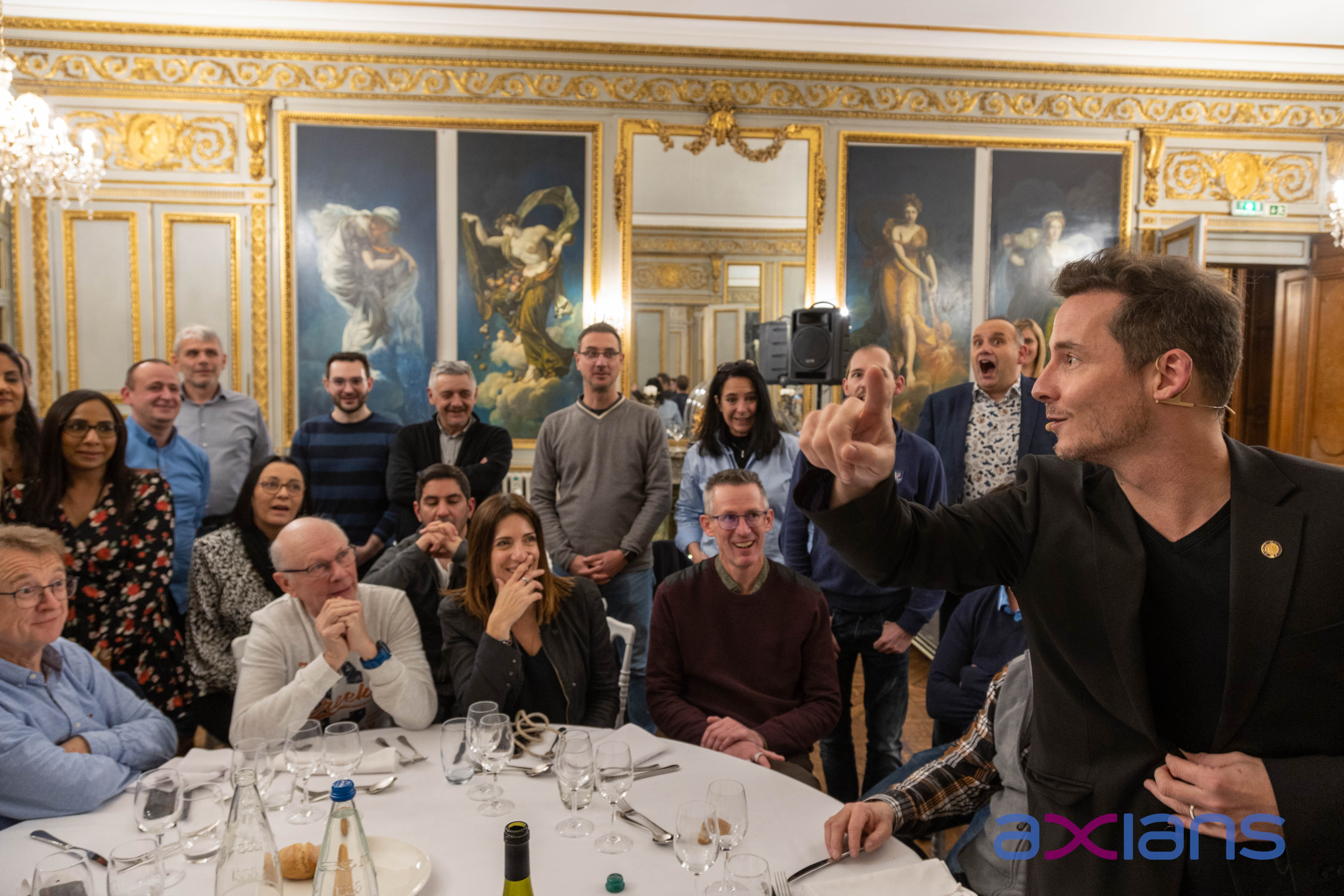
Close-up magic during cocktail (30–90 minutes): the magician circulates between groups, ideal for client appreciation and internal mixers. Practical note: we define circulation zones and avoid the bar bottleneck; we also coordinate with photographers so the performer isn’t constantly blocked.
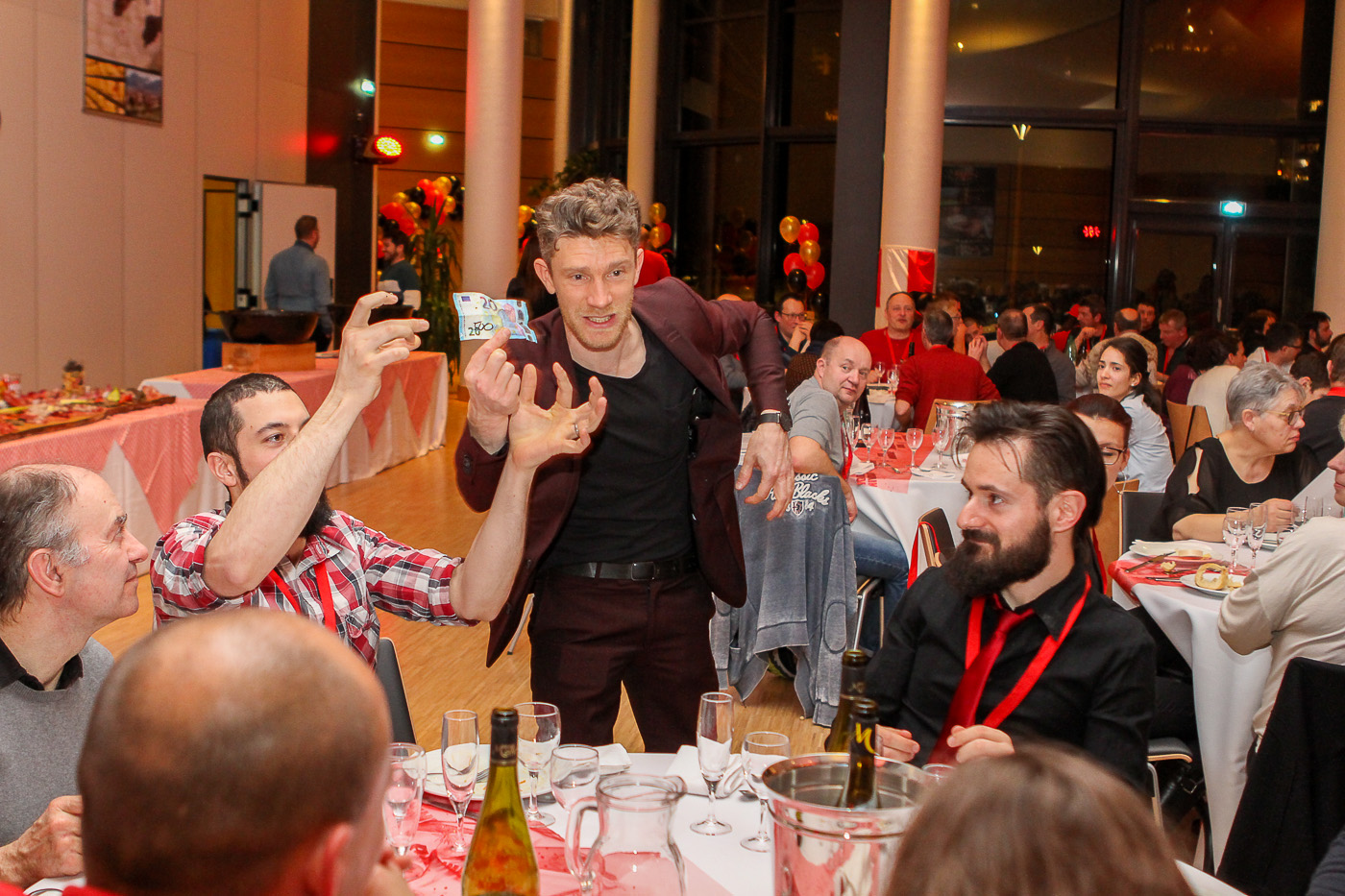
Table-hopping between courses: works well for gala dinners where you want to keep energy up without shortening speeches. We coordinate timing with service (e.g., between entrée and main) and ensure the magician can reset quickly without interfering with staff.
Interactive mentalism for leadership groups (15–25 minutes): designed for executive retreats or board-related gatherings. The tone is more “smart and subtle” than flashy. We confirm the comfort level of the group: some leadership teams prefer minimal volunteer participation.
Trade show / internal expo booth traffic: short repeating sets (3–6 minutes) to stop passersby. Key point: we build scripts that support your product messaging without sounding like a pitch, and we coordinate with your booth staff so the magician hands off leads properly.
Art animations in Quebec
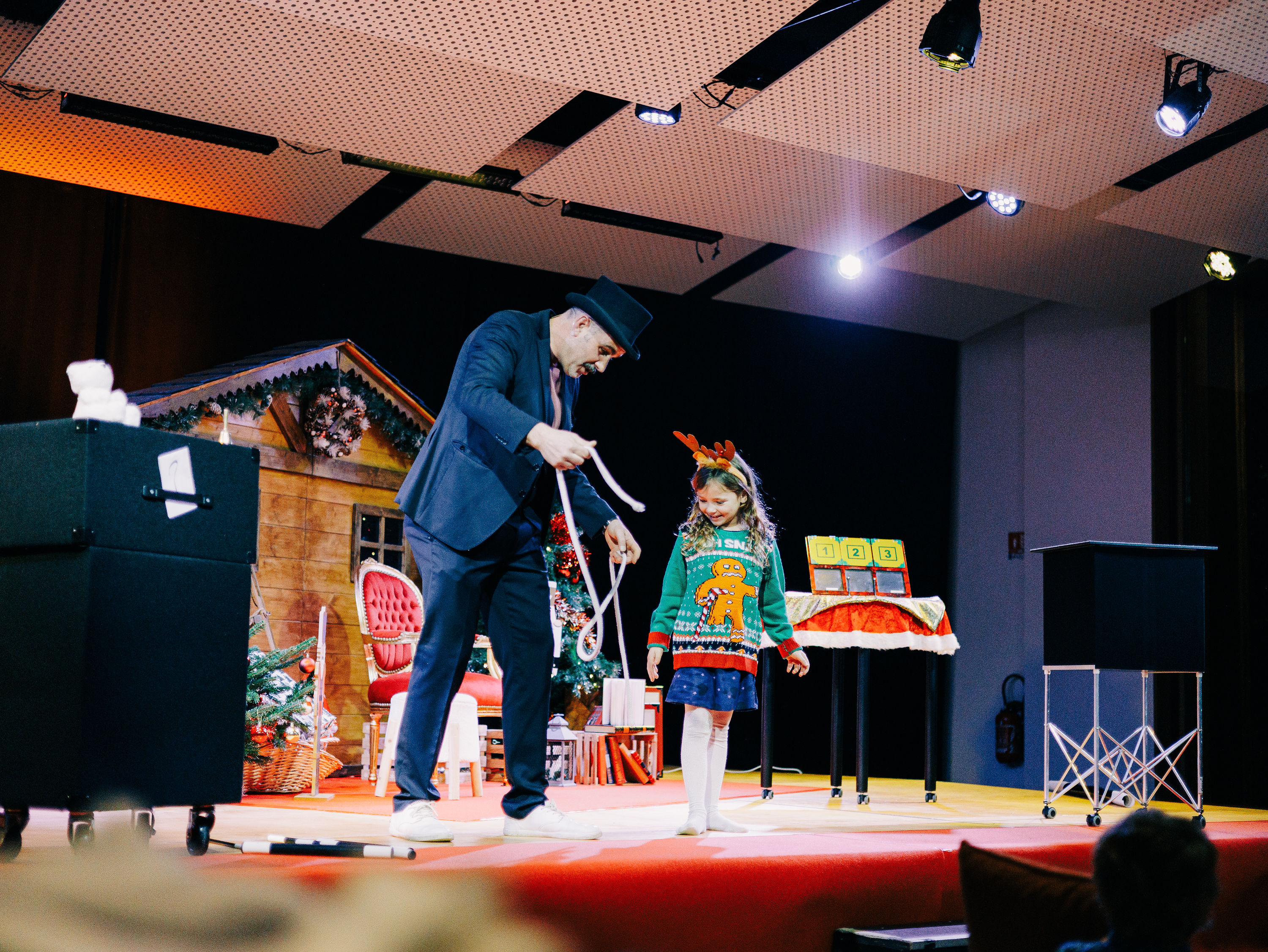
Stage show for 150–800 attendees (20–45 minutes): best for year-end parties or conferences. Requirements: proper stage, controlled lighting, and an MC who can set the room. We avoid placing it right after heavy alcohol service if you want a clean corporate tone.
MC + magic hybrid: the performer also hosts transitions (awards, video intros, speaker walk-ons). It’s effective when you want one consistent voice. We validate whether the performer’s hosting style matches your brand (formal vs. energetic).
Brand-themed illusion moments: used sparingly for product launches or milestone celebrations. The goal is not “big boxes,” but meaningful reveals that are camera-friendly for internal comms.
Innovative animations in Quebec
Magic at dessert stations: we place the magician where people naturally circulate, which increases interaction without forcing it. This format works particularly well in Montréal venues where guests move between multiple zones.
Pairing with a mixology or coffee bar: the magician performs short effects tied to the service rhythm. It supports premium perception and keeps lines moving (people are less impatient when there’s engagement).
Gourmand animations in Quebec
Digital + live hybrid (for distributed teams): a live in-room magician plus a short remote segment for satellite offices in Quebec. We ensure proper camera placement, audio capture, and a host who includes remote attendees—otherwise they feel like spectators.
Message integration for corporate themes: we embed 2–3 strategic keywords (e.g., “safety,” “customer promise,” “innovation pillars”) in a way that feels natural. We avoid turning the performance into a slogan delivery; the objective is recall, not advertising.
Micro-interventions between conference blocks: 3–5 minute segments to reset attention. Useful when you have long plenaries and need a clean transition while AV changes on stage.
Whatever the format, alignment with brand image is non-negotiable. A Corporate Magician in Quebec should match your dress code, vocabulary level, and corporate sensitivity. We validate tone and content upfront so the entertainment supports your reputation instead of creating risk.
Where to host a corporate magician in Montreal or Quebec City
The venue changes how magic reads: visibility, noise level, sightlines, and service rhythm directly impact what’s possible. In Montréal and across Quebec, we select the format of magic based on the room first—then we choose the performer who fits it.
| Venue type | For which objective? | Main strengths | Possible constraints |
|---|---|---|---|
Hotel ballroom (Montréal / Québec City) | Year-end party, awards night, large seated dinner | Reliable AV infrastructure, service pacing, easy guest flow | Sound can be “boomy”; stage height and sightlines must be verified |
Modern event loft / industrial space | Client cocktail, product reveal, networking-heavy format | Flexible zoning for close-up magic; strong brand feel | Noise management; limited backstage; load-in windows can be tight |
Conference center / convention space | Conference plenary, sales kick-off, multi-room agenda | Professional staging options; easy integration with speaker program | Union rules; strict schedules; long walking distances for performers |
Restaurant buyout with private rooms | Executive dinner, leadership retreat, small client group | High-end intimacy; ideal for close-up and mentalism | Limited space between tables; must coordinate carefully with service |
We recommend a site visit—or at minimum a detailed floorplan and tech spec review—before confirming the magician format. In the field, a 15-minute verification of ceiling height, lighting positions, and service paths prevents 90% of day-of issues.
Corporate magician pricing in Quebec: what drives the budget
Pricing for a Corporate Magician in Quebec depends less on “minutes on stage” and more on operational variables: audience size, format (close-up vs. stage), tech needs, and travel. For executives and procurement teams, the goal is not to chase the lowest fee—it’s to ensure the cost is predictable and the risk is controlled.
Performance format and duration: close-up during cocktail (typically 1–2 hours) is priced differently than a structured stage show (20–45 minutes) with rehearsal and cueing.
Audience size and room configuration: 80 people in a tight cocktail can be more complex than 200 people seated with clear sightlines. Complexity affects staffing, pacing, and sometimes the need for a second performer.
Technical requirements: headset mic, dedicated lighting, stage management, and AV technician time can represent a significant portion of the budget—especially in union venues.
Travel within Quebec and scheduling: Québec City, Saguenay, Abitibi or Côte-Nord require travel time, accommodations, and sometimes a buffer day depending on weather and timing.
Content briefing and brand integration: if you require bilingual scripting, references to corporate themes, or coordination with an MC and speakers, there is additional preparation.
Agency management and accountability: when INNOV'events manages the entertainment, you’re paying for artist vetting, contracting, run-of-show coordination, and on-site support—reducing operational risk for HR and Comms.
From an ROI perspective, the right entertainment protects what you’re already spending on the event: venue, catering, travel, and leadership time. If a magician helps keep people present, supports networking, and prevents schedule drift, it directly increases the value of the entire program.
Why a Quebec-based agency reduces risk on event day
Booking a performer is easy. Delivering a corporate segment that fits your agenda, your stakeholders, and your venue constraints is where a local agency matters. INNOV'events is established in Montréal and operates across Quebec, which means we can anticipate the realities that impact execution: bilingual audiences, venue-specific rules, winter logistics, and supplier availability.
When you work with us, you’re not only hiring a Corporate Magician; you’re securing a process: contract clarity, technical verification, a clean run-of-show, and a single point of accountability. If something changes (speech runs long, room layout shifts, AV plan updates), we adjust the entertainment without breaking the evening.
For teams running events in Québec City, our broader coverage also helps when you need full-service support beyond the act itself. If you’re building a complete program, we can align entertainment with venue sourcing and production through our partner page: event agency in Quebec.
- Local supplier coordination: we speak the same operational language as venues, caterers, and tech teams in Quebec, which speeds up approvals and avoids miscommunication.
- Reliable contingency planning: we keep alternate talent options and format adjustments ready, especially during peak season (November–December).
- Brand and HR risk management: we brief performers on corporate policies, volunteer consent, and sensitive internal context.
- On-site leadership comfort: executives should host, not manage cues. We run the entertainment block so the C-suite stays focused on guests.
From an ROI perspective, the right entertainment protects what you’re already spending on the event: venue, catering, travel, and leadership time. If a magician helps keep people present, supports networking, and prevents schedule drift, it directly increases the value of the entire program.









Corporate magician deployments across Quebec: what we actually run
Our projects are diverse because corporate realities are diverse. In Quebec, we frequently support:
Year-end parties (150–600 guests): close-up during cocktail to drive networking, followed by a timed stage segment before the DJ. The key operational win is protecting speeches and awards from drifting.
Sales kick-offs (200–1,000 attendees): short, high-impact segments between conference blocks to reset attention. We coordinate tightly with AV and stage management to keep plenary timing intact.
Client appreciation evenings (40–150 guests): high-discretion close-up magic suited to executive conversations. We avoid anything that interrupts deal-related discussions and focus on facilitating introductions.
Internal culture and recognition moments: when HR wants warmth without cringe, we choose performers with corporate hosting experience and a respectful interaction style.
Trade shows and recruitment events: repeatable micro-sets to stop traffic and create a reason to engage with your team, while ensuring lead handoff is organized and measurable.
In every case, the deliverable is not “a show.” It’s a controlled segment inside a broader program, with clear responsibilities and timing—because that’s what decision-makers are ultimately buying.
Common mistakes when booking a corporate magician in Quebec
Choosing based on social media clips only: a 20-second video doesn’t confirm bilingual comfort, corporate etiquette, or the ability to handle a room with executives and clients.
Not validating technical needs: the performer arrives needing a headset mic or lighting, but the venue can’t deliver last minute. The result is a weakened performance and visible stress.
Placing the show at the wrong moment: scheduling magic during entrée service or right after heavy speeches often creates noise and distraction. Timing should respect catering rhythm and attention cycles.
Ignoring consent and HR sensitivities: forcing participation can backfire, especially in unionized environments or in teams with strict workplace culture expectations.
No contingency plan: when speeches run late, the entertainment either gets cut chaotically or pushes the evening over time. We always plan shortened versions and alternate placement.
Unclear ownership on event day: if no one is responsible for cueing, the performer will either start late or interrupt the wrong segment. A single stage manager / coordinator prevents this.
Our role at INNOV'events is to prevent these risks before they reach your guests. That means asking operational questions early, validating tech, and designing the entertainment to serve your program—not the other way around.
Why Quebec clients rebook the same entertainment partners
In corporate events, loyalty is rarely emotional; it’s operational. HR and Communications teams rebook when the supplier is predictable, low-risk, and easy to work with under pressure. That’s what we aim for with every Corporate Magician in Quebec mandate.
High repeat demand during peak season: many clients secure entertainment 8–16 weeks in advance for November–December dates to avoid limited availability and higher technical costs.
Stable performer roster: we maintain a curated network so you’re not restarting from zero every year; we keep notes on tone, audience profile, and what worked in your room.
Reduced internal workload: clients come back when they can delegate contracting, tech verification, and briefing while keeping full visibility on the agenda and approvals.

When clients return, it’s because the event ran on time, stakeholders felt respected, and the entertainment supported the business purpose. In Quebec, that consistency is the real differentiator.
How we deliver corporate magician bookings in Quebec
👉 1) Scope the objective and constraints (Quebec context)
We start with a structured intake: event type, audience profile, bilingual needs, venue, union/AV constraints, agenda, and sensitivities. We also ask who must approve: HR, Comms, executive sponsor, procurement. This prevents last-minute reversals and ensures the performer’s style fits your corporate culture.
👉 2) Propose the right magician format and shortlist
Based on your room and objectives, we recommend close-up, stage, or hybrid formats and provide a shortlist of vetted performers. We explain trade-offs (visibility, noise tolerance, volunteer participation, tech needs) so you can make a decision that’s defensible internally.
👉 3) Contracting, insurance, and compliance
We confirm availability, fees, travel conditions within Quebec, cancellation terms, and any insurance requirements (common in larger venues and public-sector events). We ensure the agreement matches corporate procurement expectations and avoids ambiguous deliverables.
👉 4) Technical alignment and run-of-show integration
We validate the tech rider with your AV supplier or venue: mic type, lighting, stage position, music cues, and timing. Then we integrate the performance into the run-of-show with clear cue ownership (who calls the performer on, what happens if a speech runs long, and the “short version” option).
👉 5) Briefing and rehearsal-level preparation
We brief the performer on your audience, leadership presence, brand guidelines, sensitive topics, and the desired tone. If you have executive remarks or key themes to echo, we align on wording that feels natural. For larger shows, we plan a quick on-site run-through with the MC and AV.
👉 6) On-site coordination and contingency management
On event day, we manage call times, soundcheck, and transitions with the venue and AV team. If the schedule shifts, we adjust the entertainment segment without stress for your leadership team. After the event, we debrief on what worked and capture notes for next year’s rebooking.
FAQ sur l'organisation Corporate Magician à Quebec
How much does a corporate magician cost in Quebec?
Most corporate bookings in Quebec fall between $1,200 and $4,500 for the performer, depending on format (close-up vs. stage), duration, preparation, and travel. For larger stage shows with dedicated AV and stricter technical needs, total entertainment spend (performer + tech) often lands between $3,000 and $9,000+.
Close-up or stage show for a Montreal corporate event?
If your priority is networking, choose close-up during cocktail (people stay engaged while still talking business). If you need a single high-impact moment for 200+ attendees, choose a stage segment (20–45 minutes) with proper sound and sightlines. Many Montréal events do both: close-up first, stage later, so you cover engagement and collective energy.
Can the magician perform bilingually in Quebec events?
Yes, but “bilingual” should be defined. We typically recommend either (1) a bilingual performer who can switch smoothly, or (2) a mostly visual set with a bilingual MC handling transitions. For mixed audiences, this keeps pace and avoids long explanations in two languages.
How long should the magic segment be in Quebec City?
For cocktail close-up: 60–90 minutes is common. For a stage segment in a corporate program: 20–35 minutes tends to be the sweet spot—long enough to land, short enough to protect speeches, awards, and transport schedules.
What information should HR send before booking in Quebec?
Send the agenda (with hard end time), venue details (room layout and AV contact), audience profile (size, languages, executive presence), any sensitive context to avoid, and your participation policy (volunteers OK or not). This is what allows a Corporate Magician in Quebec to deliver a segment that is safe, professional, and on schedule.
Request a quote for a corporate magician in Quebec
If you’re comparing agencies, we suggest a practical first step: share your date, city in Quebec, estimated attendance, venue type, and the role you want entertainment to play (networking, awards pacing, conference reset, client engagement). We’ll come back with a recommended format, a shortlist of appropriate performers, and a clear view of technical needs and budget ranges.
Peak season dates (especially late November and December) book early. Contact INNOV'events now to secure availability and lock a run-of-show that protects your executive agenda.
INNOV'events Quebec Agency
Thierry GRAMMER is the manager of the INNOV'events Quebec office. Reach out directly by email at canada@innov-events.ca or via the contact form.
Contact the Quebec agencyToutes nos prestations & animations Quebec, Quebec
Découvrez nos prestations événementielles
Découvrez nos animations événementielles disponibles au Quebec
- Event Hostess in Quebec
- Escape Game in Quebec
- MasterChef-Style Cooking Workshop in Quebec
- Corporate Magician in Quebec
- Tent Rental in Quebec
- Color Analysis Workshop in Quebec
- Inflatable Games in Quebec
- Valet Service in Quebec
- Soccer Simulator in Quebec
- LED Furniture Rental in Quebec
- LED Branding Activation in Quebec
- Immersive Culinary Experience in Quebec
- Light Painting Activity in Quebec
- Immersive Mystery Night in Quebec
- Promotional Contest in Quebec
- Promotional Materials (POS) in Quebec
- Virtual Reality Experience in Quebec
- Molecular Gastronomy Workshop in Quebec
- Halloween Event in Quebec
- Fireworks Show in Quebec
- Sports Challenge – Giant Games in Quebec
- Professional Event Host in Quebec
- Photo Booth Animation in Quebec
- Santa Claus Appearance in Quebec
- Kids Entertainment in Quebec
- Guided Tour in Quebec
- Urban Rally in Quebec
- Ball Pit Activity in Quebec
- Flight Simulator in Quebec
- Food Truck Rental in Quebec
- World Record Attempt in Quebec
- Surf Simulator in Quebec
- Soccer Simulator in Quebec
- Wine Casino in Quebec
- Makeover Workshop in Quebec
- Perfume Creation Workshop in Quebec
- Acting Workshop in Quebec
- CSR Activities in Quebec
- Archery Activity in Quebec
- Event Security Guard in Quebec
- Wine Tasting Workshop in Quebec
- Mime Performance in Quebec
- TV Game Show Animation in Quebec
- Funfair Event in Quebec
- Crisis Management Workshop in Quebec
- Crisis Negotiation Workshop in Quebec
- Arcade Games in Quebec
- Indoor Skydiving Simulator in Quebec
- Ski Simulator in Quebec
- Racetrack Driving Experience in Quebec
- Introductory Flight Experience in Quebec
- Tasting Experience in Quebec
- Build Your Own Foosball Workshop in Quebec
- 2CV Rally in Quebec
- LEGO Challenge in Quebec
- Casino Night in Quebec
- Interpreter / Translator in Quebec
- Promotional Merchandise in Quebec
- Shuttle / Transportation Service in Quebec